Skip to content
The Map — No. 11
Obsession
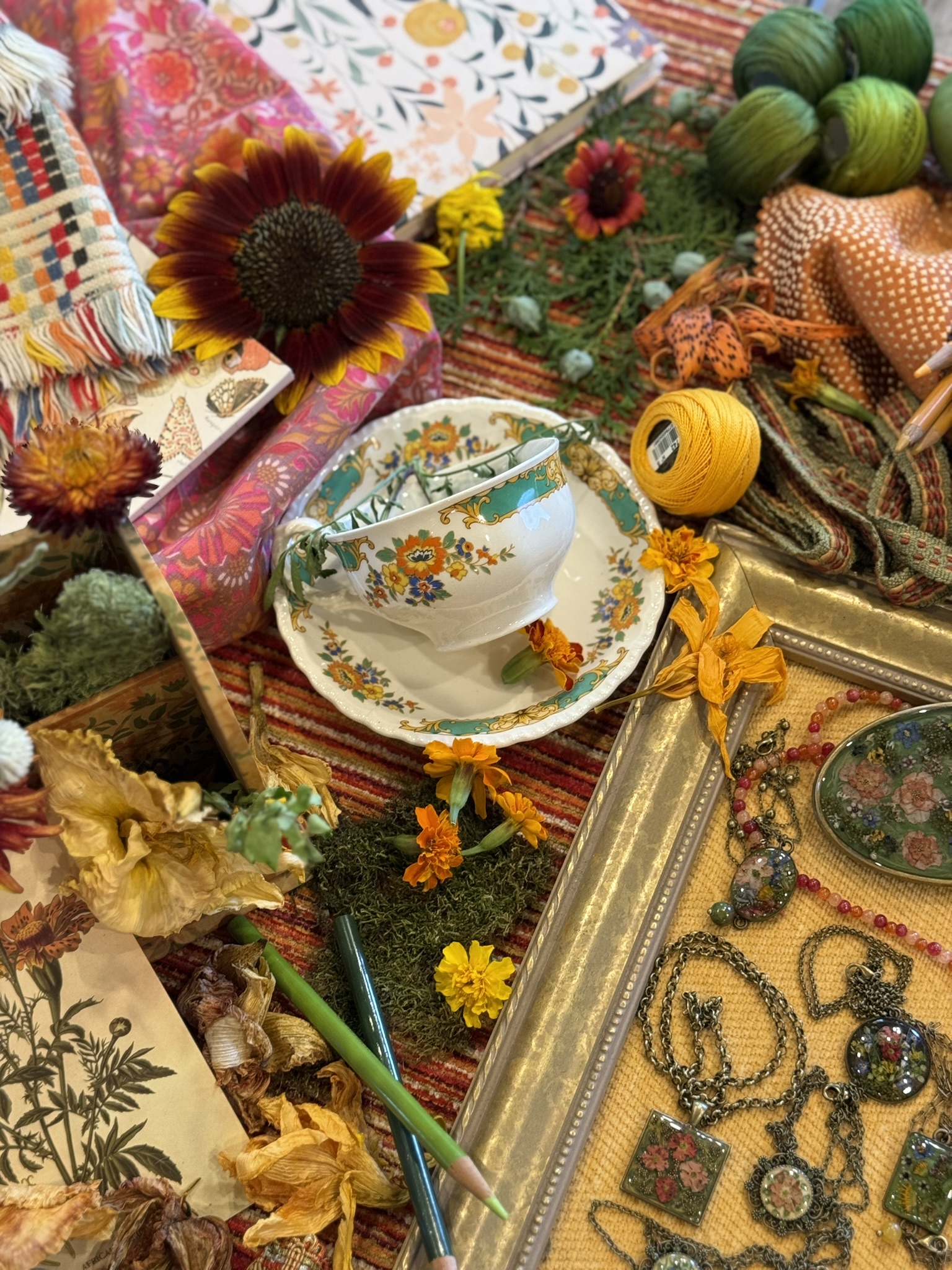
Two obsessions. The same question.
Two obsessions. Neither one first.
Not austere white china, or perfectly matched formal place settings, but china covered in flowers — roses dissolving into gold, violets scattered across saucers, peonies opening over dinner plates, tiny blossoms painted in colors that have remained vivid for nearly a century. These and the living flowers of Floral Alchemy have always coexisted in this life. Neither vies for primary attention. Neither arrived before the other. They simply both belong, equally and completely, in the same hands.
I now live with dozens of vintage floral china patterns made in England, France, Japan, and America. Some arrived as complete services. Others came to me as a handful of plates, a solitary cup, or one surviving piece separated long ago from everything that once belonged beside it.
When I find them at a resale shop, I feel something I can only describe as protectiveness. A sadness. Because I know what they meant when they were new — what it took to save for them, to choose them, to bring them home and unwrap them and set them on a table surrounded by family. I know what that table represented. And I know what happened to it.
The Question Both Obsessions Are Asking
Floral Alchemy and vintage china appear unrelated. One preserves flowers. One depicts flowers. But they are asking the same question.
How do you keep something beautiful after the flower is gone?
China answers: paint it. Porcelain preserves memory through image. Floral Alchemy answers: keep the flower itself. Preserve the actual bloom.
One preserves representation. The other preserves presence. The woman who collects both is using two different archives to answer the same question — and she is not ready to stop asking it.
The Formal Floral Farmyard Feast
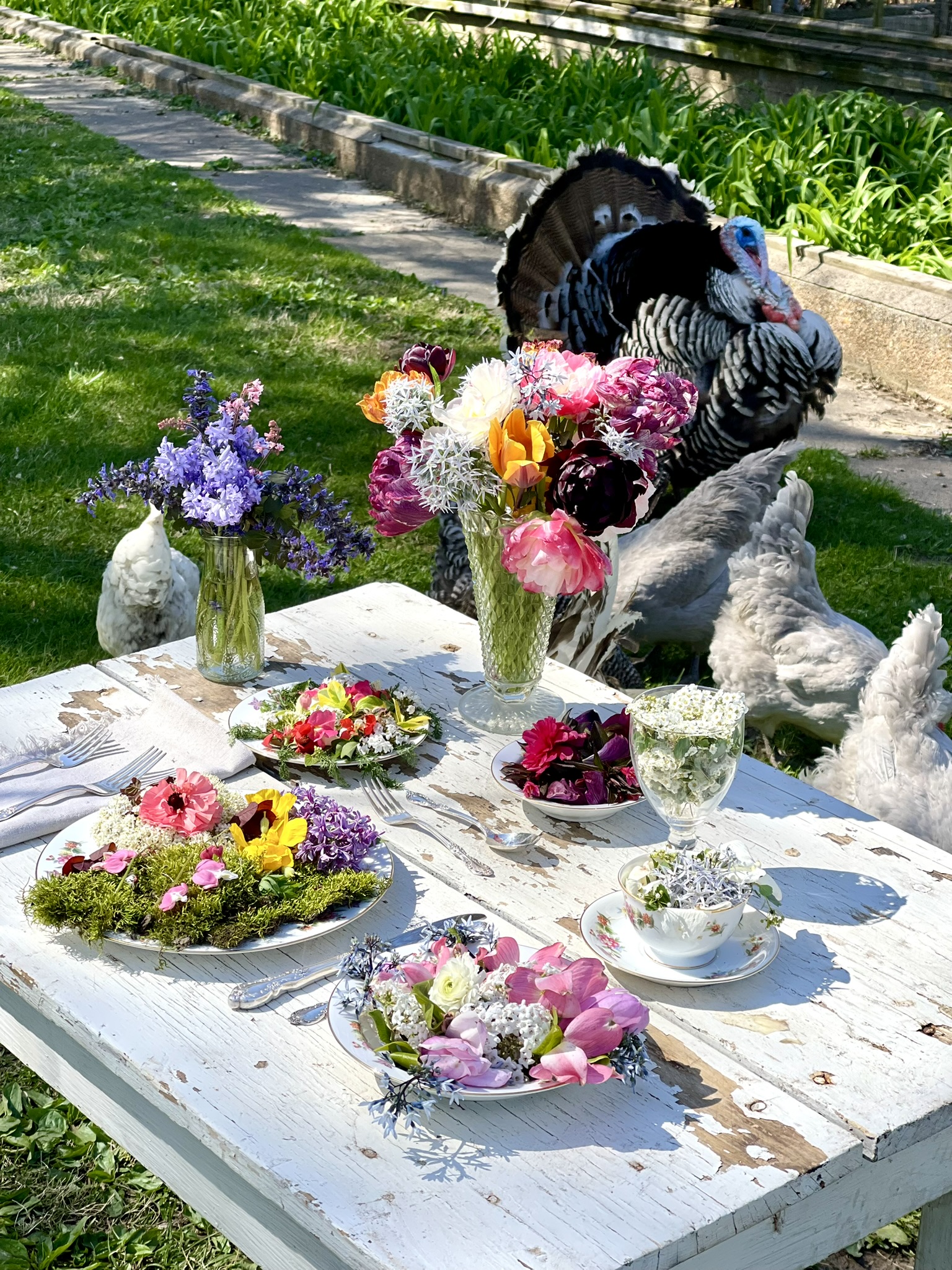
No invitation was sent. The turkey arrived anyway.
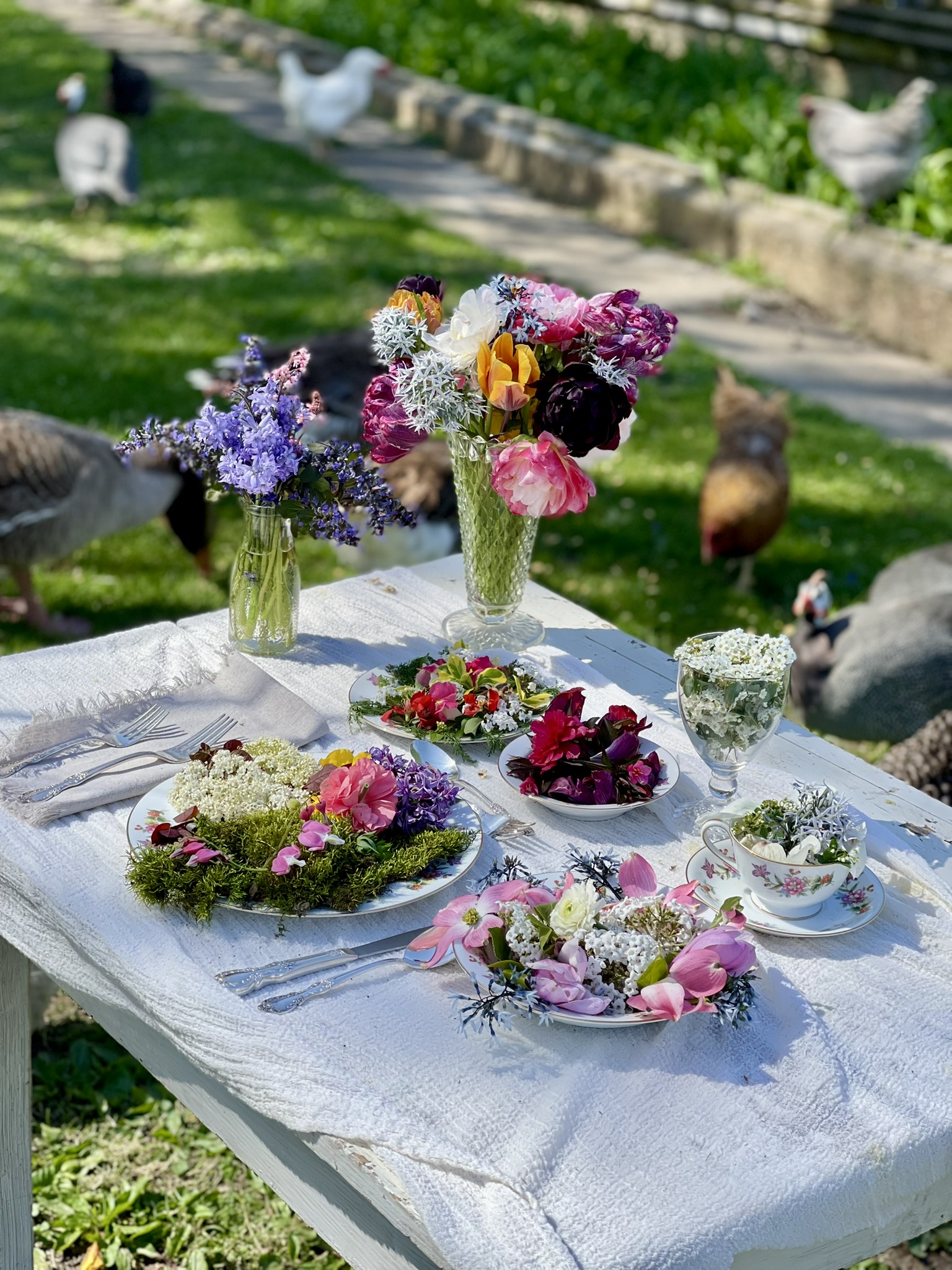
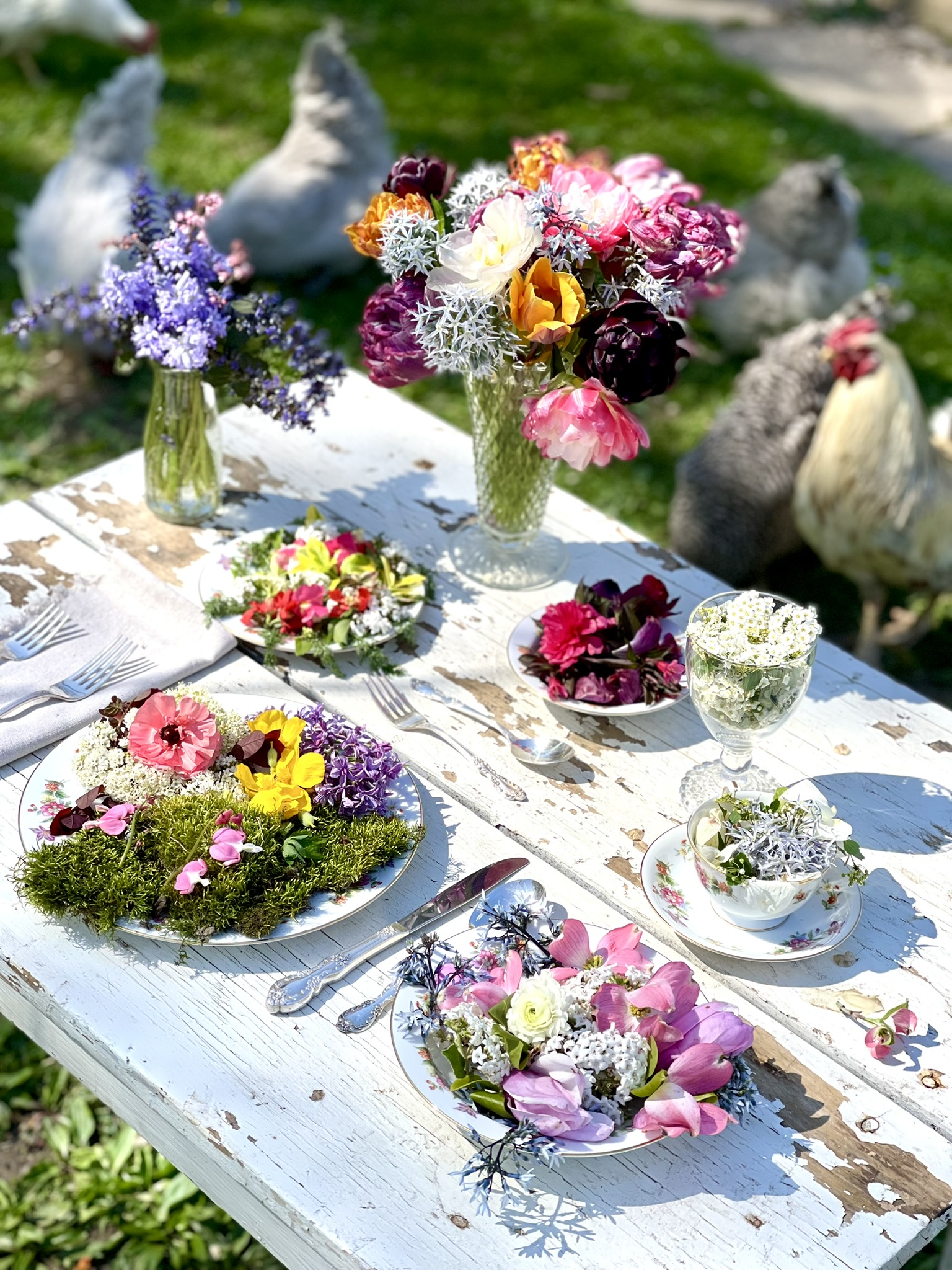
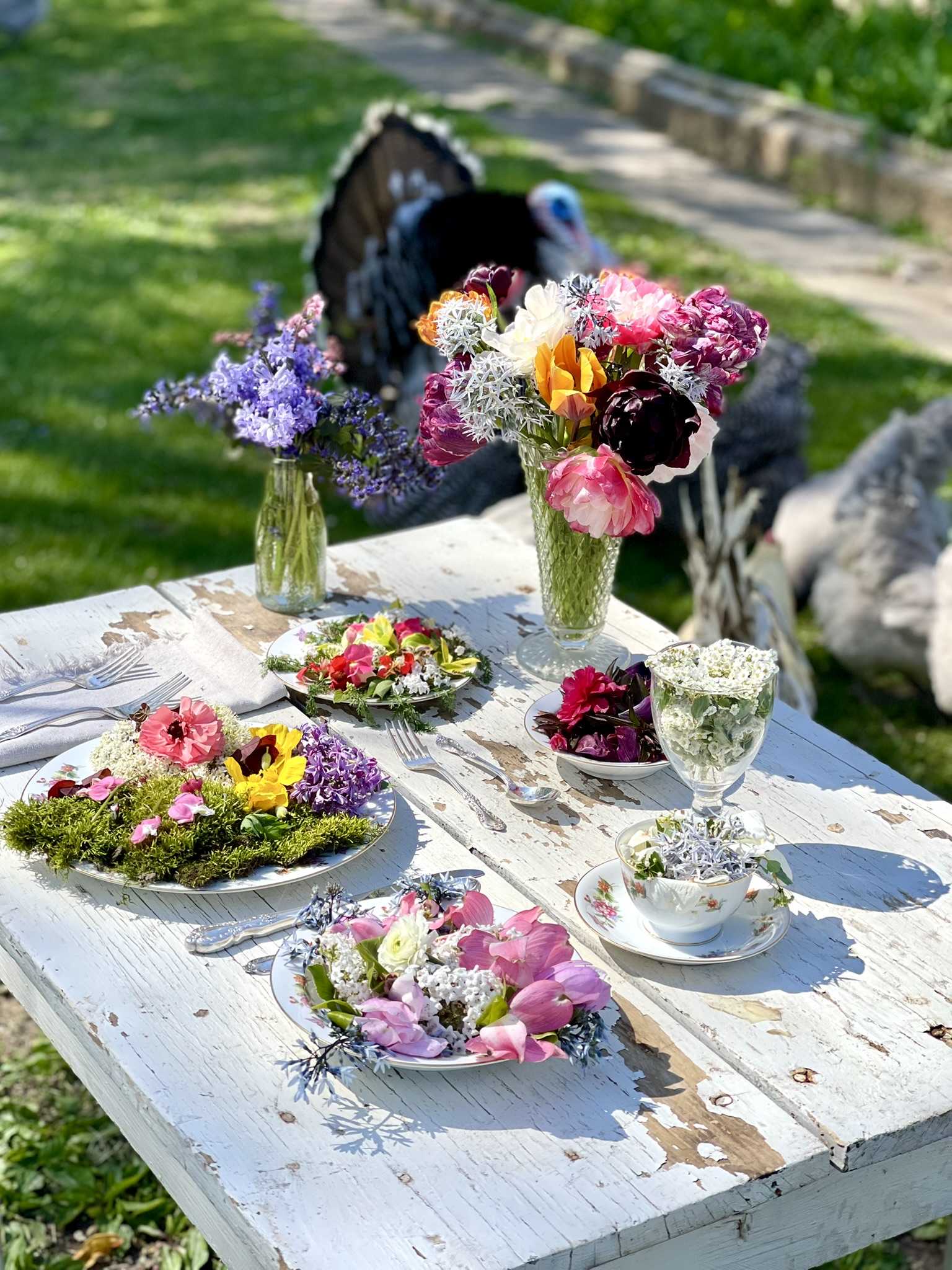
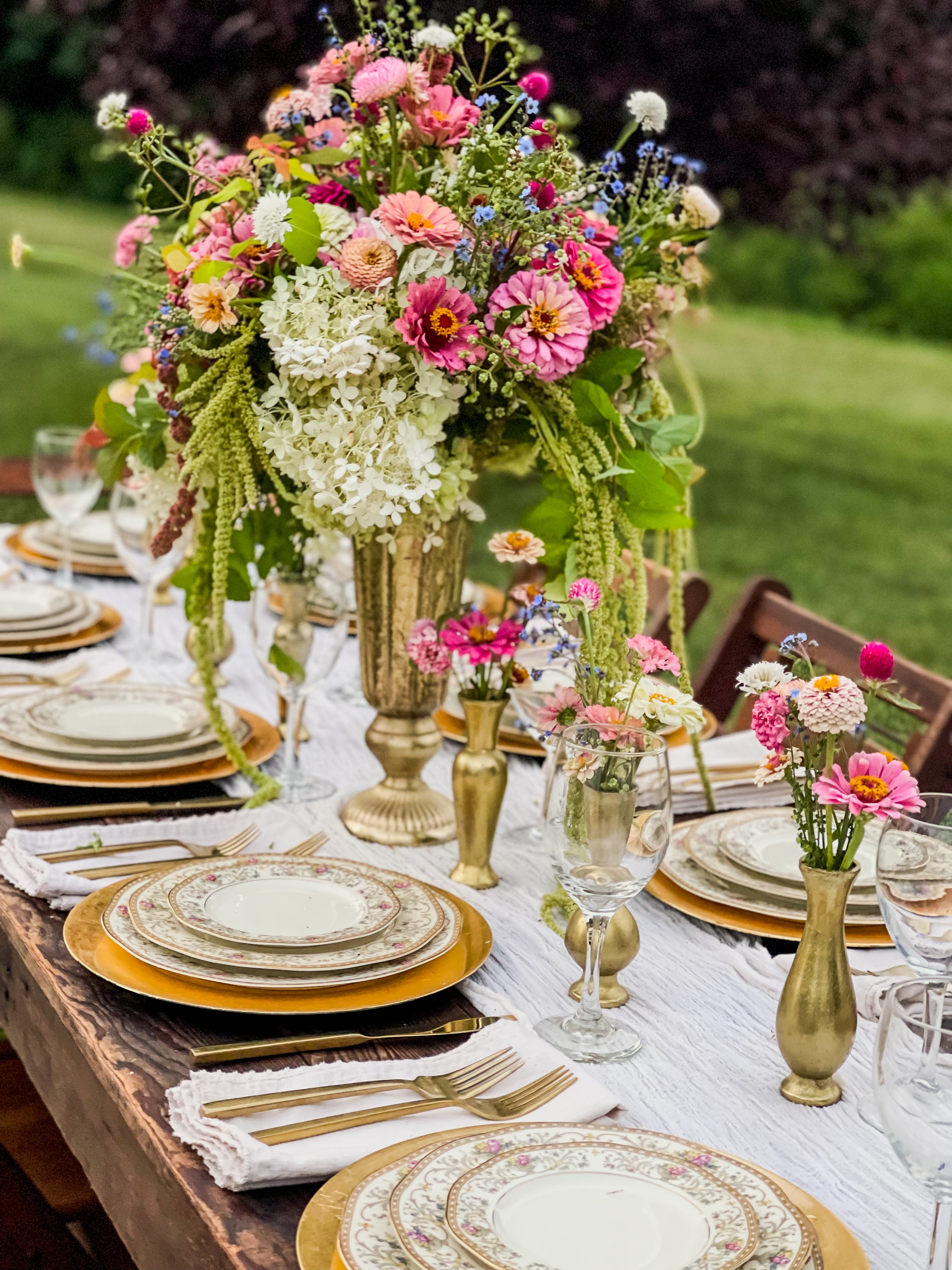
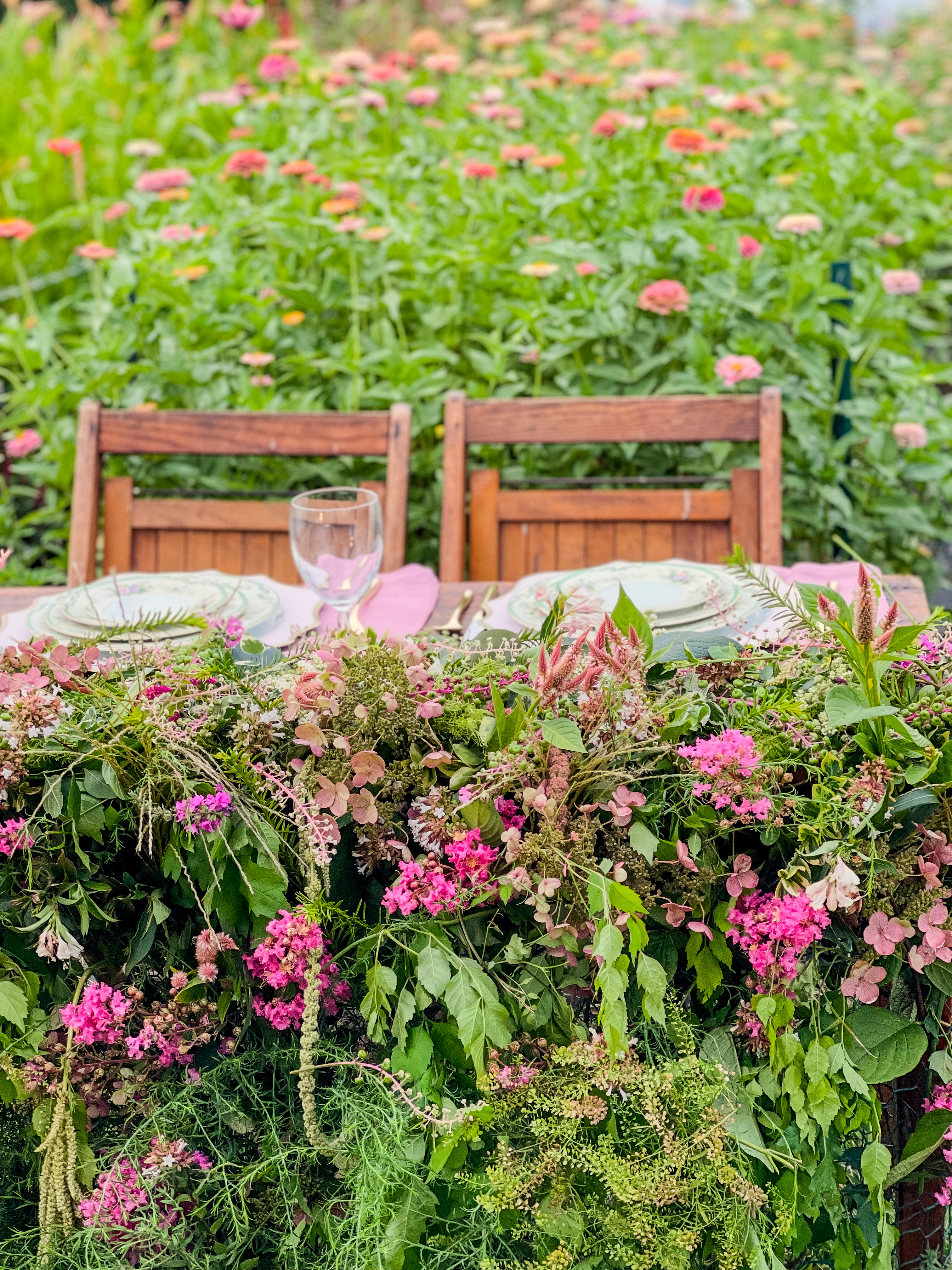
The table was set with vintage china and living flowers from the farm — photographed outside the greenhouse in the farmyard, where the geese and guinea fowl and turkeys roam freely. The geese came first. Then the chickens. Then the tom turkey arrived in full display, as if the table had been laid for him specifically, as if he were the guest of honor at a dinner in his own honor.
No one asked him to leave.
Scroll to see the full feast — and the uninvited guests →
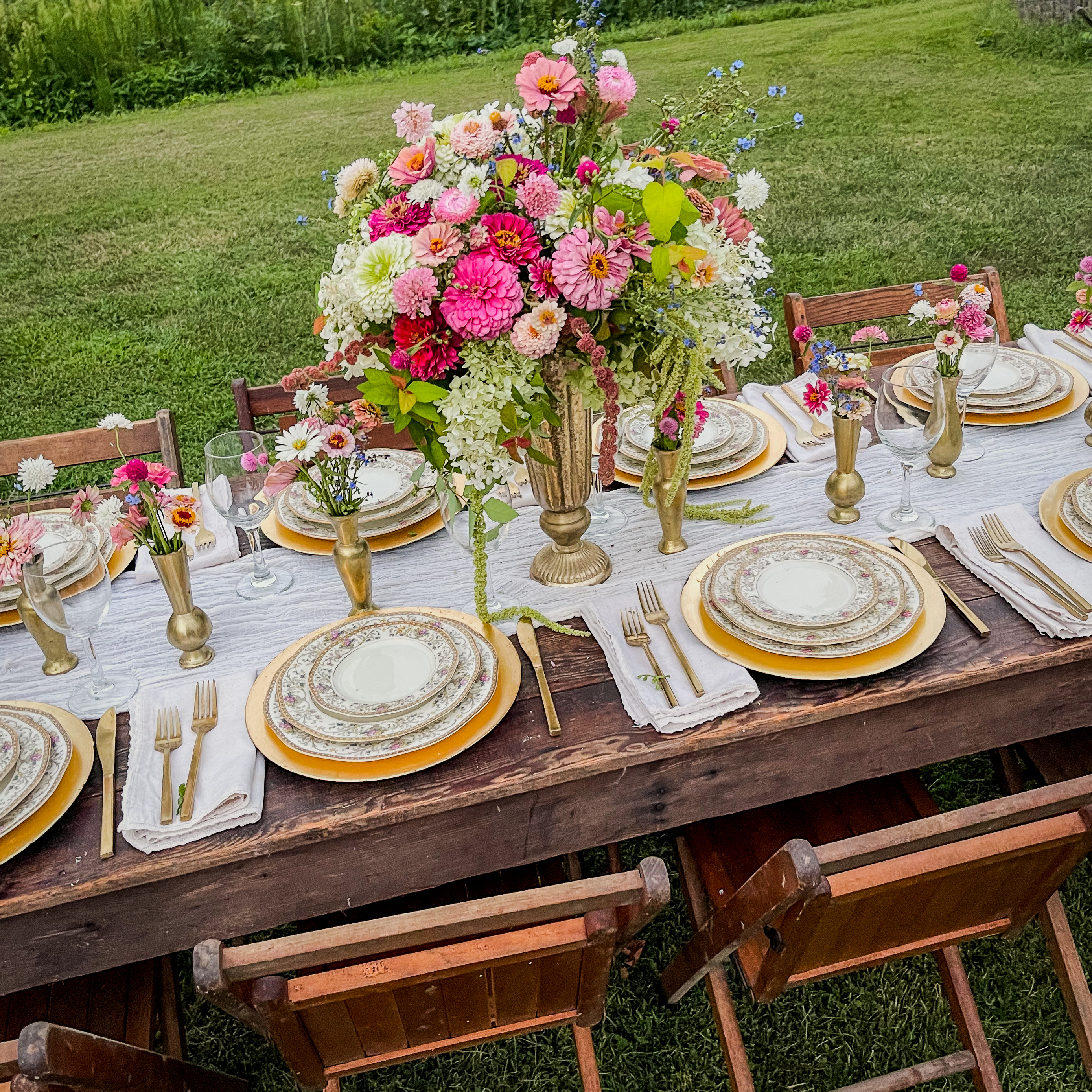 The Formal Floral Farmyard Feast — set the table, invite the flock
The Girls
I sometimes think of the pieces as girls gathered in a room, each waiting to tell me where she came from.
One speaks with an English accent and remembers tea poured during uncertain years. One crossed the Atlantic from France in a carefully packed crate. One came from Japan, bearing a mark that locates her between war and recovery. One remembers a wedding. Another remembers a grandmother. Another has forgotten every name but still carries the pale scratches of a family's daily meals.
Taken together, the photographs reveal a remarkably coherent visual obsession. Again and again, I chose flowers arranged around an open center: garlands, wreaths, sprays, bouquets, and little botanical constellations orbiting an empty white or ivory field. That open center matters. The flowers frame the meal and the people gathered around it. They decorate domestic life without overwhelming it.
You are collecting different answers to the same question: how much beauty can be placed around an ordinary meal?
The Garden Girls
These are the ones that feel like actual gardens — loose, living, unhurried. Not formal dining rooms but cutting gardens. Not ceremony but morning.
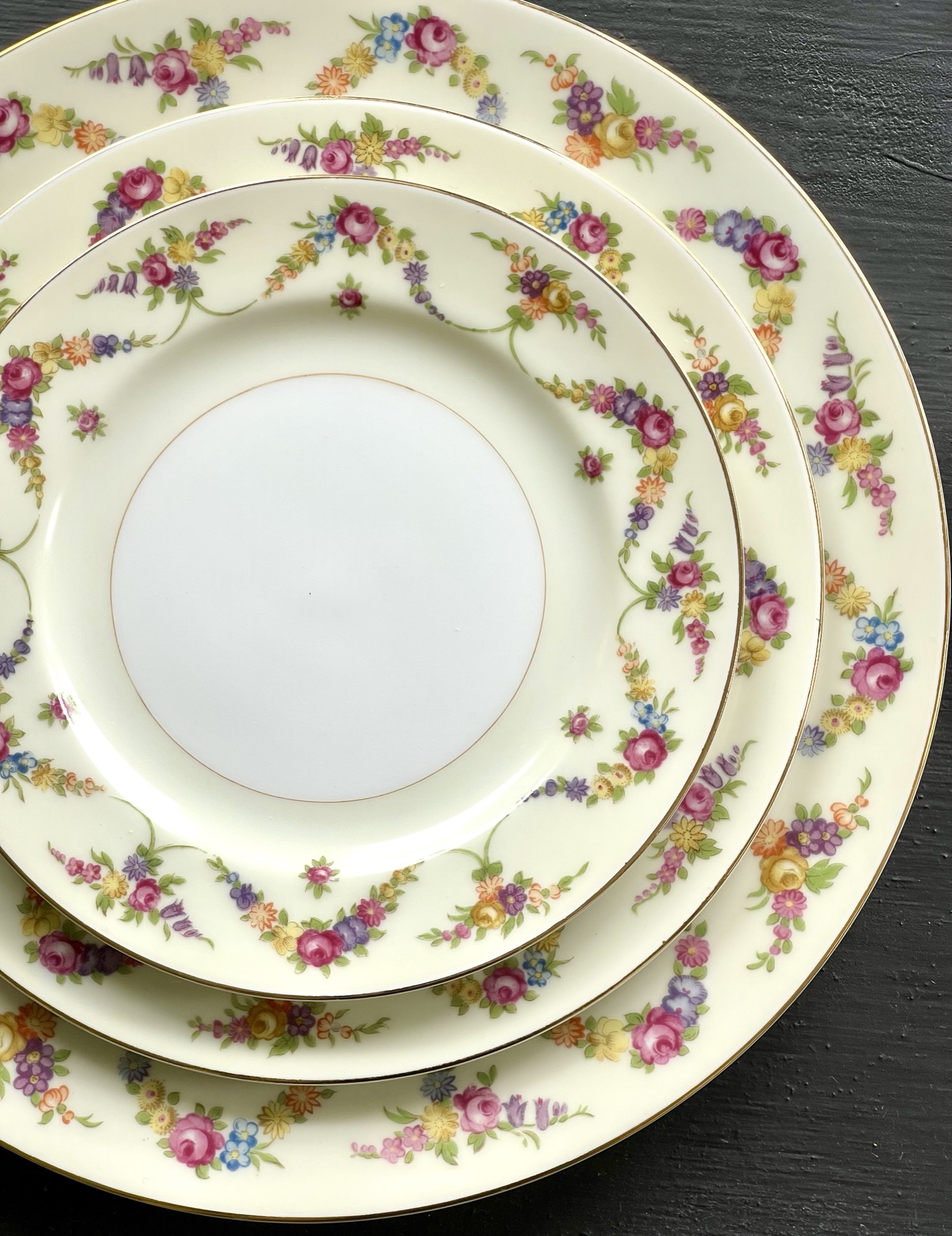
Duchess
American, c. 1940s–1950s
The most jubilant girl in the room. Her garland runs all the way around without stopping — roses, peonies, bluebells, lavender, forget-me-nots — nothing restrained, nothing reconsidered. She was made for celebration. For the Sunday when everyone comes. For the birthday that almost didn't happen.
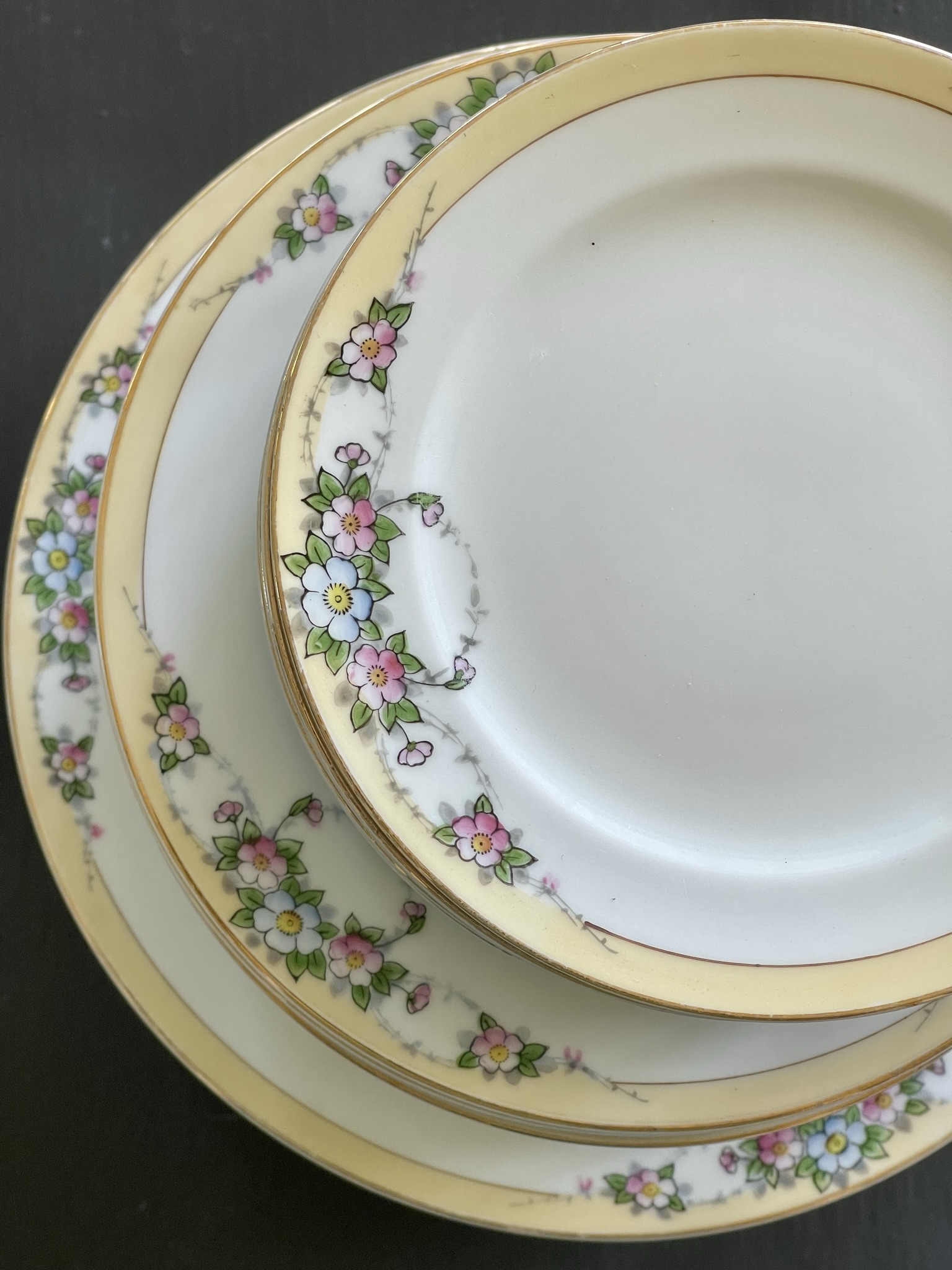
Apple Blossom
Japan, c. 1920s–1940s
Pink and blue blossoms trailing along gray twig branches across cream-yellow. She looks like a branch in March, before anyone knows what the season will bring. The twig pattern suggests cherry or apple — a flower that exists for only a moment, painted here so it never has to leave.
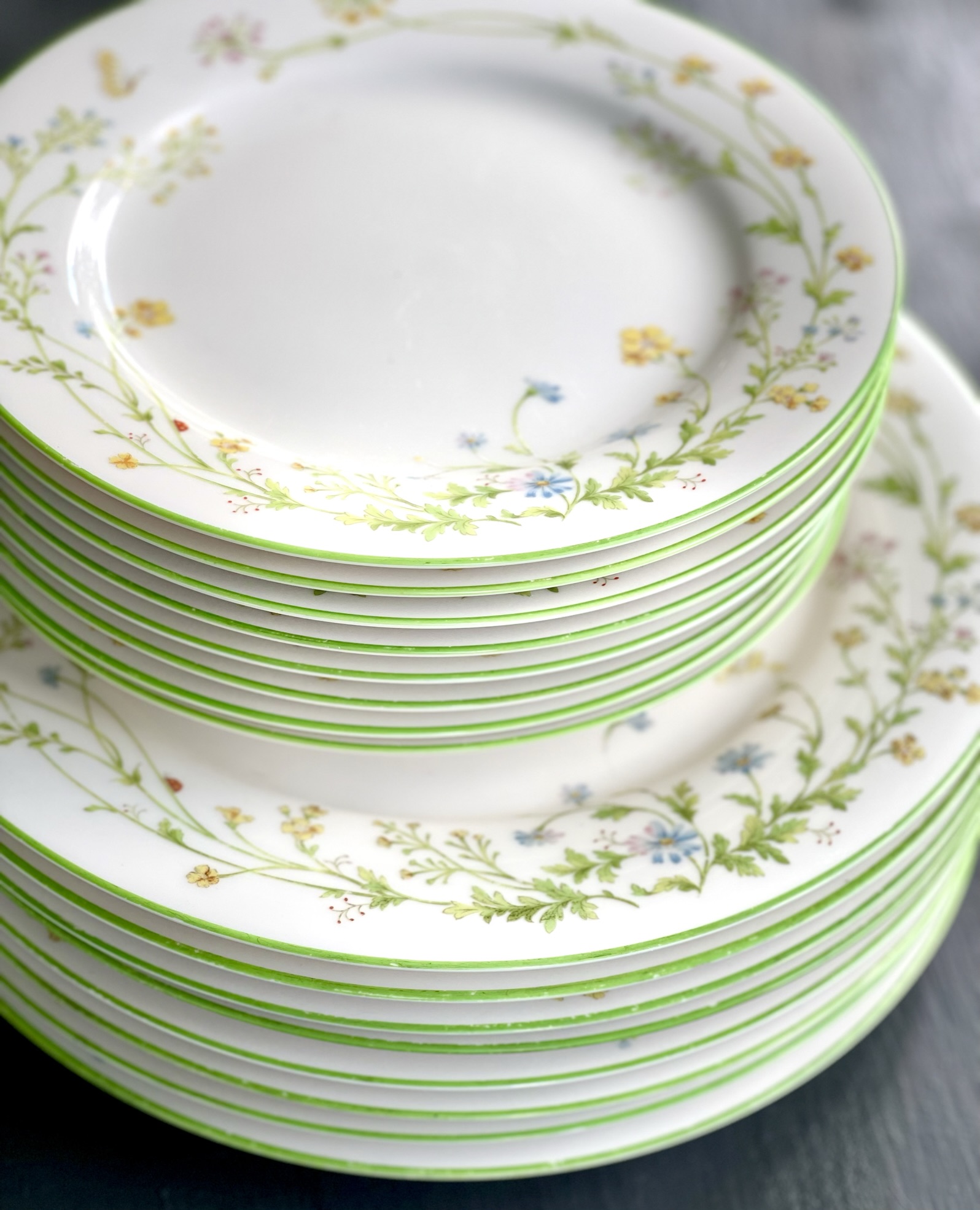
Meadow
Japan, mid-20th century
The most whispered of the green girls. A thin pale-green band holds a garland of yellow buttercups, blue forget-me-nots, a blush of pink, small red berries — as if the garland was pressed from an actual field and placed lightly on the rim. She is not trying to impress anyone. She is simply there.
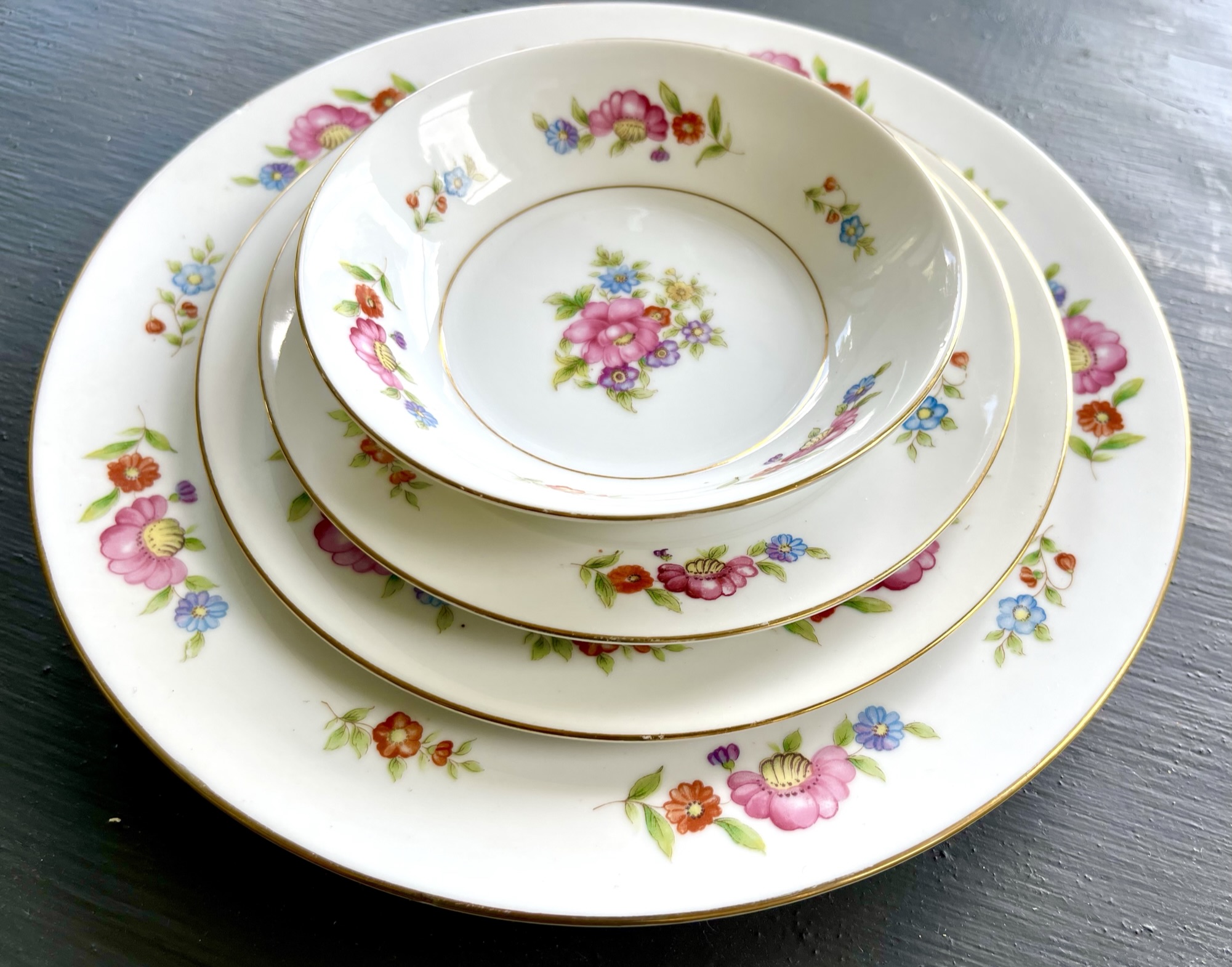
Meito Bloom
Meito, Japan, c. 1940s–1950s
Pink, red, orange, and blue flowers scattered across white — not arranged, just scattered. The center bowl holds a small bouquet. A Meito export pattern, painted in Nagoya for a household in Ohio or Minnesota or Missouri. The flower painter never met the woman who washed these.
The Abundant Ones
Some patterns announce themselves quietly. These ones announce themselves by sheer number. Thirty pieces. Forty. The entire tower of plates visible in a single photograph — a family's determination made visible, a household that believed in the future enough to buy enough for everyone.
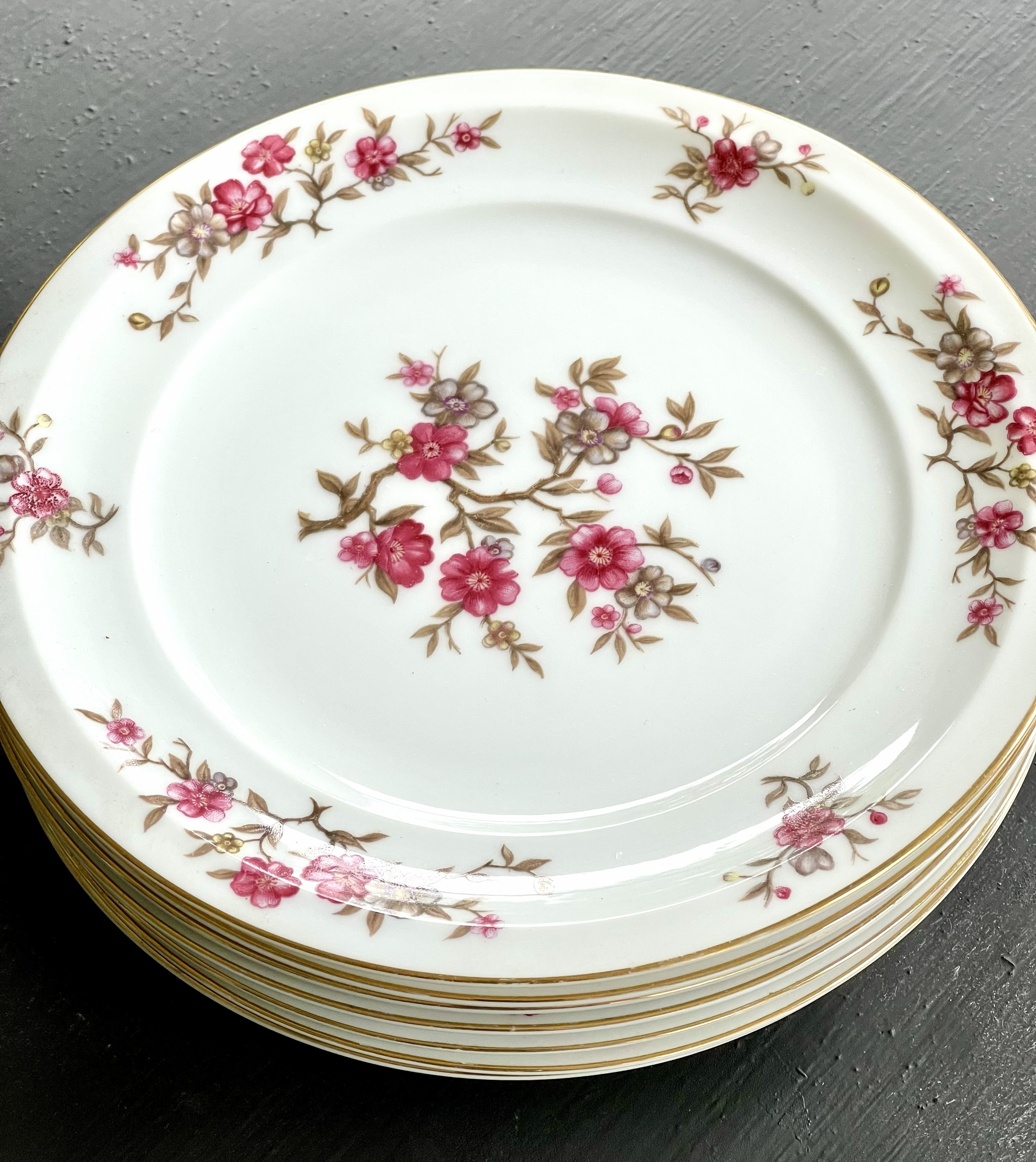
The Cherry Blossom Stack
Japan, mid-20th century
Bare branches. Pink blossoms opening mid-air. A pattern that doesn't need a border to contain it — the branch just travels where it wants, from the well to the rim, uninterrupted. Eight plates deep and the blossom keeps blooming.
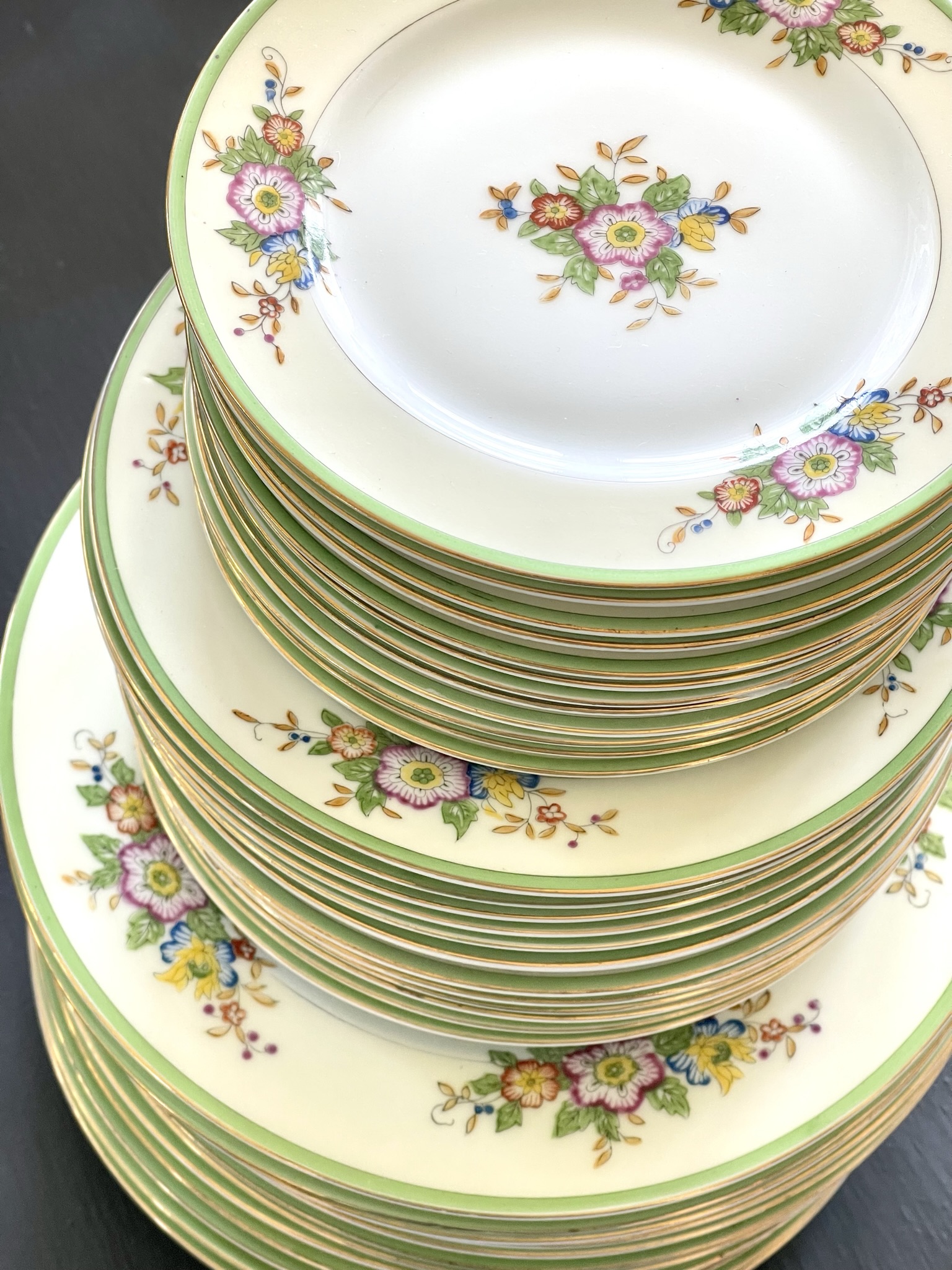
The Green Edge Set
Japan, mid-20th century
More than thirty pieces. Three sizes of plates stacked all the way down — a family's determination made visible. Someone believed in the future enough to buy thirty plates. The green edge, the scattered bouquets: this is what abundance looked like when it was made in porcelain.
A secondhand store isn't a warehouse.
It's an archaeological site.
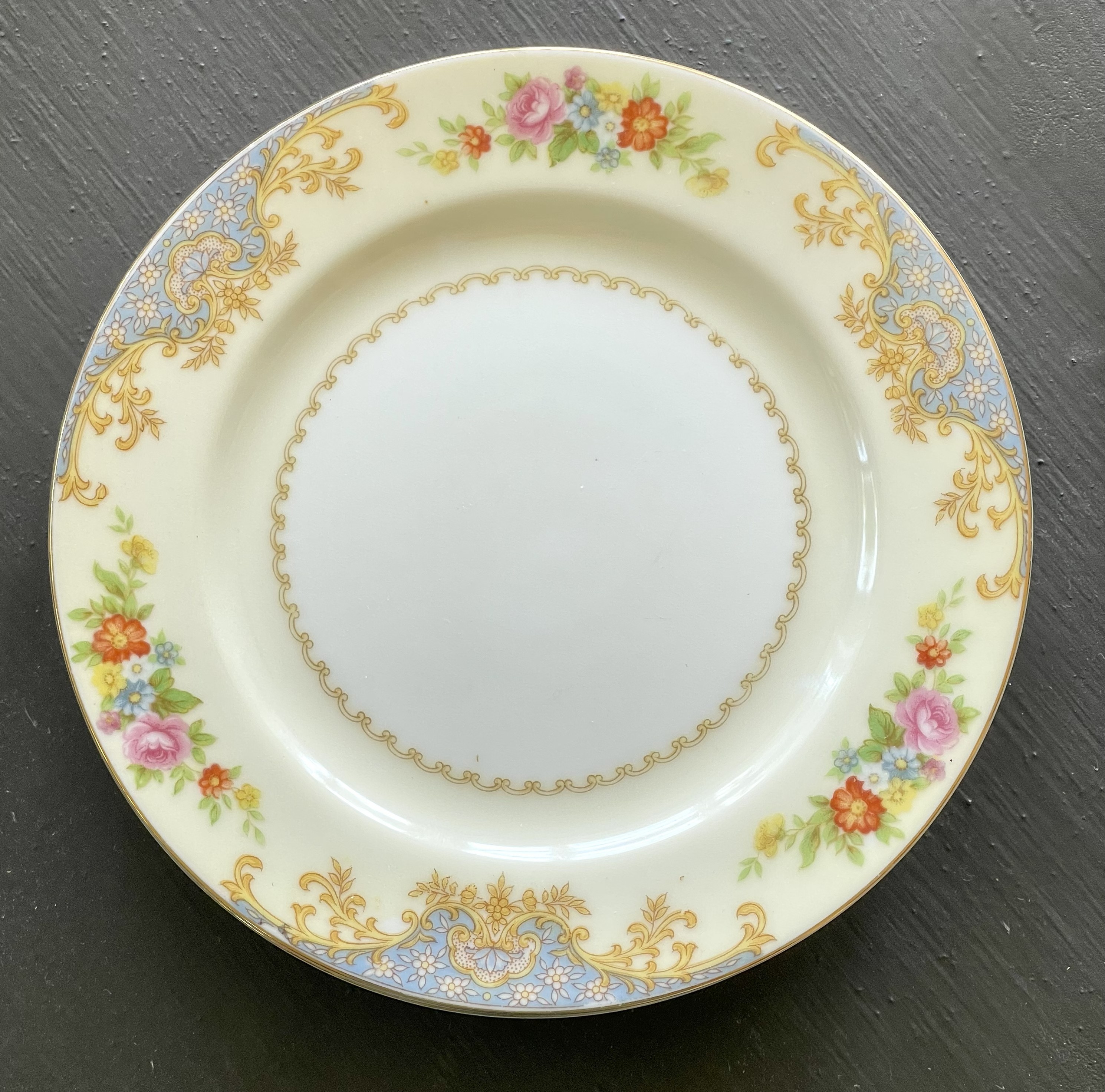
The Blue Cartouche
Japan, mid-20th century
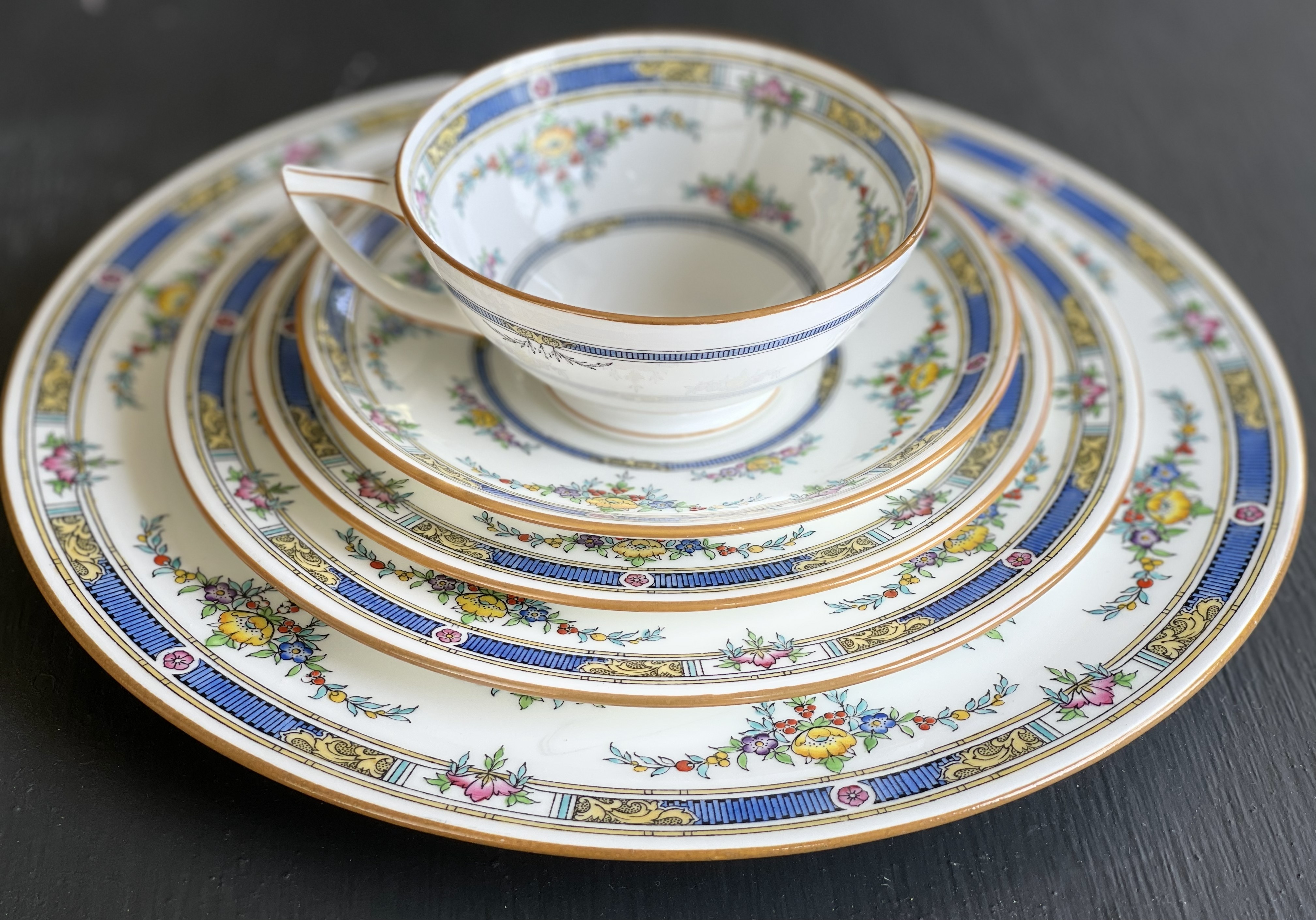
Someone sat down and painted this. The blue cartouches. The gold acanthus curling between them. The rose bouquet placed exactly where the eye expects it. This is not decoration — this is design at the level of intention. Every element earns its place.
The Full Five
Japan, mid-20th century
Dinner. Salad. Bread. Saucer. Cup. The full five, all in one pattern, all intact, all together. This is what completeness looks like. Most sets arrive missing pieces — someone broke a cup, lost a saucer, kept the bread plates separately. To find the full five is to find a family that took care of things.
War Changed the Plates
The flowers stayed. Everything else changed.
Before the First World War, porcelain often reflected confidence. Old European houses produced objects for households with servants. Delicate. Complex. Aristocratic.
Then came two world wars. Factories bombed. Entire cities destroyed. Families erased. Heirlooms scattered. Millions of homes disappeared.
The china that survived wasn't simply tableware anymore. It became one of the few physical witnesses left.
Several patterns in this collection date to the years around the Second World War — 1939, 1941, 1942. A 1941 service was not necessarily purchased with foreknowledge of everything that year would bring. A woman might have selected it for a wedding and imagined decades of ordinary dinners. Instead, there could be enlistment. Separation. Telegrams. Rationing. Widowhood. A household reorganized around women's work.
We cannot assign that biography to any specific plate without documented provenance. But we can say these patterns entered a world in which such experiences were widespread. Their dates allow us to tell the history of the kinds of households for which they were made.
"This pattern was made for households beginning or maintaining domestic life during wartime" is historically grounded. "We are left to wonder what happened to the woman who chose it" is the truth.
The Formal Girls
These arrived with architecture. Gold urns. Arabesque scrollwork. Rococo cartouches. Borders that look like building facades. The flowers are almost incidental — tucked into the ornamentation like bouquets placed on a mantel. These were made for dining rooms with high ceilings and genuine expectations.
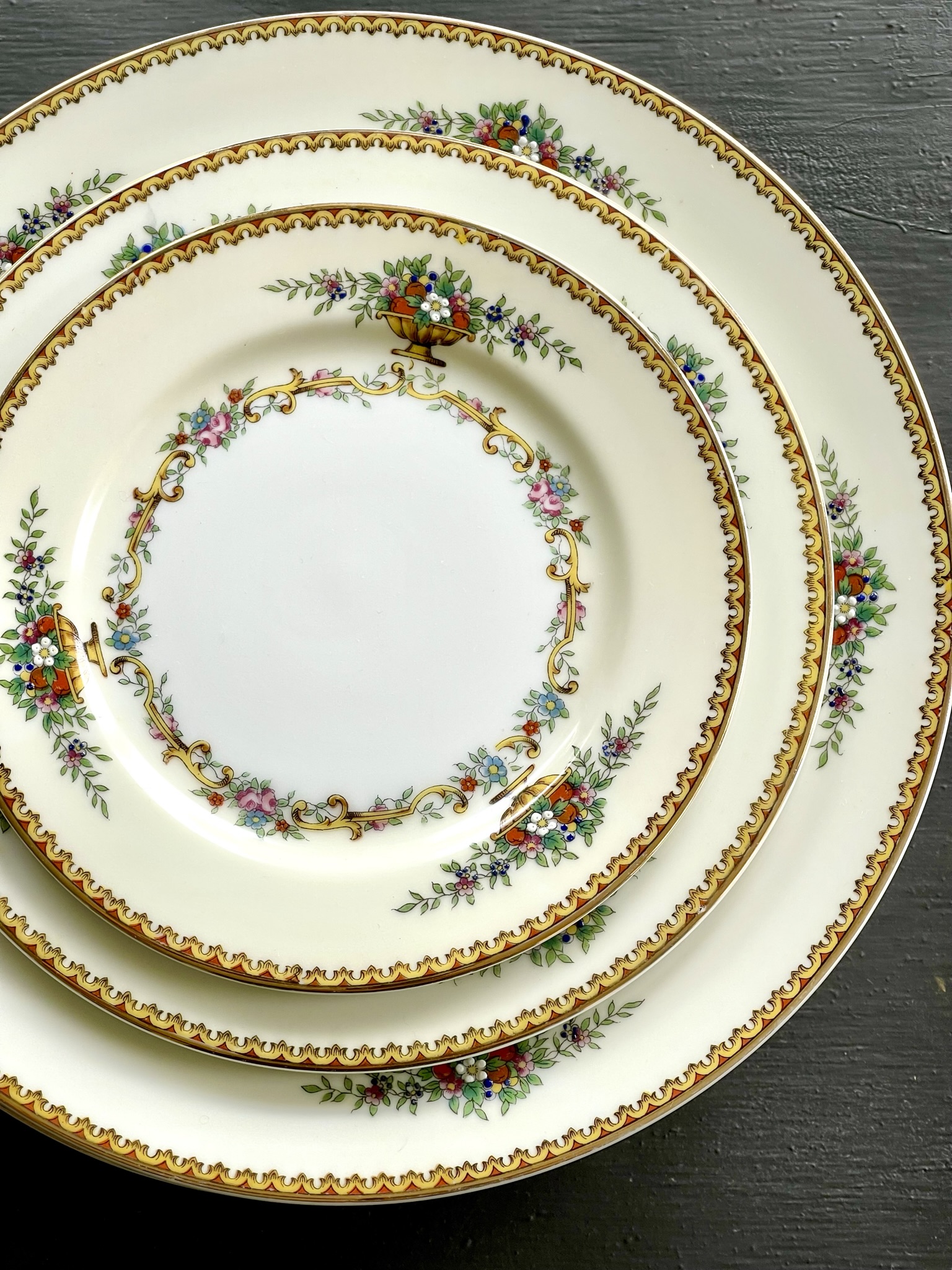
Romola
Noritake, Japan, 1921
One year after the flu pandemic. Three years after the armistice. Romola arrived with architectural authority — the gold urns on her outer border look like trophies from a world that survived. She was made for formal occasions in the years when formality was itself a form of healing.
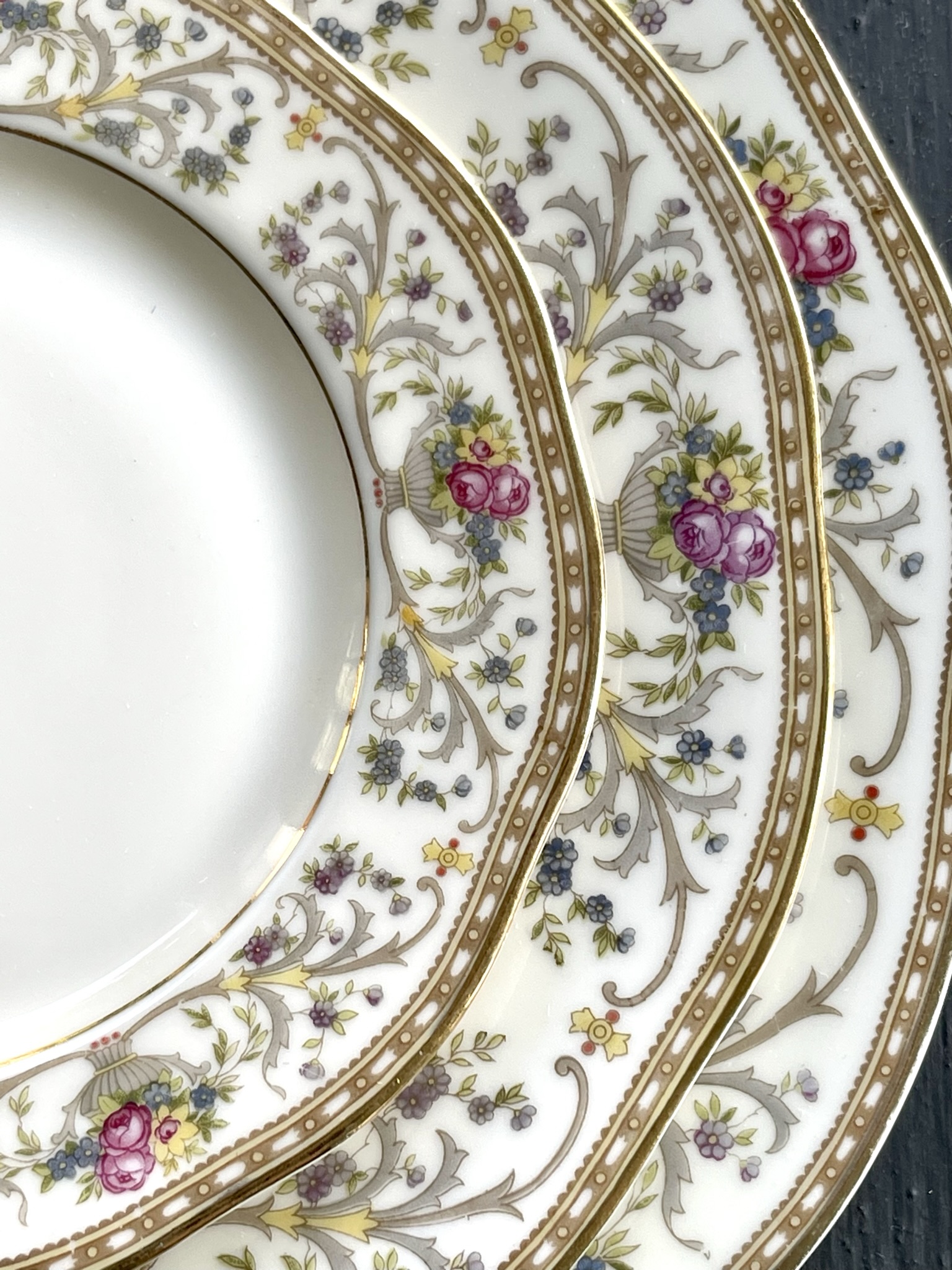
Arabesque
Noritake or similar, Japan, c. 1960s–1970s
The most cosmopolitan girl. The silver-gray arabesque scrollwork doesn't arrive from a European garden — it references something older, something that traveled along trade routes. Pink roses appear in the medallions like a Western addition to an older grammar. She's a conversation between civilizations.
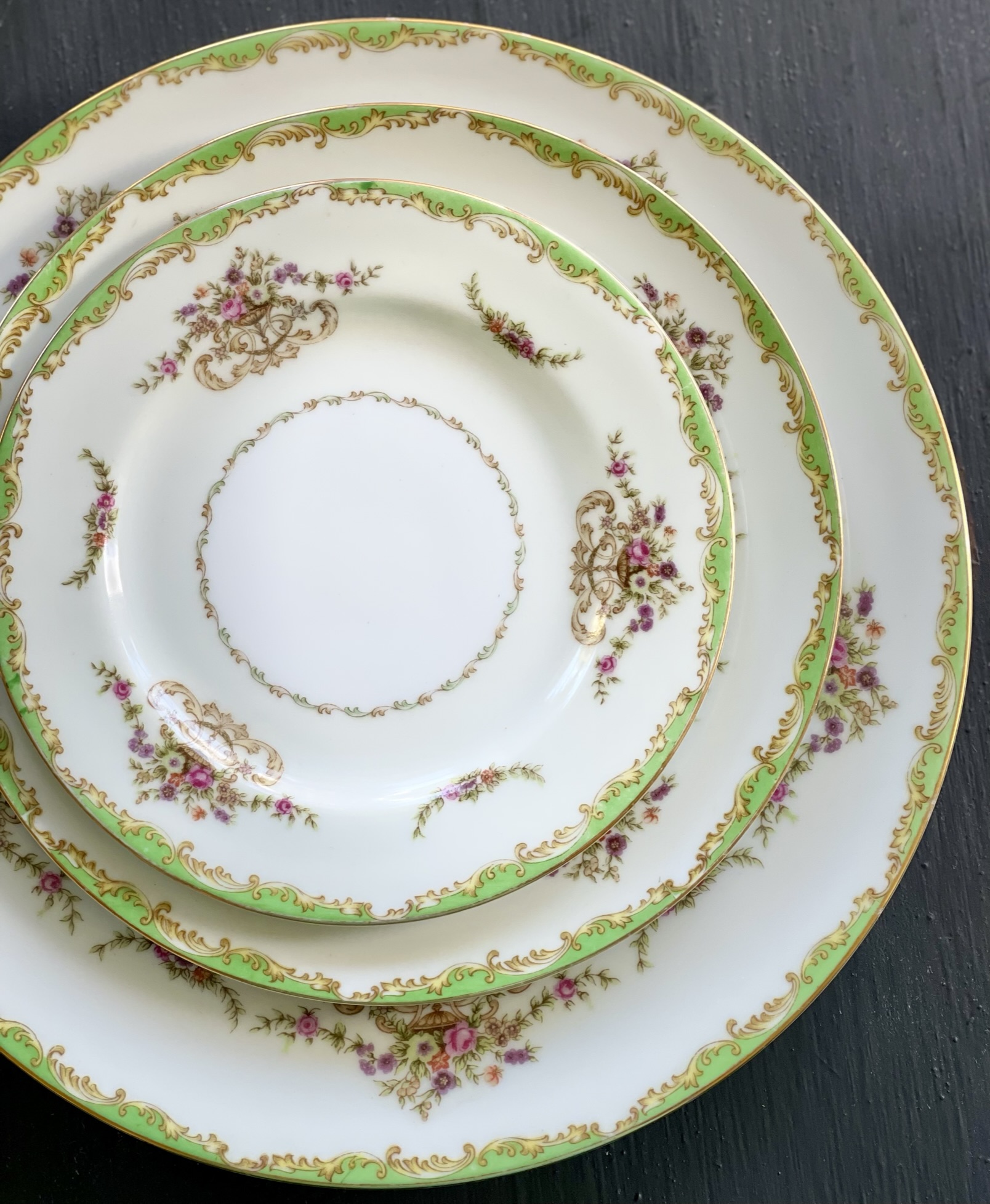
Lime Rococo
Noritake, Japan, c. 1920s–1930s
The most theatrical girl in the room. The lime green and heavy gilt together feel almost like Versailles — a service for a dining room with high ceilings and real expectations. The small pink and purple flower sprays are almost incidental, tucked into the architecture like bouquets placed on a mantel after the guests have arrived.
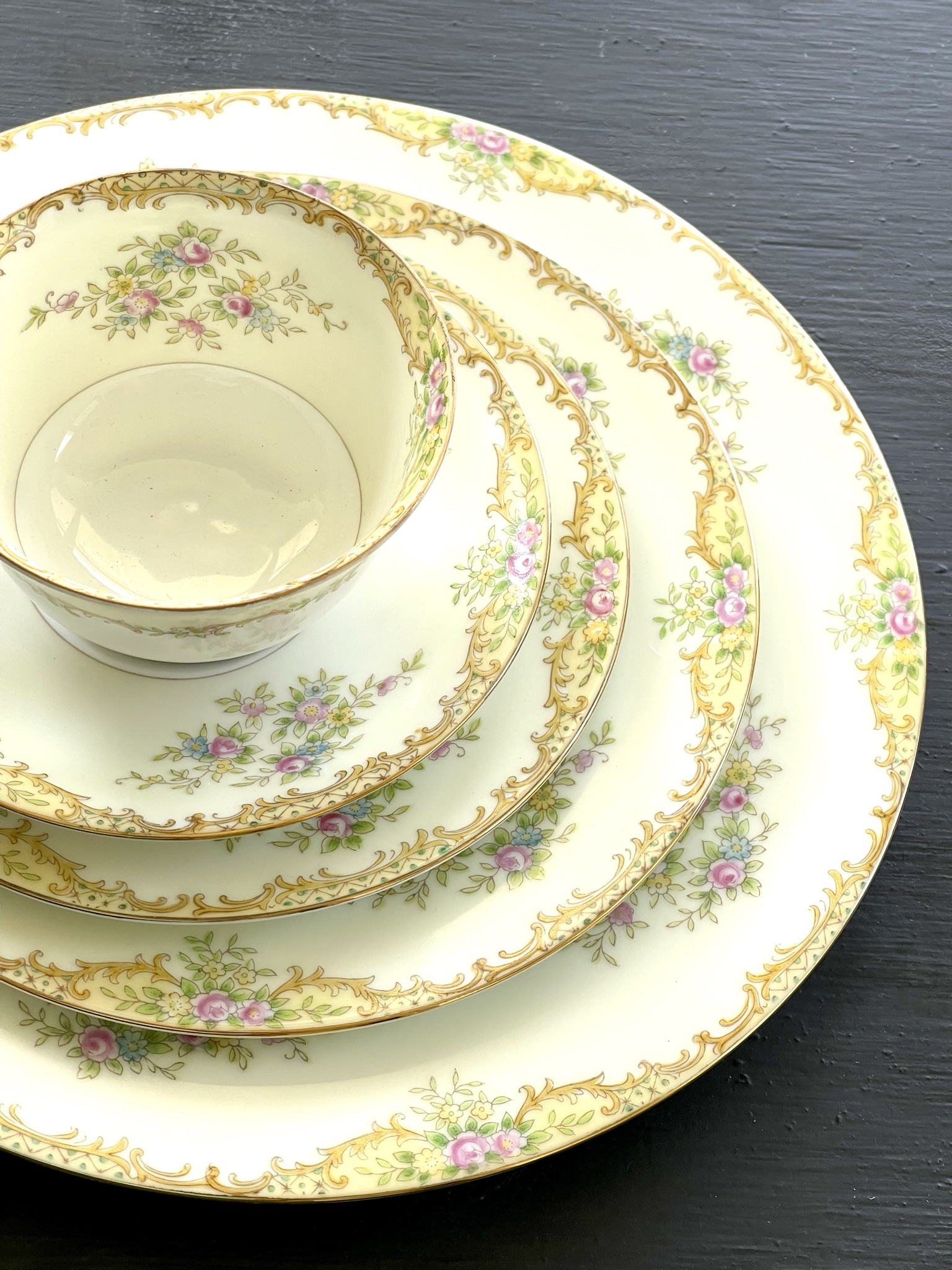
Golden Rococo
Noritake, Japan, c. 1930s
The warmest girl. The cream ground moves toward yellow, and the gold Rococo cartouches catch the warmth and deepen it. She looks like late afternoon in a dining room, 1935 — the last good dinner before everything changed, or the first good dinner after. She could be either.
Japan's Story
The Japanese pieces form the heart of this collection. Noritake, Meito, Moriyama, Kongo, Yamato, and others appear again and again. Visually, these pieces are not secondary imitations of European china. They show Japanese makers becoming extraordinarily fluent in the desires of Western households: English garden flowers, French-style gilding, Dresden-inspired bouquets, cream grounds, formal borders, complete American-style dinner services.
But there are moments when a different sensibility comes through — more asymmetry, a more delicate branch, open space around a flower, a botanical line that feels observed rather than merely ornamental.
These dishes are documents of cultural translation. They were designed in one country, often for women in another country, and carried across the ocean into homes whose owners might never meet the people who made them. The china crossed the ocean. Most of the makers' individual names did not.
The words on the underside — Japan, Nippon, Made in Japan, Occupied Japan — can turn a delicate floral cup into a historical document. Those marks speak of changing borders, trade laws, political identities, and the way Western consumers perceived Japanese manufacture.
Your 1930s and 1940s Japanese services become especially affecting. They were created during years of nationalism, depression, expanding war, and enormous civilian suffering. Then come pieces marked to the occupation and postwar period: china produced in a defeated and devastated country, exported into American households as Japan rebuilt its industries and international identity.
The flowers make that history almost unbearably poignant. Political worlds had collapsed, but someone was still painting roses.
The Japanese Girls
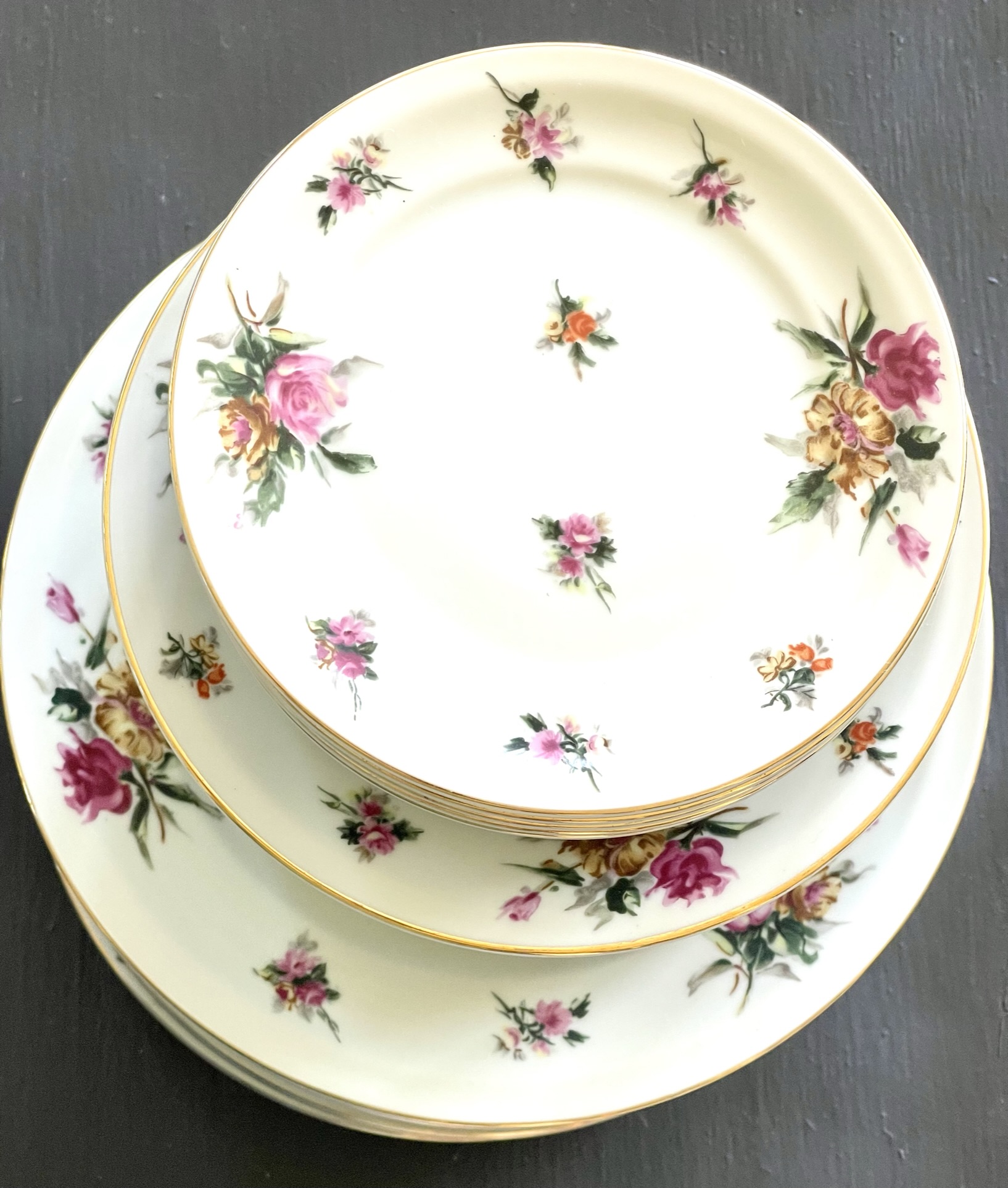
Rosalinde
Theodore Haviland, New York, c. 1930s–1950s
Theodore Haviland crossed from France to New York and made this: pink roses and golden chrysanthemums floating untethered across cream white, with no border to hold them in. Something free about it. Something a little unmoored — as if the flowers escaped from somewhere and landed here, and were glad of it.
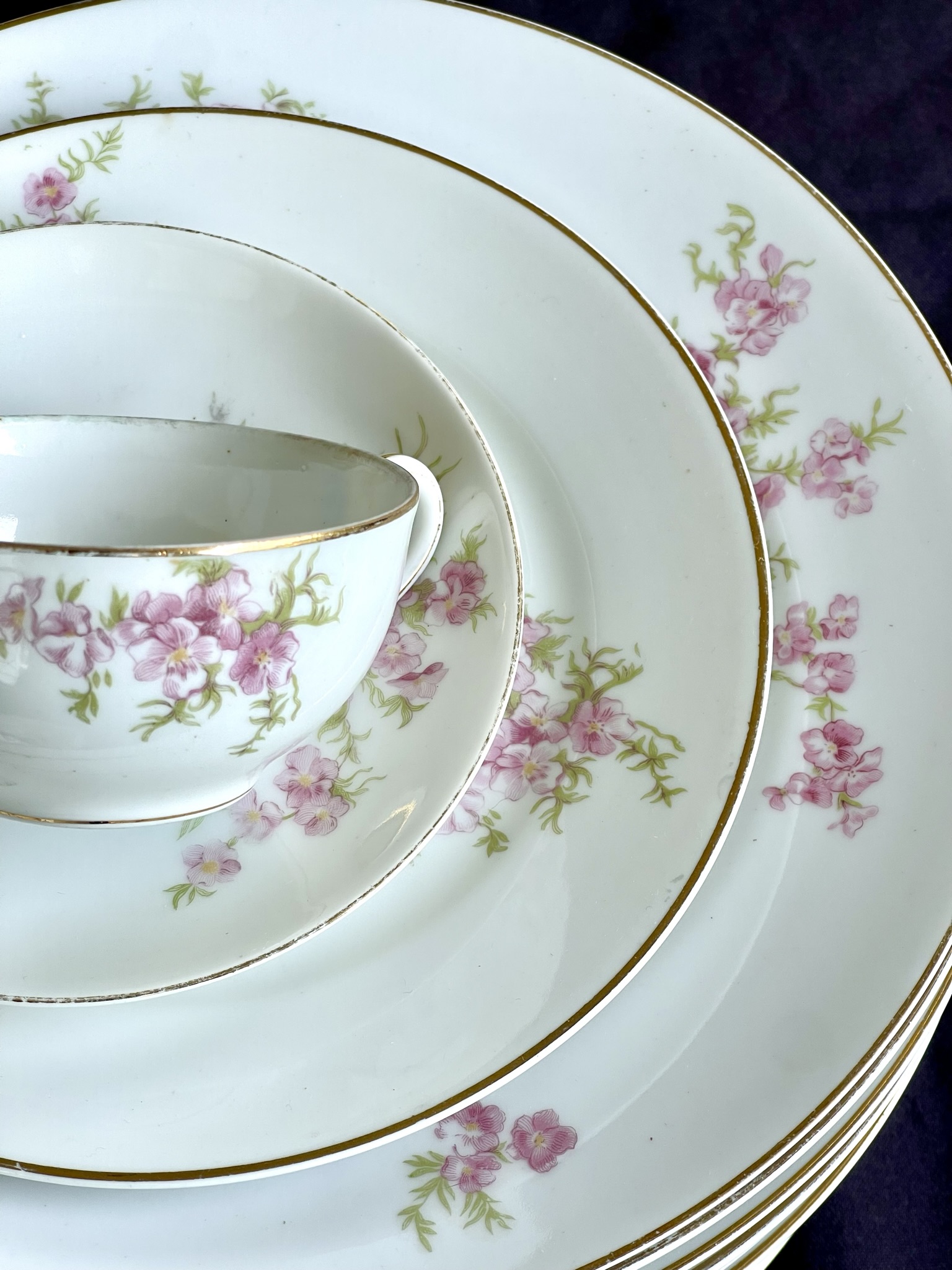
Cherry Blossom
Japan, c. 1950s–1960s
The most minimal. Pink cherry blossoms scattered on pure white, a gold rim worn thin at the lip. The cup sits on the saucer sits on the plates: three generations of the same quiet thought. The gold is worn where hands have held it. Wear is use. Use is evidence. Evidence is love.
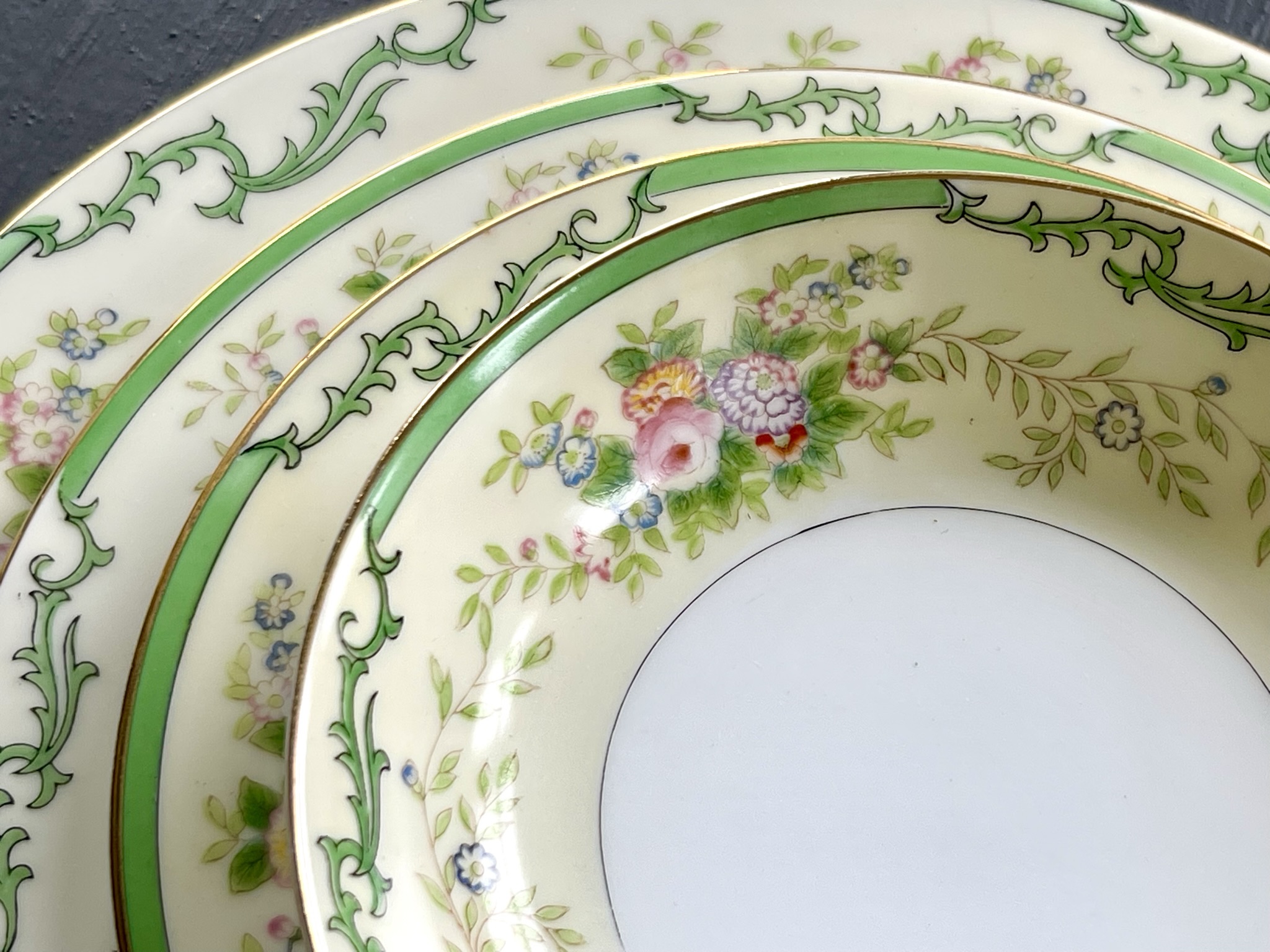
The Green Scroll Set
Maker unknown, mid-20th century
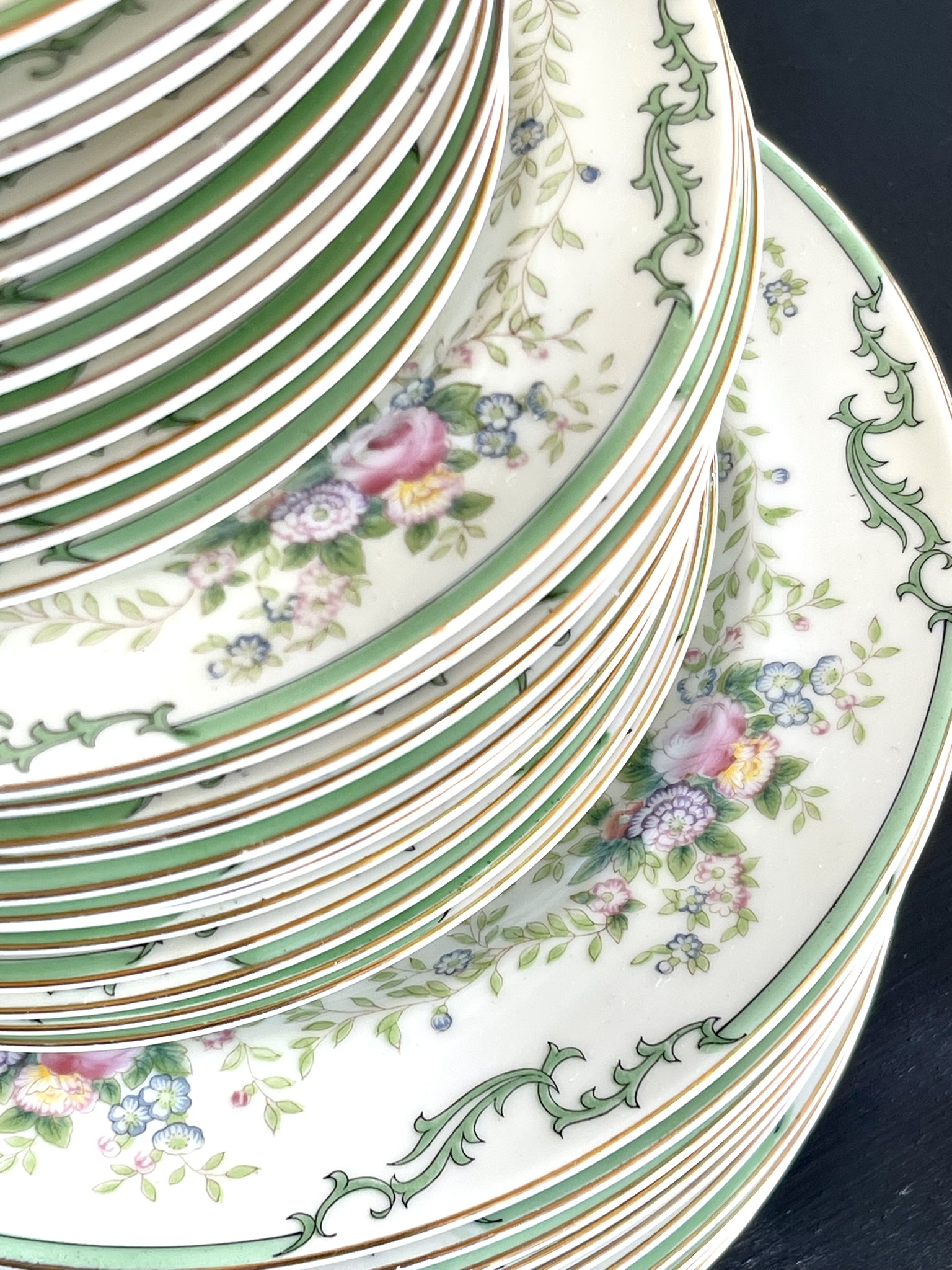
The scrollwork is alive. The green acanthus curls and reaches and spirals around the flowers — not a border but a living vine. A large set, complete. This is what happens when the craftsperson was genuinely enjoying themselves. You can feel the pleasure in the line across every plate.
The Stack
Maker unknown, mid-20th century
Every plate the same, stacked and waiting. The china arrived in a household, outlasted the household, and arrived again here. Whoever chose this pattern chose well — the vine never tires, the roses never fade, the pleasure in the pattern remains completely intact.
England: Flowers Against the Weather
English floral china carries a particular language of domestic reassurance. In a country shaped by gardens, industry, empire, strict social codes, and rapidly changing class structures, flowers entered the home through porcelain and earthenware. Roses, forget-me-nots, primroses, and other familiar blooms turned tea and dinner into small ceremonies of beauty.
One of the pieces in this collection dates to approximately 1912 — the year of the Titanic. That date immediately opens a door. The set belongs to a world still confident in established customs and social hierarchies, yet already standing at the edge of enormous change. Within two years, Europe would be at war. Men would leave home by the millions. Women's lives and labor would be transformed.
The dishes survived the world that made them.
Later English pieces speak from other chapters: the interwar years, the Depression, wartime rationing, postwar rebuilding, and the gradual disappearance of the formal dining customs for which many services had been created.
Their flowers remained cheerful even when history was not.
The Aged Ones
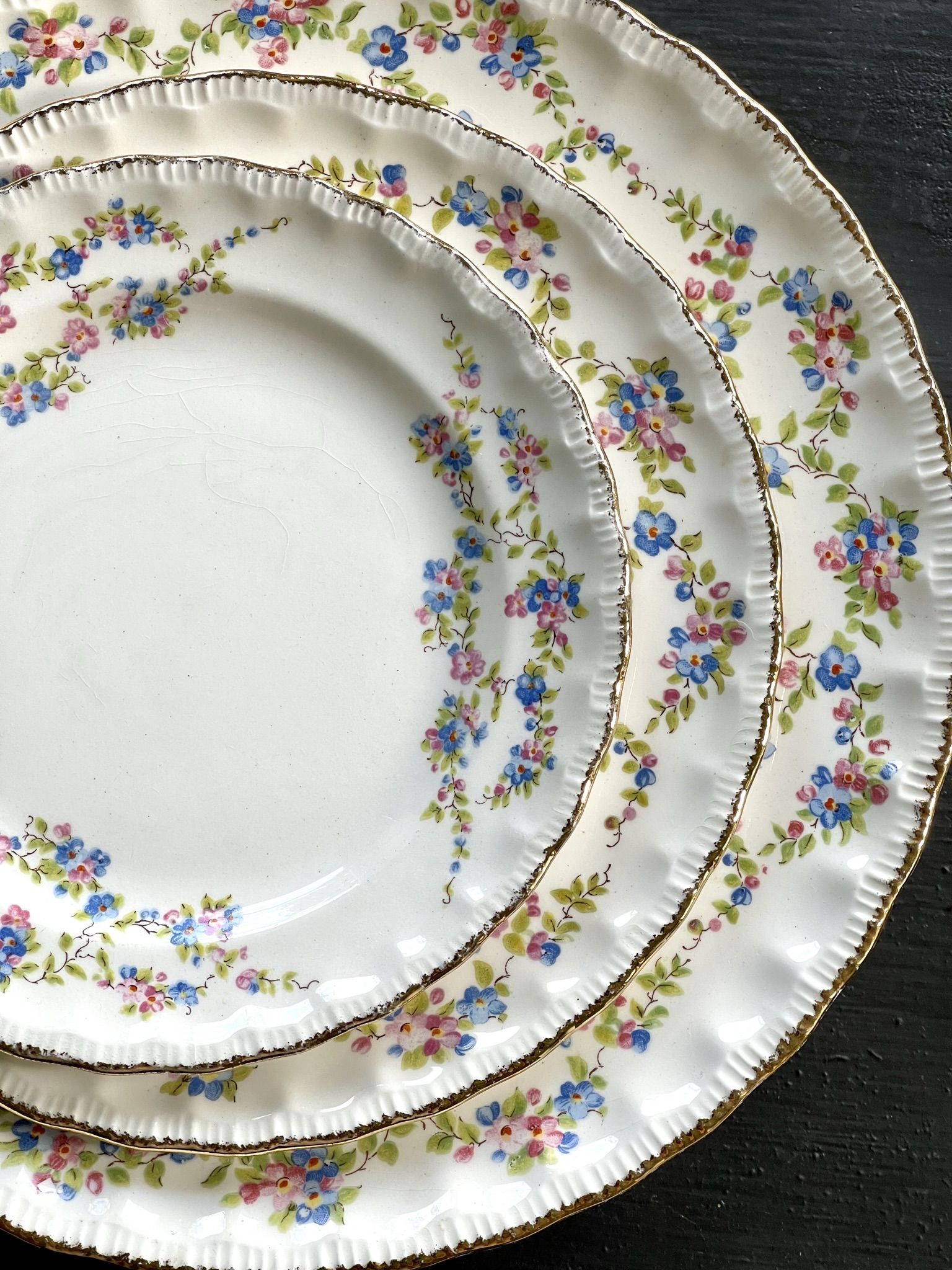
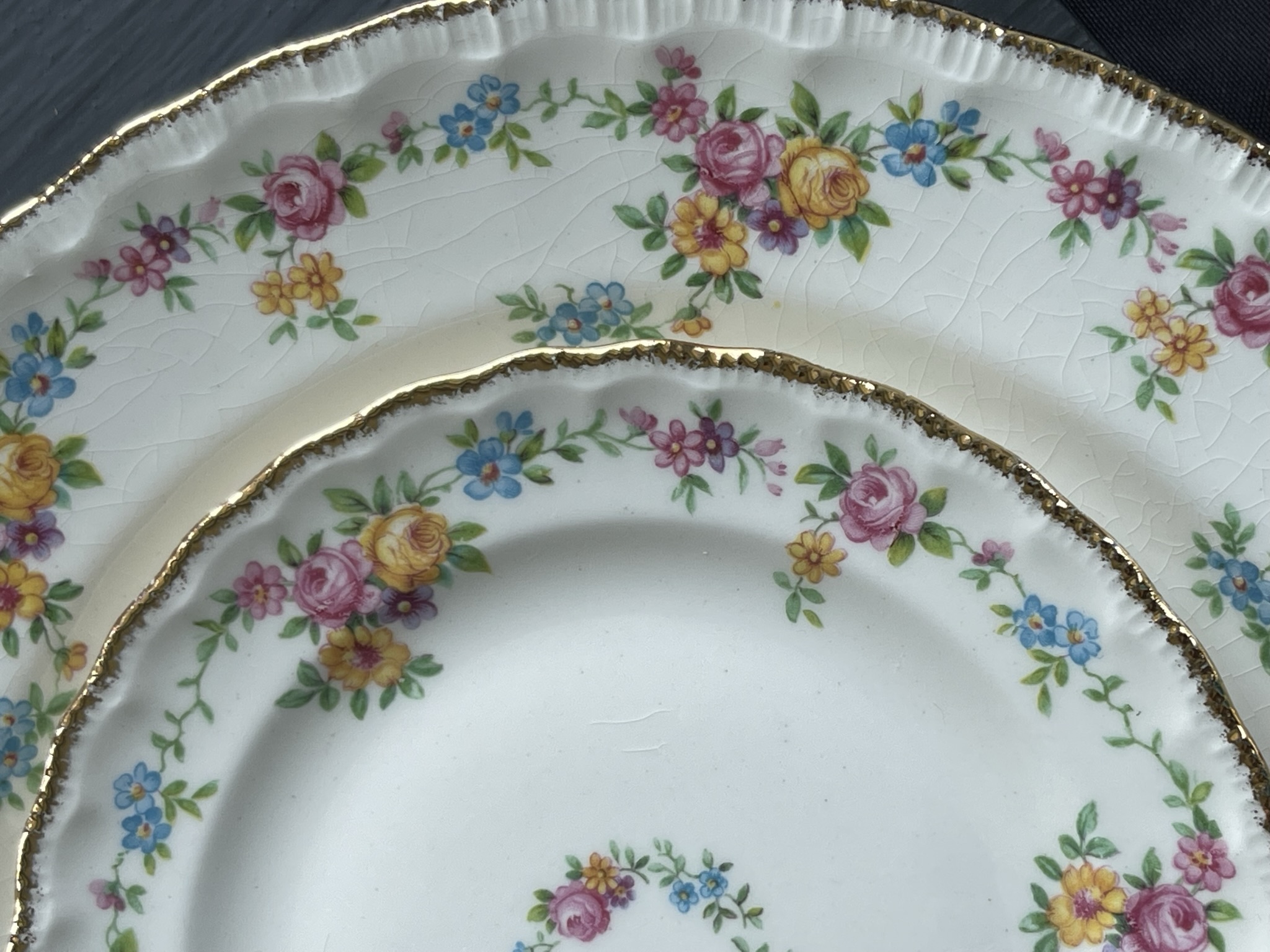
These are the ones that show their years. The crazing. The worn gold. The piecrust edge with its hairline cracks. They have been washed many, many times. They remember more than they will say.
Princess
Minton, England, c. 1924
The oldest-feeling girl. The piecrust edge. The scattered forget-me-nots covering the entire surface — not a border but a field, all the way across. Look at the crazing: those fine hairline cracks in the glaze are a century of thermodynamics. She has been washed many, many times. One year after the lost generation. The English table attempting to restore beauty.
Cottage Roses
Pope Gosser, American, c. early 20th century
The most lived-in girl. Pink roses, yellow roses, blue forget-me-nots covering her entire surface — not a border but a conversation, from edge to edge. The crazing records every temperature change of every washing, every seasonal shift in whatever house she lived in. She was not stored carefully. She was used. That is the whole story.
The china began as merchandise, became household identity, then inheritance, then unwanted remainder — and finally became an archive.
What the Collection Says About Women
These dishes are entwined with women's history.
For generations, china was one of the few forms of art that many women were socially encouraged to choose, arrange, display, and preserve. A dinner service could be an aesthetic declaration inside a life whose larger architecture had already been prescribed.
The choice between a green border and a maroon one could look trivial from a distance. Inside the household, it was a form of authorship.
Women selected these patterns, learned their names, remembered which aunt had owned which service, and decided when the good china could be used. They washed it, protected it, divided it among daughters, and worried about who would want it next.
Then women's lives changed. The formal table could become a burden rather than an achievement. Services were broken up when houses were sold, marriages ended, or daughters declined to inherit them.
And my heart breaks for the woman who craved these plates as a sign of something — her opportunity to own something beautiful, to show it off, to set a table that said: I have made something here. Come and sit at it.
This collection reverses that dispersal. The divided tables gathered back together — not into their original families, but into a new family of flowers.
The Washing
In the era when these plates were actively in use — the formal dining rooms, the servants, the Sunday dinners, the holiday tables — someone washed them. Quietly. Carefully. In soft, warm, soapy water, one by one, watching for chips, checking rims, setting them to dry with the attention that beautiful things require.
That work belonged to servants. It was invisible labor performed in a room most guests never entered, by people whose names were not written on the boxes the china arrived in.
Then the war came. The servants didn't return. The women who had sat at those tables came into the kitchen themselves. And something shifted.
Because even though it was still an era when the men might retire to another room after dinner — cigars, conversation, the business of the world — the women who remained at that table would gather at the sink. Together. And in the washing of the plates, something that had been invisible labor became something else entirely: female time. A brief respite. A room of their own that lasted exactly as long as the dishes took.
Women talked at that sink in ways they couldn't at the table. Quietly, hands in warm water, drying the roses and the forget-me-nots and the peonies on each plate, passing them carefully to be stacked. The china didn't know it was hosting a different kind of gathering. But it was.
Then came the dishwasher. Then the microwave. And with them, the end of that ritual — and, eventually, the end of formal china altogether. No one needed plates that couldn't go in the machine. No one wanted the care. The formal dining room shrank, then disappeared from floor plans entirely. The generation that grew up in open-plan houses with kitchen islands inherited no tradition of the tablecloth, the placed silver, the occasion.
That is a heartbreak all its own.
The Rescue
I find them at resale shops. Estate sales. Antique markets. Sometimes just a few plates — a service broken apart and scattered, the pieces traveling separately to different corners of the state, each one unaware the others still exist.
What I cannot bear is what happens to them otherwise. Broken deliberately for mosaics. Used as craft elements, shattered to be set in cement. Separated into individual plates for wedding rentals, never reassembled. Given away in pieces to strangers who don't know what they're holding.
When I see them, I bring them home.
I am, essentially, a vintage china rescue operation. I cannot save all of them. I have saved as many as I can. They live here now, in a house that still believes in the occasional formal table, still believes in the Sunday dinner, still believes there is something worth celebrating that requires the good plates.
The woman who saved up for these, who carried them home carefully, who washed them by hand and dried each one and placed them back in the cabinet — I think about her every time I lift one from the shelf. I don't know her name. But I am keeping her china safe.
The Romance Sisters
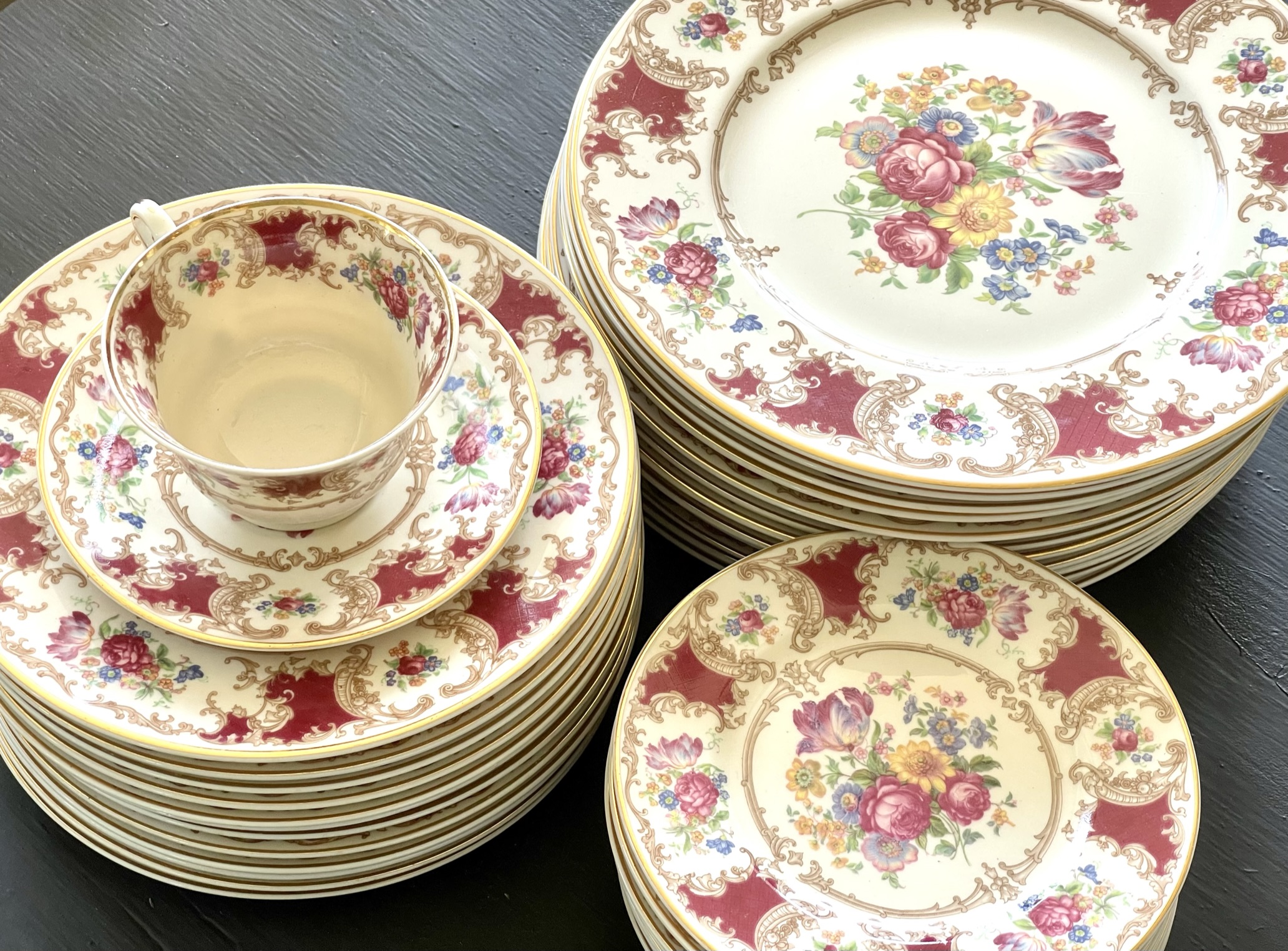
Two colorways of the same pattern. Two entirely different emotional temperatures. The aqua and maroon Romance services are wonderful examples of how dramatically a border changes identity. Aqua feels exuberant and almost fantastical. Maroon feels heavier, richer, more ceremonial. Related patterns with entirely different lives.
Romance — Maroon
American, c. 1940s
Heavier. Richer. More ceremonial. She was chosen for the serious occasions — the Thanksgiving, the anniversary dinner, the meal that needed to announce itself as significant. The maroon says: something important is happening here.
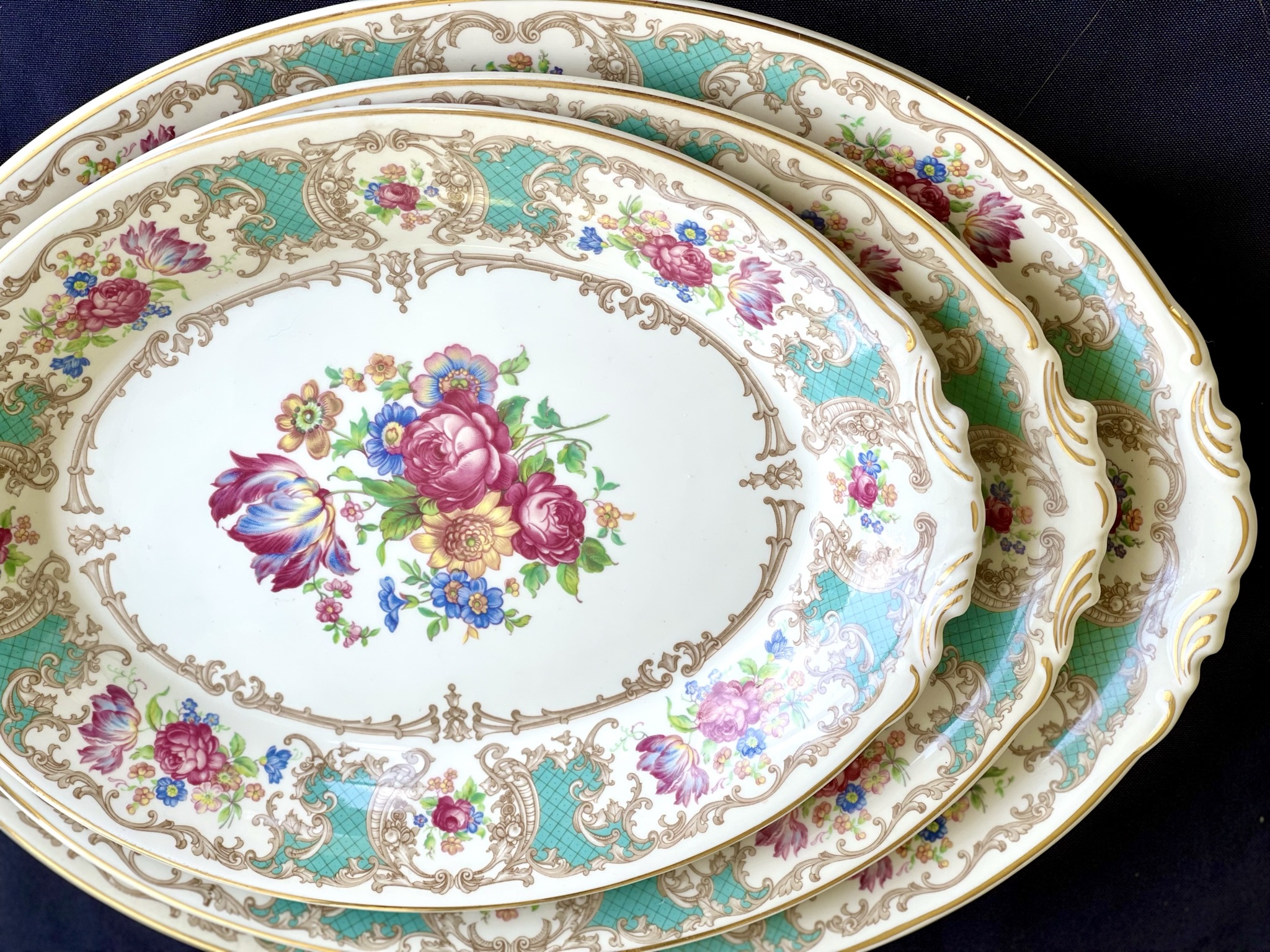
Romance — Aqua
American, c. 1940s
Exuberant. Almost fantastical. She was chosen by a woman who wanted something that made the table look like a party had arrived. The aqua says: everything is possible here. The flowers are abundant. Bring everyone. Bring more chairs.
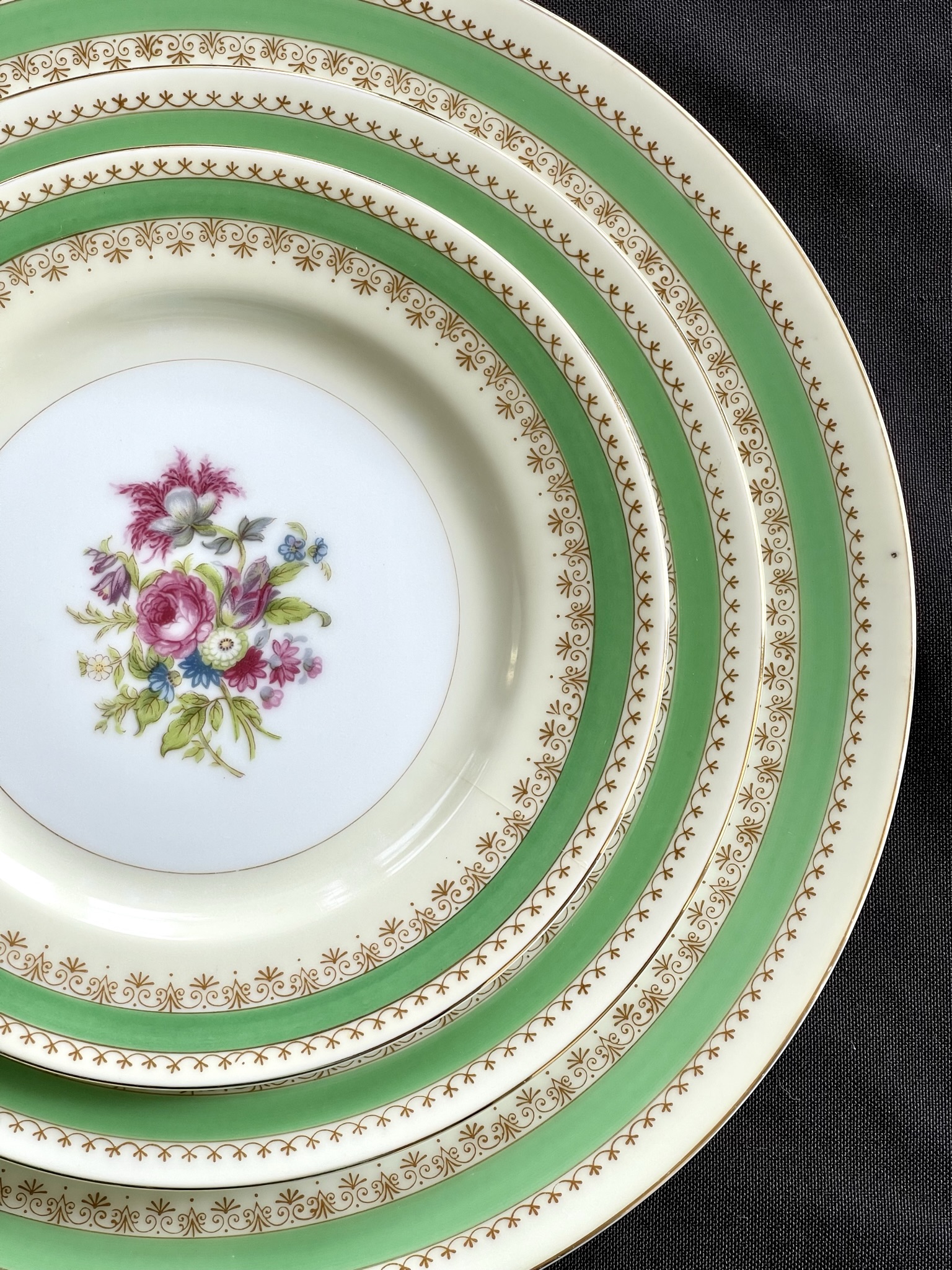
Green Filigree
Japan, c. 1950s–1960s
Three sizes nested — dinner, salad, bread — in apple green and gold filigree. The filigree pattern looks like ironwork, like the garden gate rather than the garden itself. Formal. Purposeful. Made for a particular kind of afternoon that may never come again. The stacks are complete. Someone kept them all.
Lime & Gold
Japan, c. 1920s–1930s
When the formal girls gather, she is the one who commands the room. The lime green against the gold, the gold against the cream — she knows exactly what she is and makes no apology for it. Grand. Unapologetic. Entirely herself.
The Cup
This is where it started.
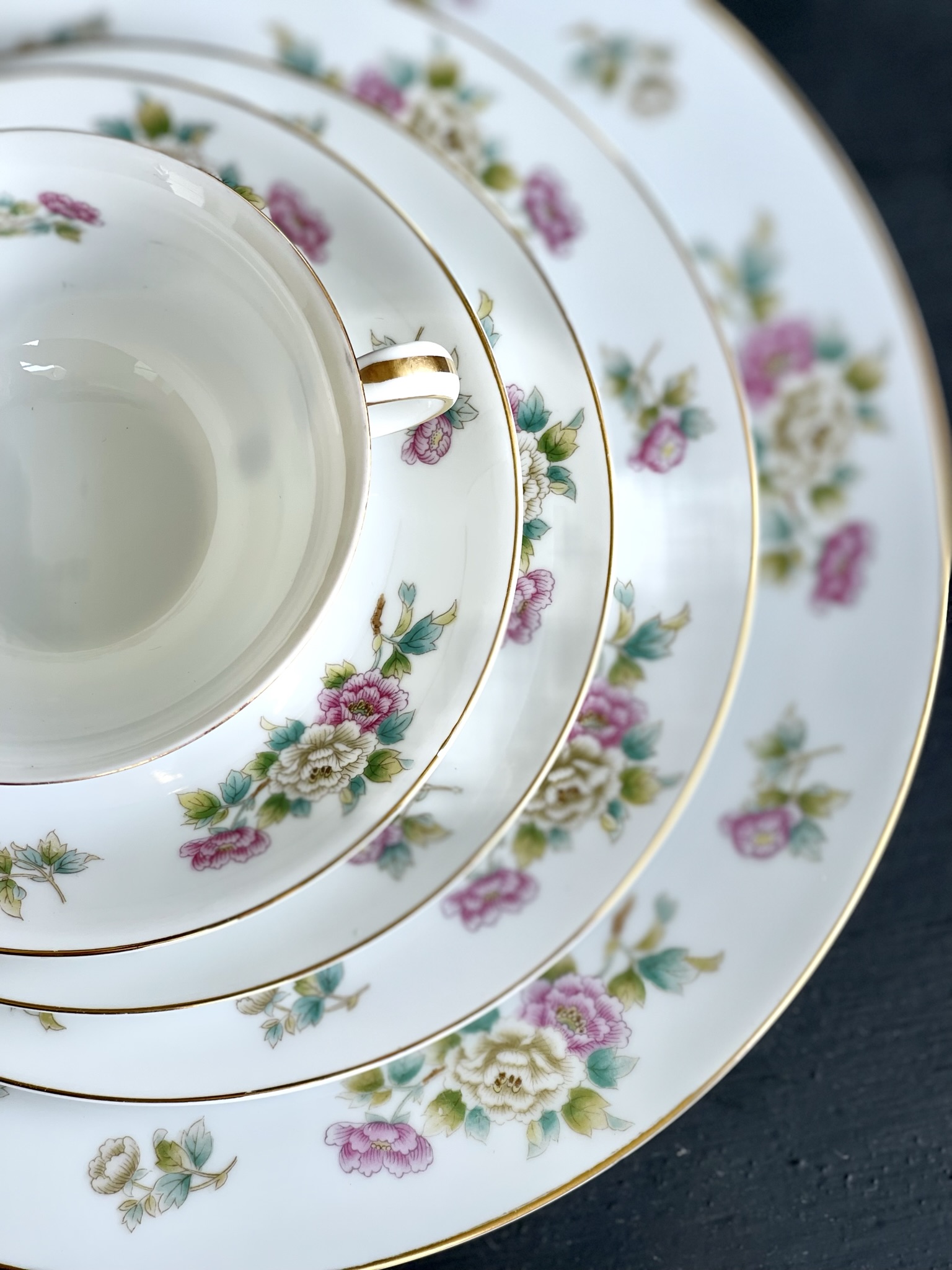
The Cup and Saucer
Japan, mid-20th century
The peony was the queen of Japanese export china — the flower that appeared again and again on the finest services, chosen not for whimsy but for meaning. In Japanese tradition, the peony signals prosperity, good fortune, the highest possible life. When Japanese makers translated that meaning into porcelain for Western households, the peony traveled with it — a blessing painted on every plate. This is a fine set, found at an upscale resale shop: complete, exquisite, impeccably kept. Whoever had it before understood what they had. The plate, the saucer, the cup: a world in three circles. I didn't know it was the beginning of something. I thought I just liked the flowers.
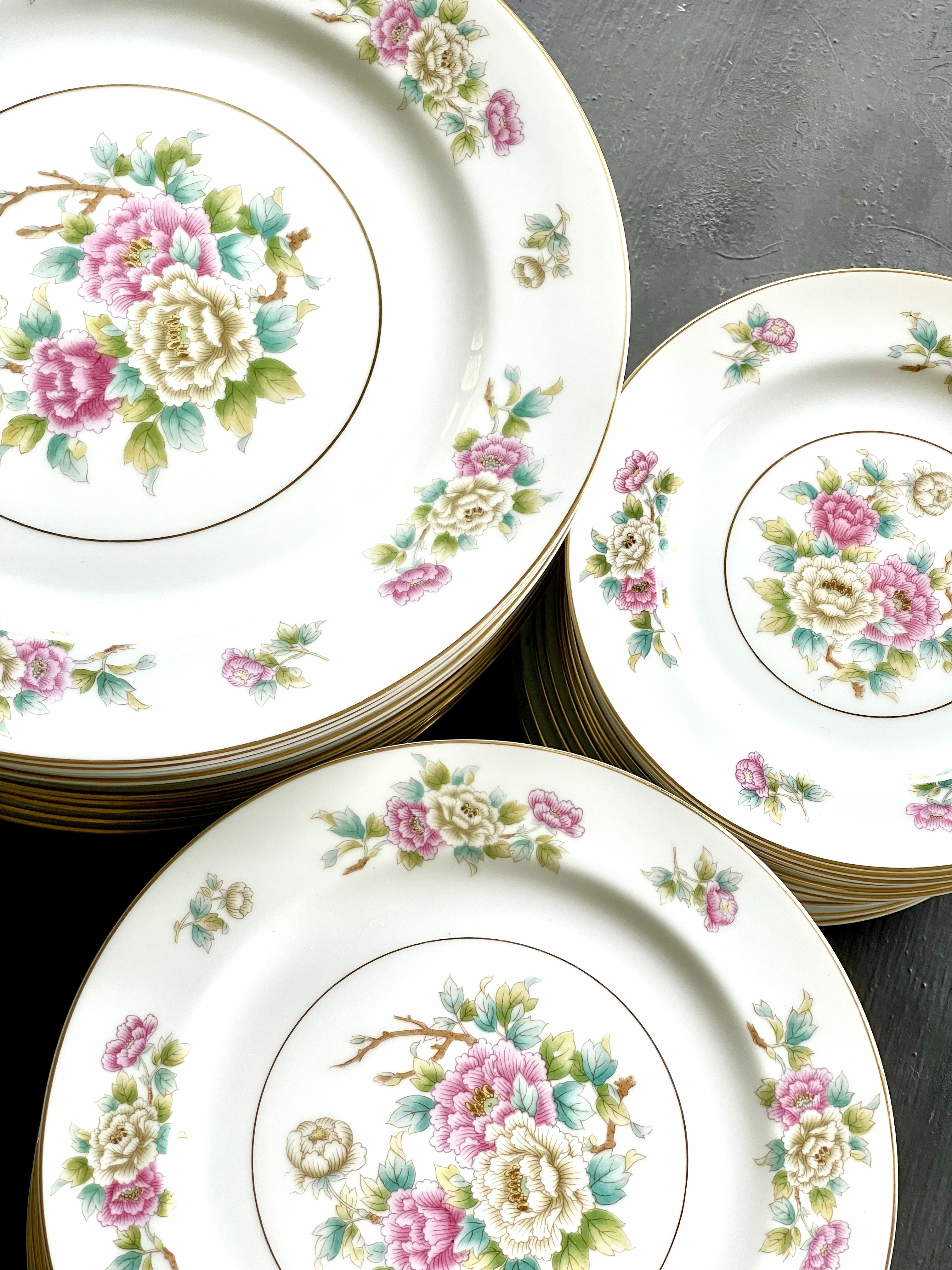
The Full Peony Service
Japan, mid-20th century
Three stacks. Three sizes. The cup and saucer was the beginning — this is what came with it. Dinner plates, salad plates, bread plates, all in the same pattern, all complete. Someone set this table for years. The peony at the center of every plate, every meal, every gathering. I didn't know when I found the cup that the whole story was still out there waiting.
Why Flowers
Flowers are among humanity's oldest languages.
We use them to mark births, courtships, marriages, illnesses, victories, deaths, apologies, remembrance, and return. We plant them over graves. We carry them into hospitals. We place them on tables when we want an ordinary day to feel significant.
Porcelain flowers do something living flowers cannot: they refuse to fade.
The rose painted on a plate in 1912 is still opening. The violets chosen for a bride remain in bloom long after everyone at the wedding has gone.
That permanence is part of what connects this collection to Floral Alchemy. Both begin with flowers, but neither is only about flowers. They are about attention, memory, craftsmanship, inheritance, and the human need to preserve beauty in the presence of impermanence.
The history of flowers is the history of us.
A floral plate is not really about flowers. It is about saying: this house is still civilized.
We still gather. We still invite people. We still cook. We still celebrate birthdays. We still believe tomorrow deserves a beautiful table.
Flowers become shorthand for hope.
The Complete Service
Most sets arrive missing pieces. A cup with no saucer. Eight dinner plates and four salads. The tureen but no ladle. Time takes its toll and families divide their inheritances unevenly and things break and the ones that break are never replaced because who replaces things anymore.
To find a complete service — every piece type, every size, the cups and the saucers and the serving bowls and the tureen — is to find a household that held together. That took care of things. That believed enough in the future to keep the whole set intact.
This is the rarest find. This is the one you don't walk past.
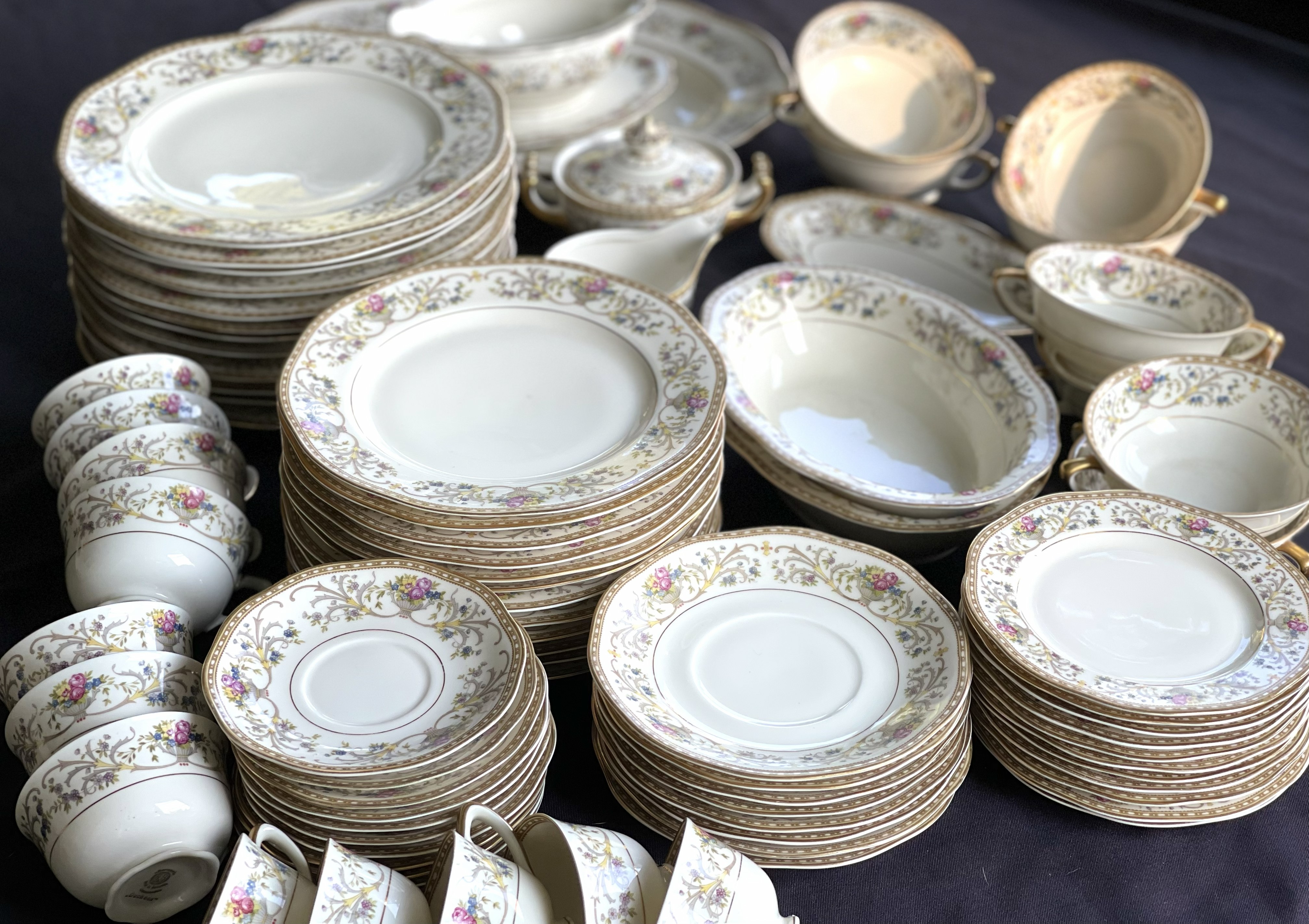 The complete service — every piece, every size, all intact
The Meeting Place
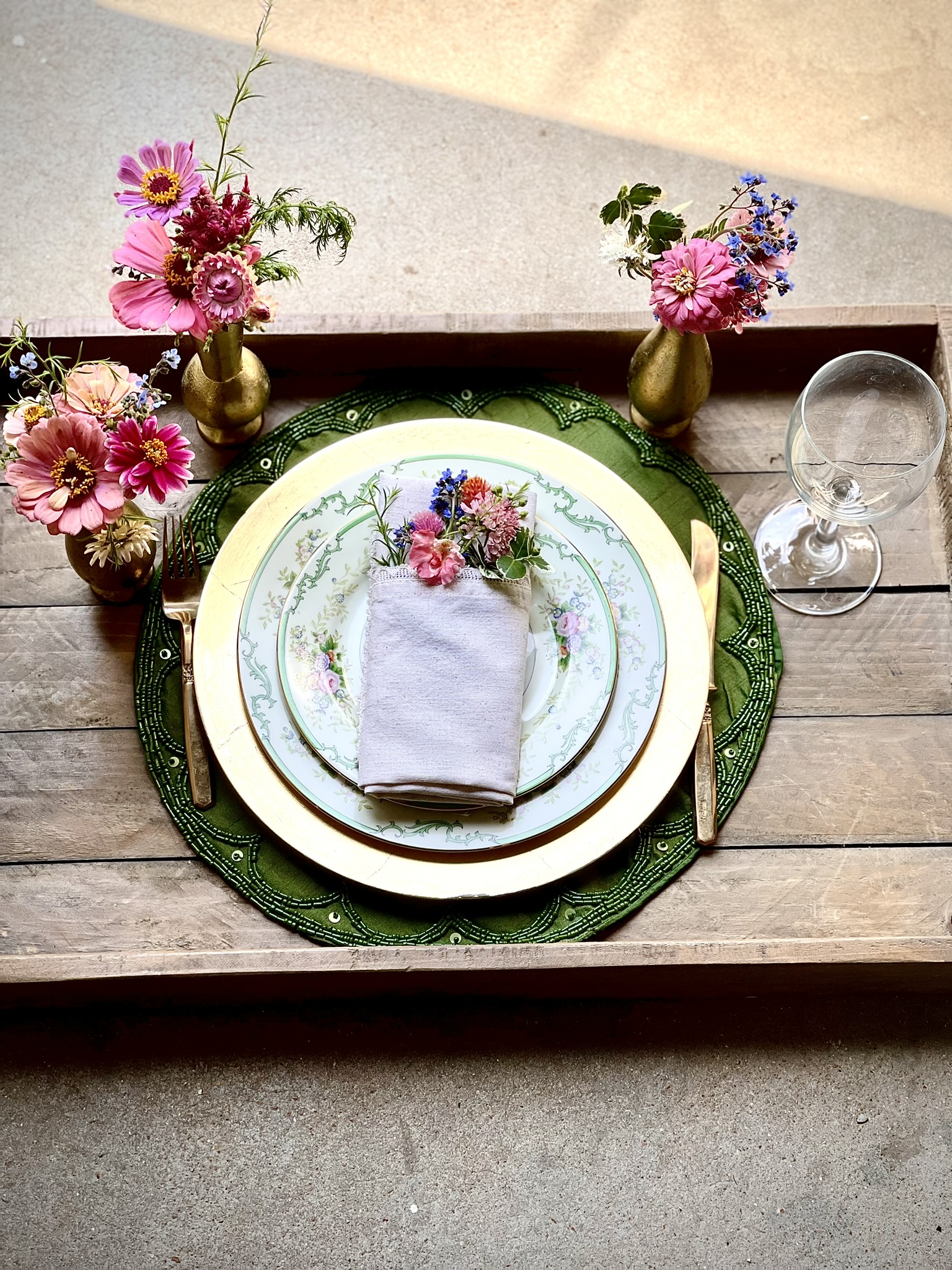
This summer, the two obsessions met at a weathered white table in the garden. Vintage china plates — women's choices from another century — filled with flowers grown from this land. Living flowers placed inside painted flowers. The thing that fades inside the thing that doesn't.
This is the answer to both questions at once.
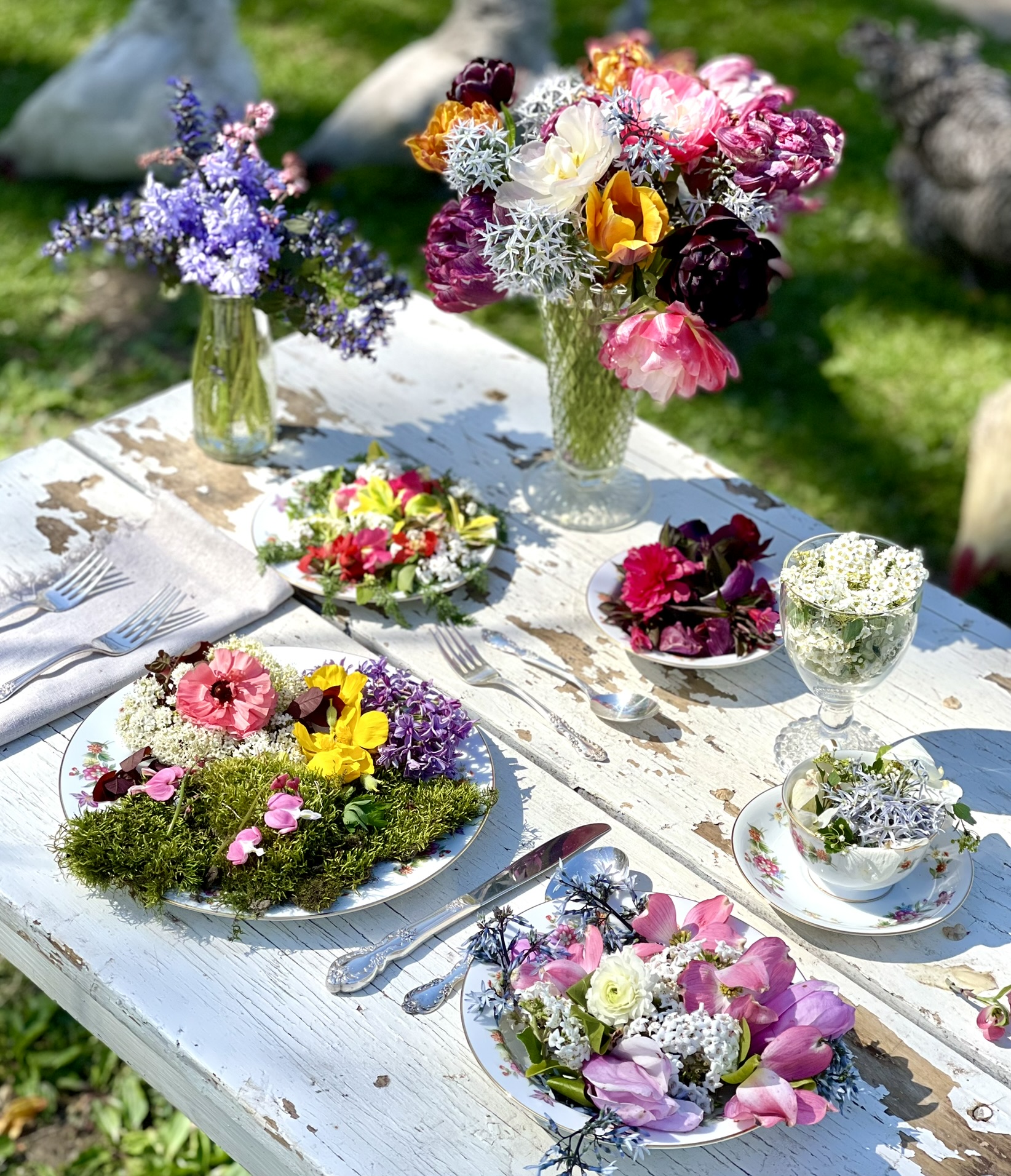 Garden flowers in vintage china — the two obsessions, unified
You are not accumulating objects.
You are assembling a chorus.
Each manufacturer. Each country. Each decade. Each war. Each change in women's lives. Each evolution in taste. Each immigration. Each economic recovery. Each household. Each flower.
They're all speaking at once. You're simply learning how to listen.
Every plate is a pressed flower from someone else's life.
Flowers don't only bloom in gardens. Sometimes they bloom in porcelain, carrying across generations the quiet insistence that, no matter what history has done, there will always be someone who sets the table, pours the tea, invites another person to sit down, and chooses beauty anyway.
Floral china is the domestic art of memory — the flowers people lived with when life was happening.