Wonder Table No. 32
Equipment & mechanics of floral design
They called it a frog because the holes in the glass looked like a frog sitting on a lily pad. That is the whole origin story — someone looked at a small pincushion of bubbled glass and saw something alive in it, and the name stuck.
Long before floral foam existed, the frog was how you held a flower in place. It still is — if you know what you're doing. The kenzan, the wire grid, the glass bubble frog, the wire dome, the chicken wire disc. Each one works differently. Each one rewards a different kind of stem, a different shape of vessel, a different intention. And each one will outlast you if you treat it right.
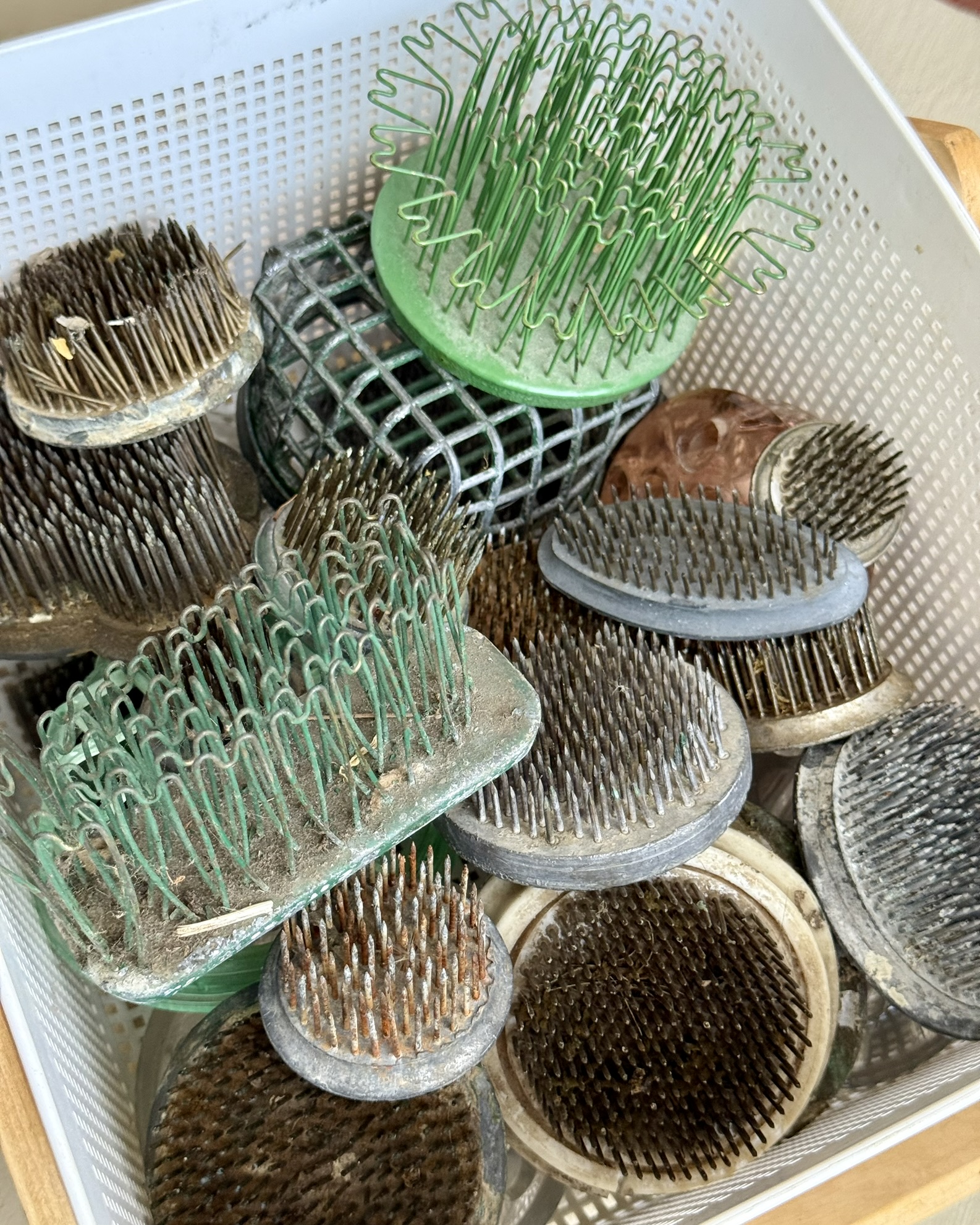
I have been collecting the vintage ones for years. The kenzans especially — their pins oxidized to dark bronze, the lead base heavy in the hand, made to last longer than anyone expected them to. You find them at estate sales, in the back of antique shops, in the tool drawers of grandmothers who arranged flowers the old way. Someone always used them well.
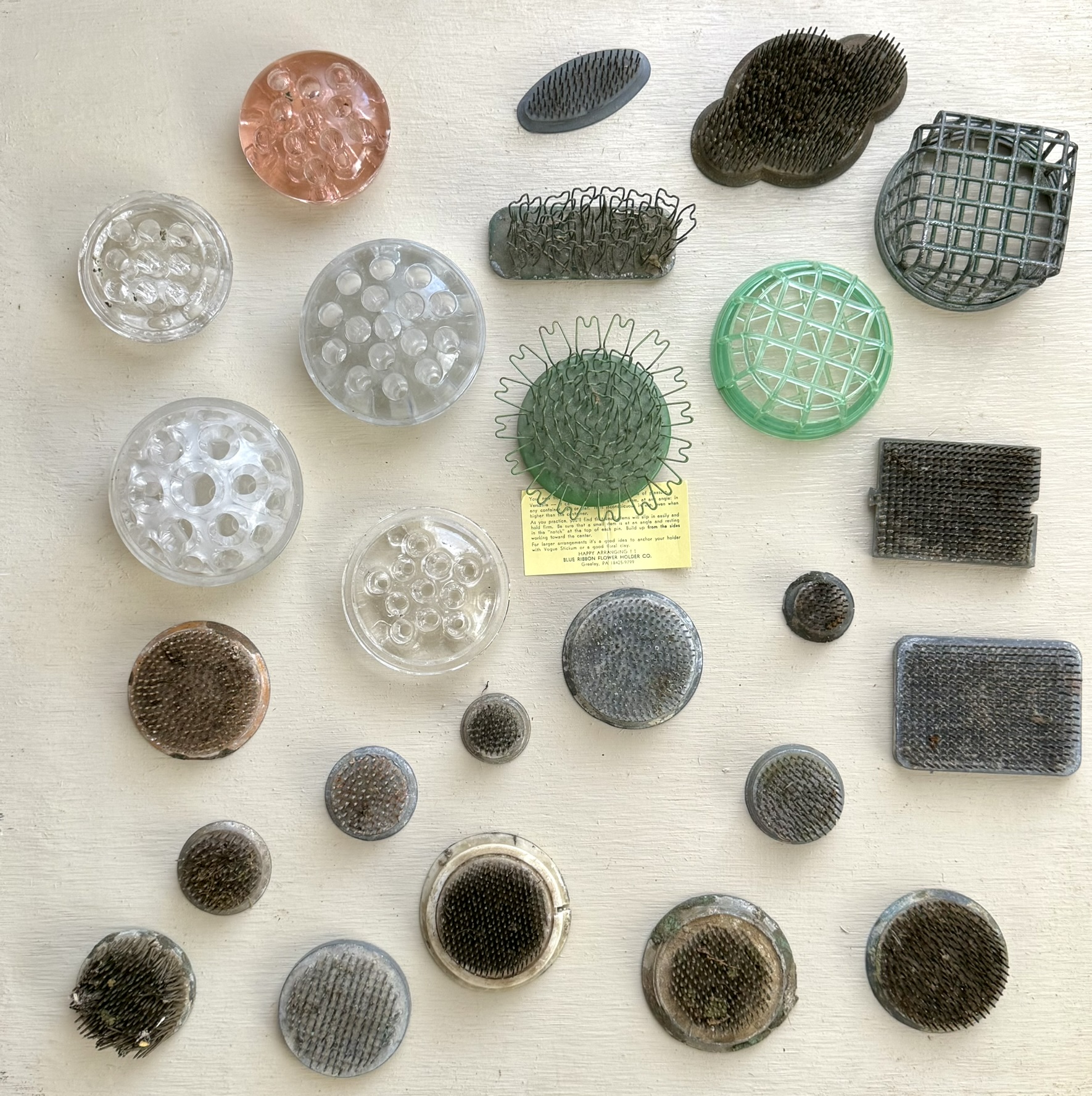
The Kenzan — Japanese in origin, a bed of upright pins soldered to a weighted lead base. You press the stem down and the pins hold it at whatever angle you choose. Angled stems, branchy stems, woody stems — they all go in. The kenzan is honest work: you have to mean each stem. There is no vagueness with a kenzan. It asks you to decide.
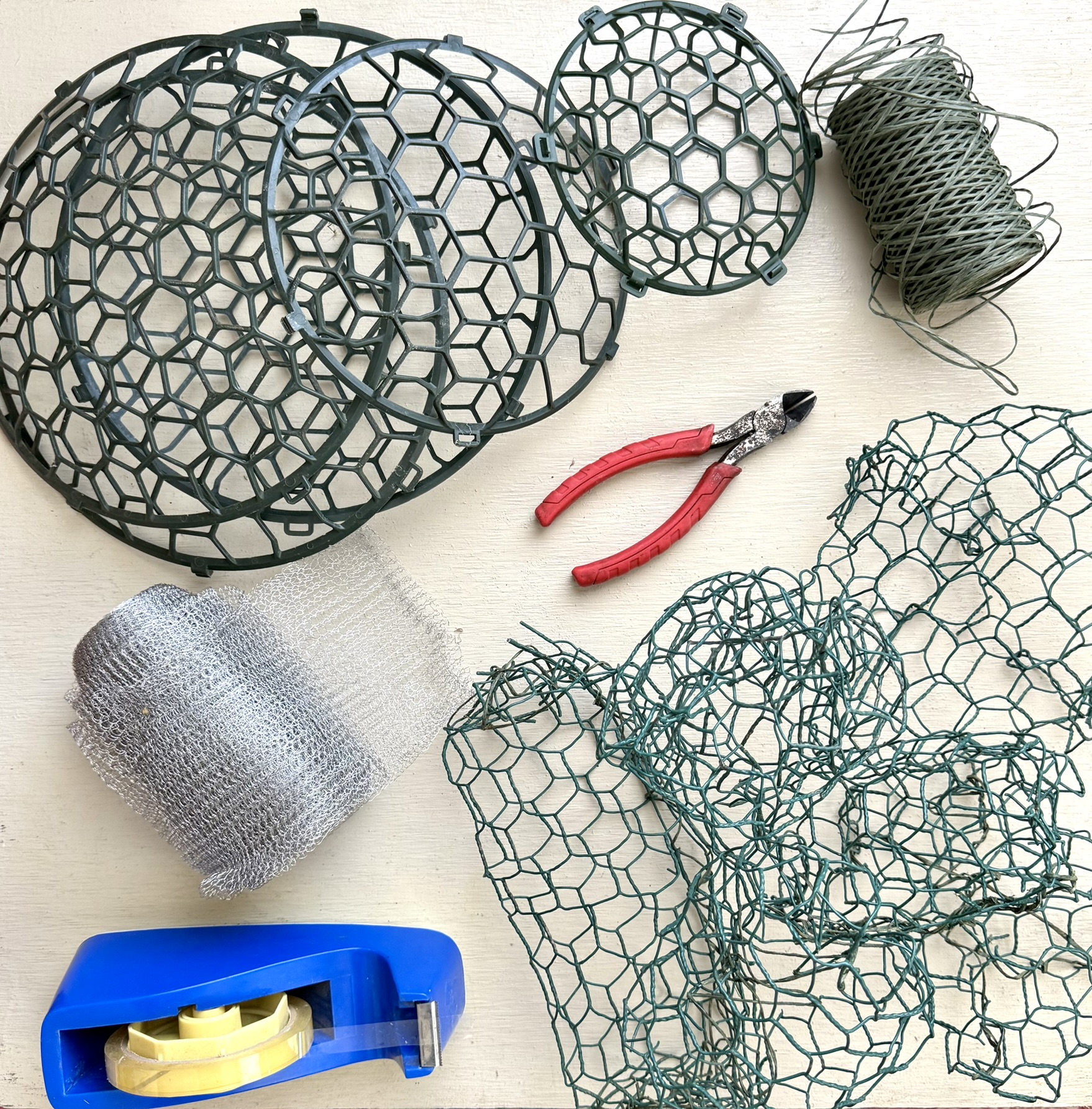
The Wire Grid — a flat disc of welded wire, cut to fit the mouth of a vase or bowl. Stack three in a deep vessel and you have architecture. Stems thread through the grid and cross-support each other, the whole arrangement becoming more stable as it grows. The wire grid is collaborative: the flowers hold each other in.
The Glass Frog — Depression-era, often pink or clear, with raised bubble holes arranged in rings. Beautiful even empty. Each stem sits in its own chamber, surrounded by water on all sides. These are the most forgiving: you can move a stem without starting over, pull it out and place it again without disturbing anything else. The glass frog is patient.
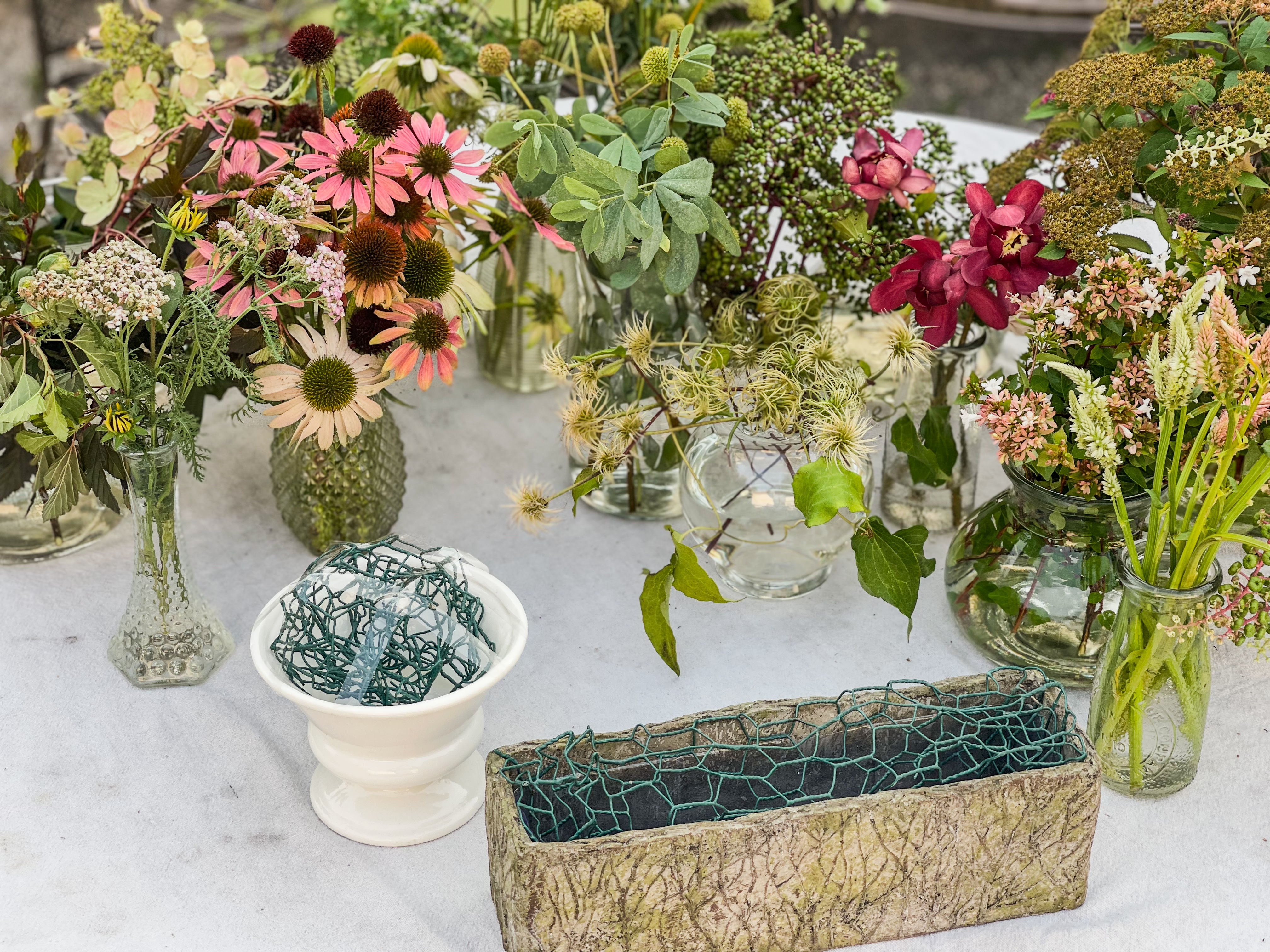
The Dome and the Cage — bent steel wire or coiled wire mesh, packed into a vessel and compressed to fit. Use them in tall urns, in buckets, in anything with a wide opening that needs the stems to anchor somewhere in the middle instead of leaning against the sides. These are the most improvisational of the frogs. You shape them to the problem.
The collection — kenzans, glass frogs, wire grids, domes & cages
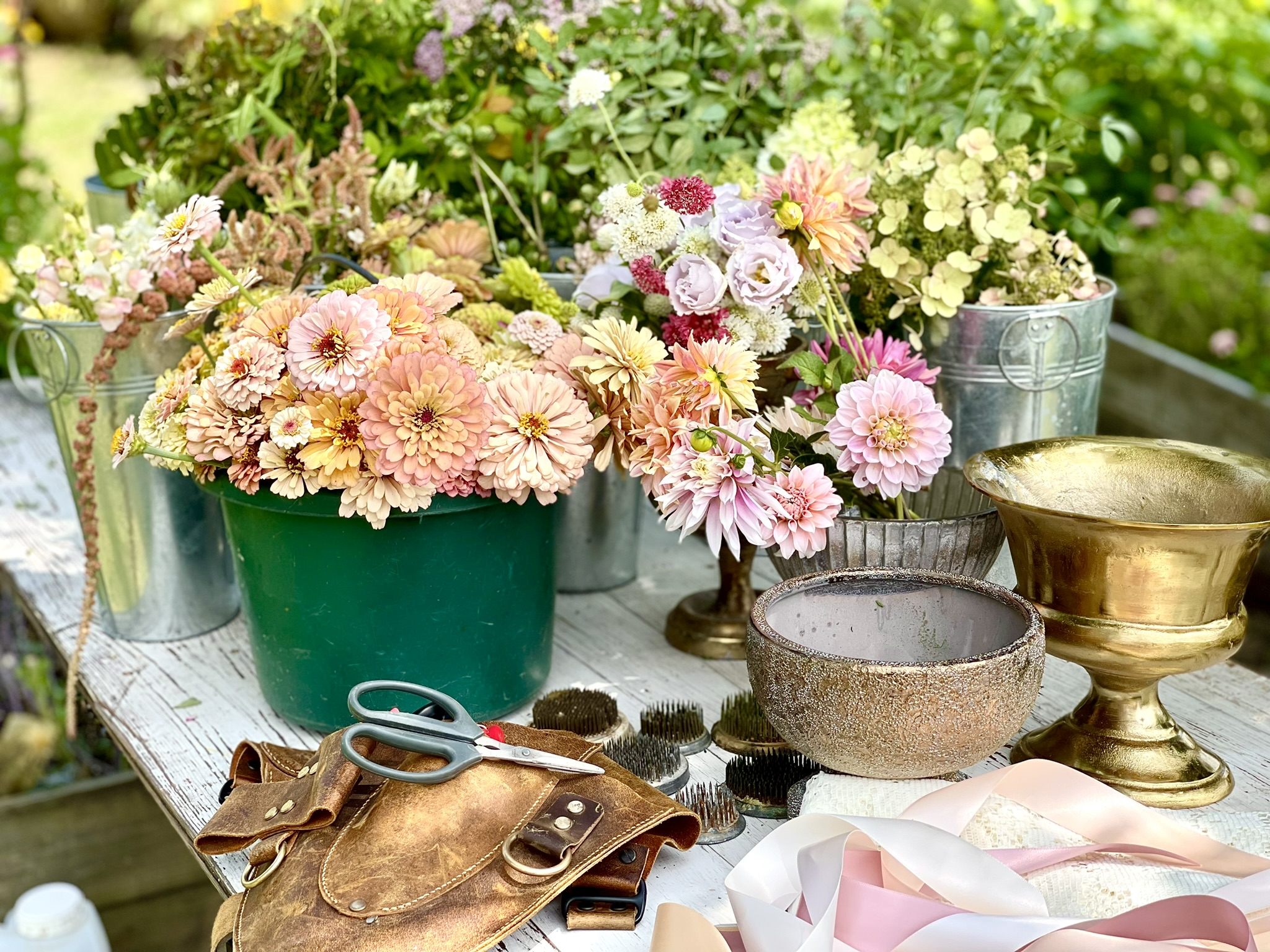
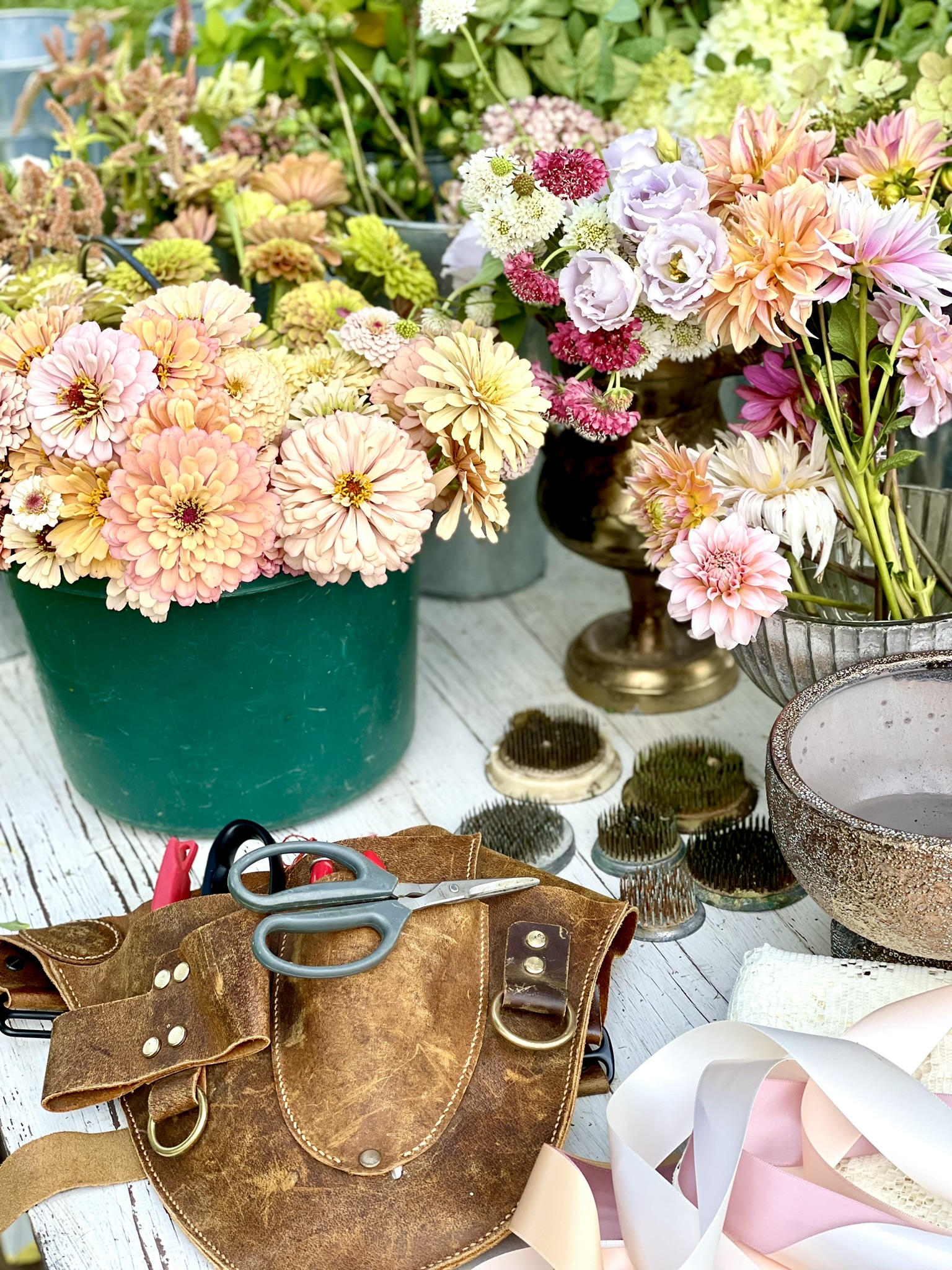
The snips are the most important thing on the table. Not one pair — five. Each one does something the others don't. The long floral shears for thick stems. The bypass pruners for woody branches. The compact snips for tight angles. The Japanese precision scissors for close detail work. The OASIS knife for anything that needs a clean diagonal cut at the base.
Around them: three kinds of twine — cotton, jute, and waxed green. Floral tape, which bonds to itself only when stretched. Stem wire in three gauges. Copper wire for wrapping. Green paddle wire for binding. Rubber bands, because sometimes the simplest solution is the right one. A turntable, so you can read the arrangement from every angle without picking it up and turning it.
The leather tool pouch holds the things you reach for most — the ones that would otherwise migrate across the table. A tag and a pen, always. You find things you don't remember finding, and you have to write it down before it's gone.
And gloves. Two pairs. The ones you started with, and the ones you find when those are wet.
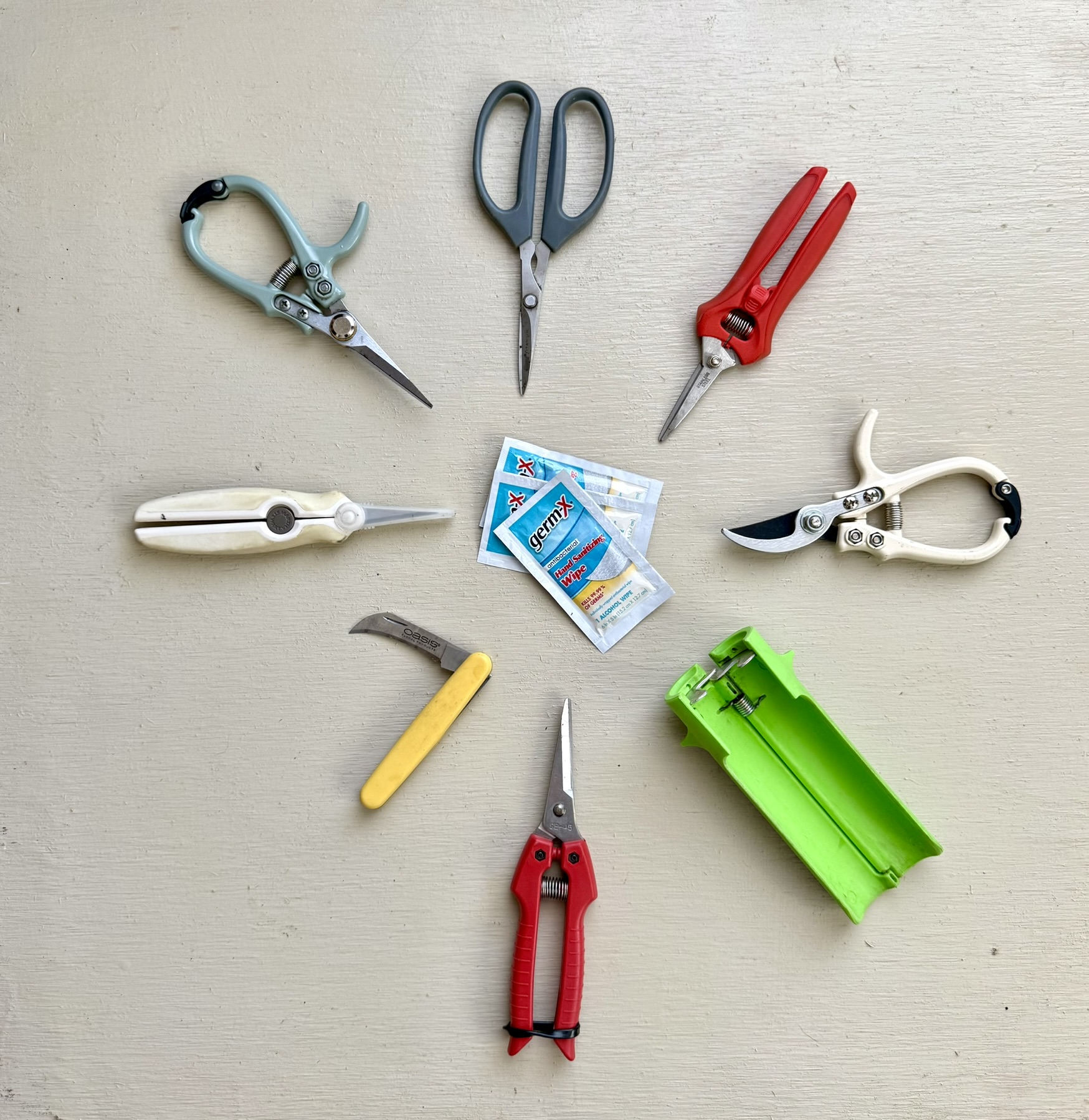
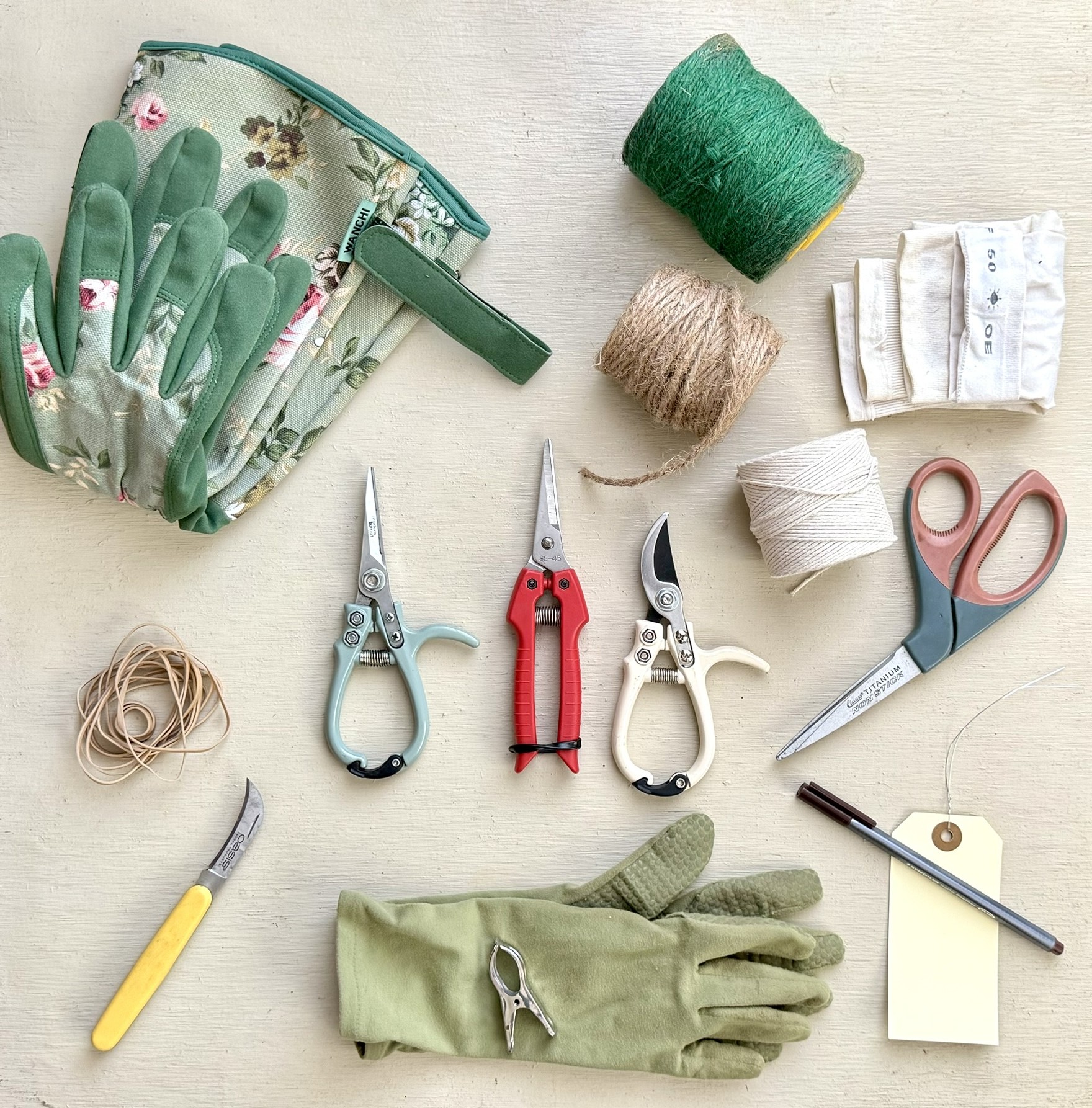
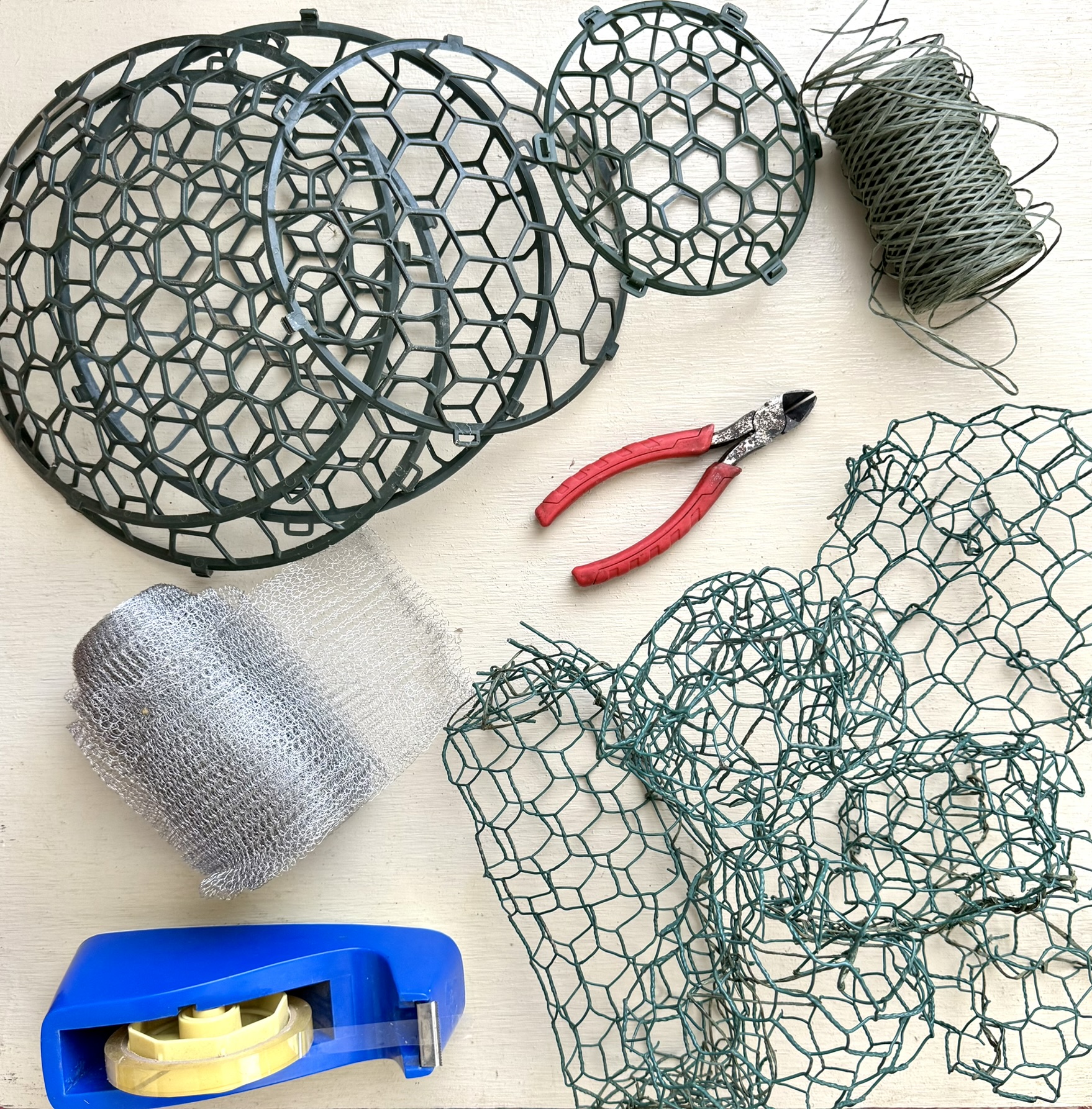
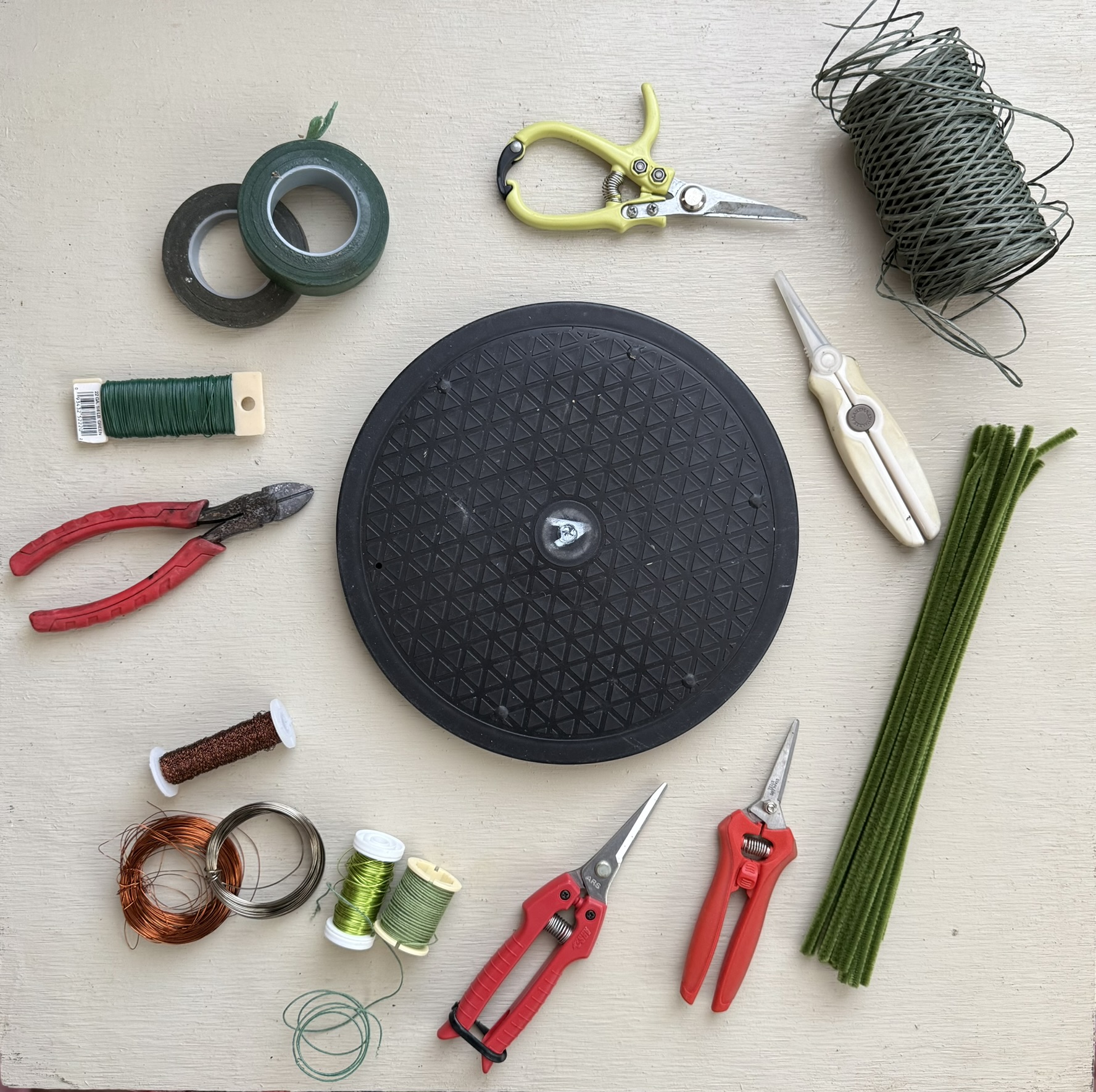
The kit — six slides, everything on the table before the flowers arrive
This is what it looks like before the flowers arrive — before the stems, before the water, before the decisions. The kit is already a kind of intention.
The design table is never tidy. That is not what it is for. Clippings on the floor. Stems in the wrong bucket. A jar of water that got knocked over and righted again without comment. The table is where you think with your hands, and thinking with your hands is not a clean process.
What happens there: you see which stems want to lead and which ones want to follow. You find the angle that makes everything else fall into place. You put a stem in, pull it out, put it back in a different position, and realize the second placement was right for a reason you couldn't have named in advance. The frog holds your indecision without complaint. It holds the arrangement while you walk away to look.
From harvest bucket to finished arrangement — the complete sequence. The flowers came from the field twenty feet away. The kenzan was already in the urn.
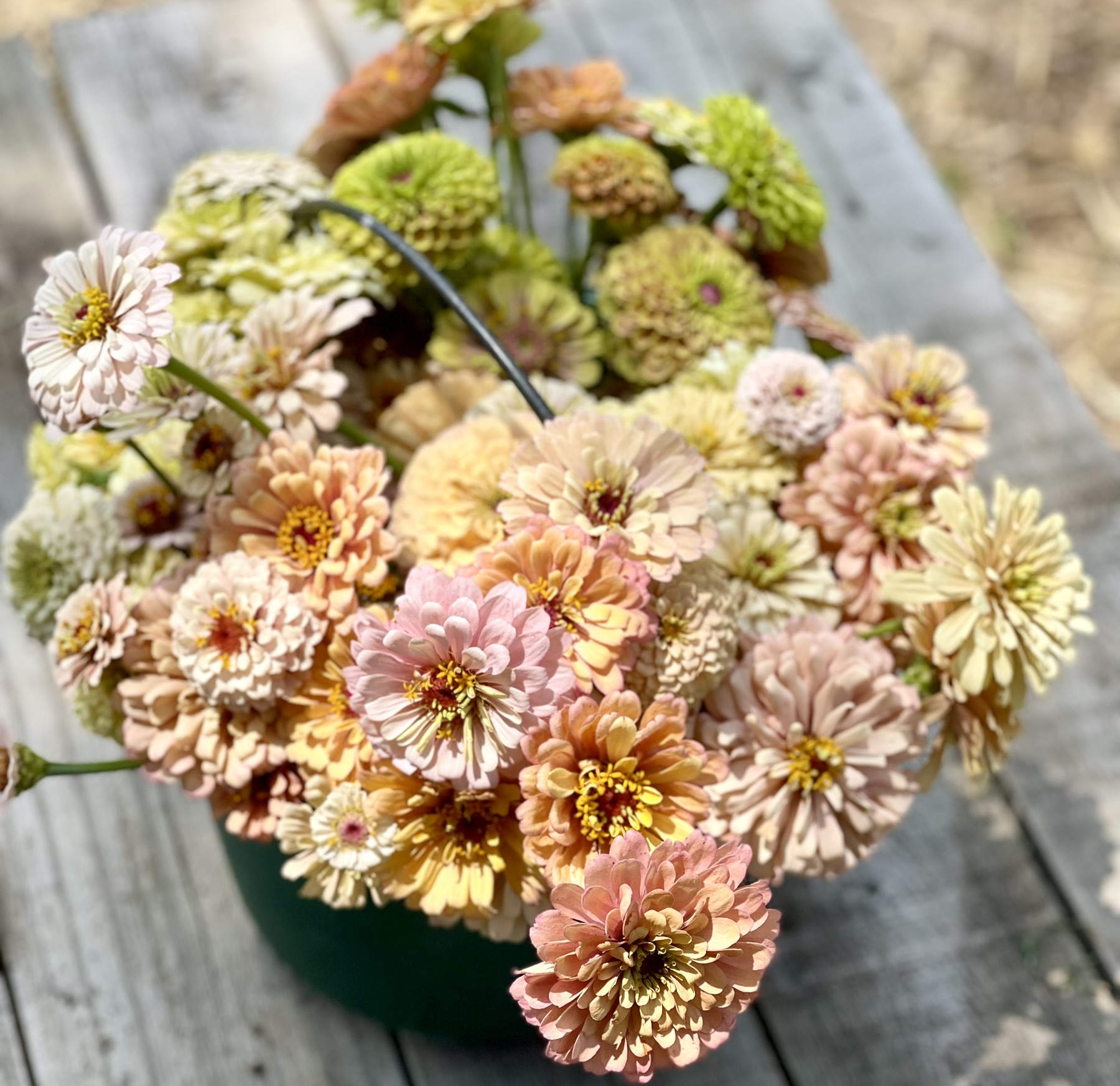
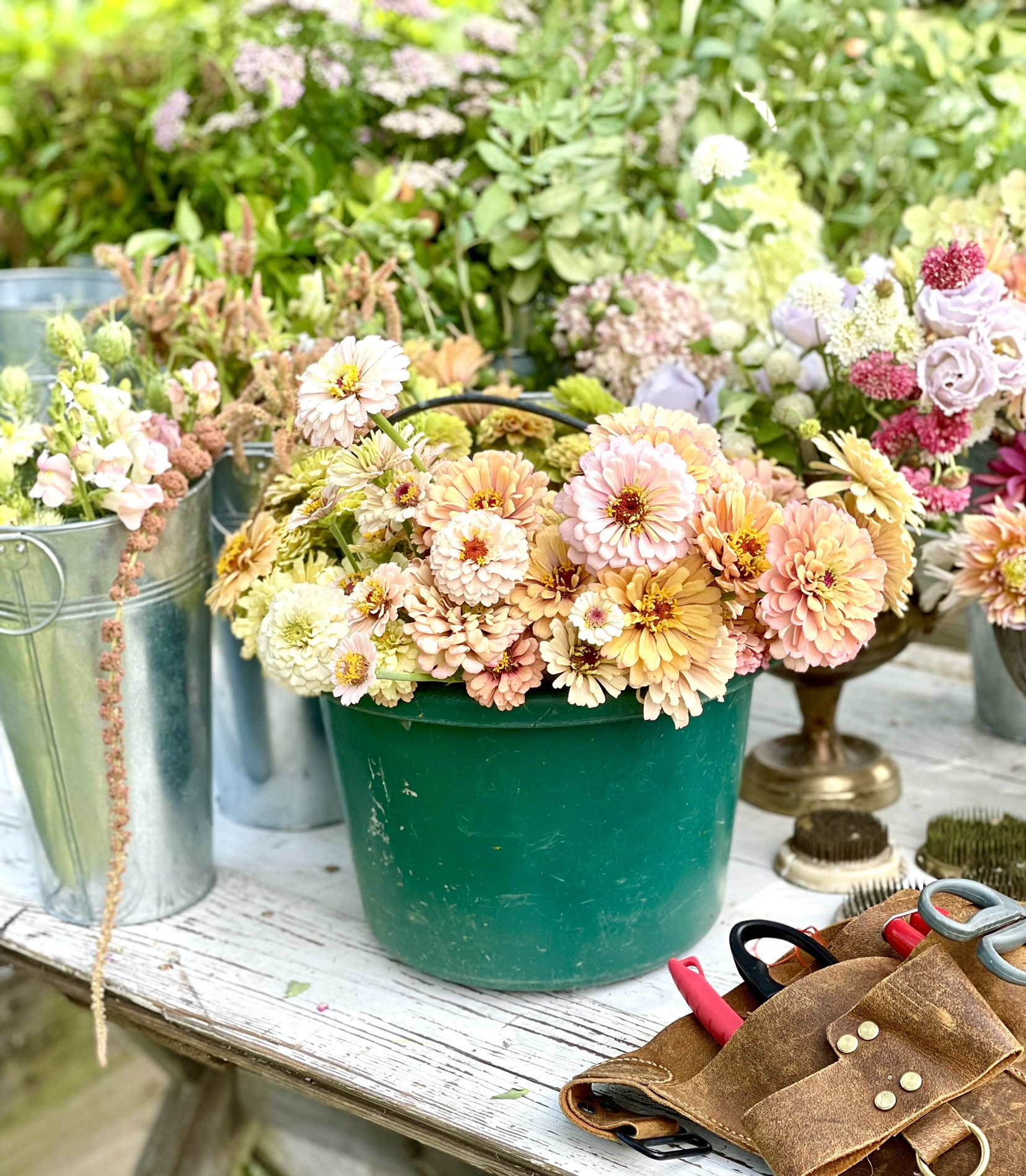
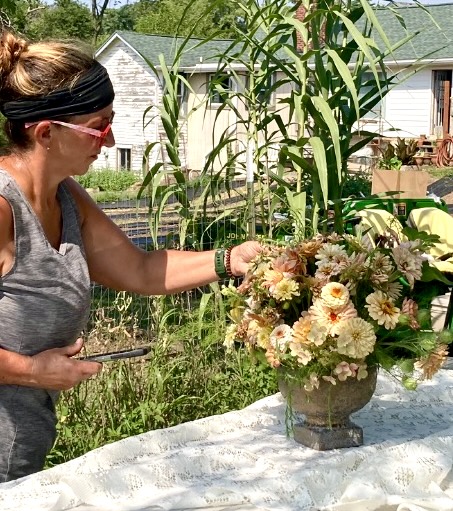
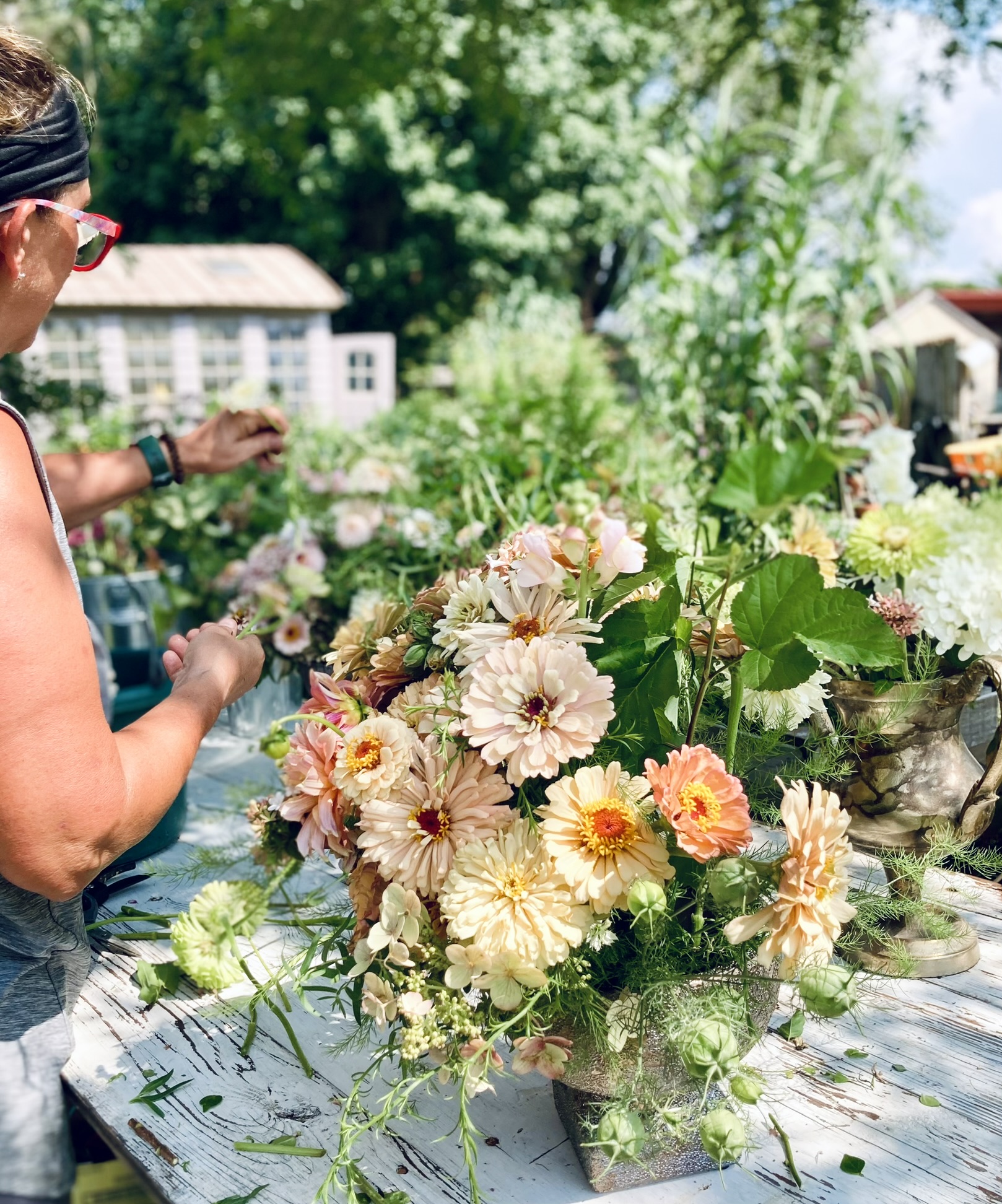
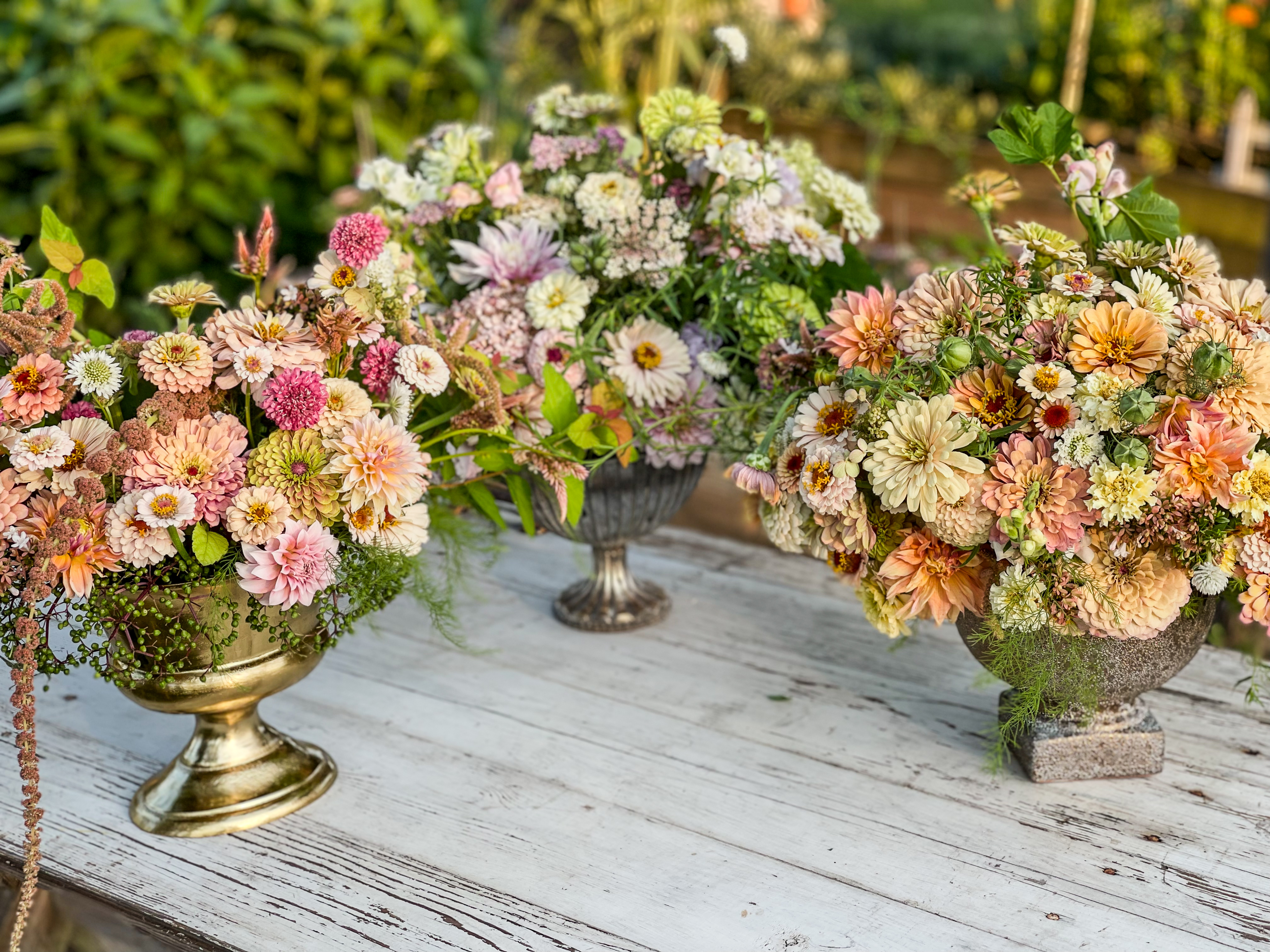
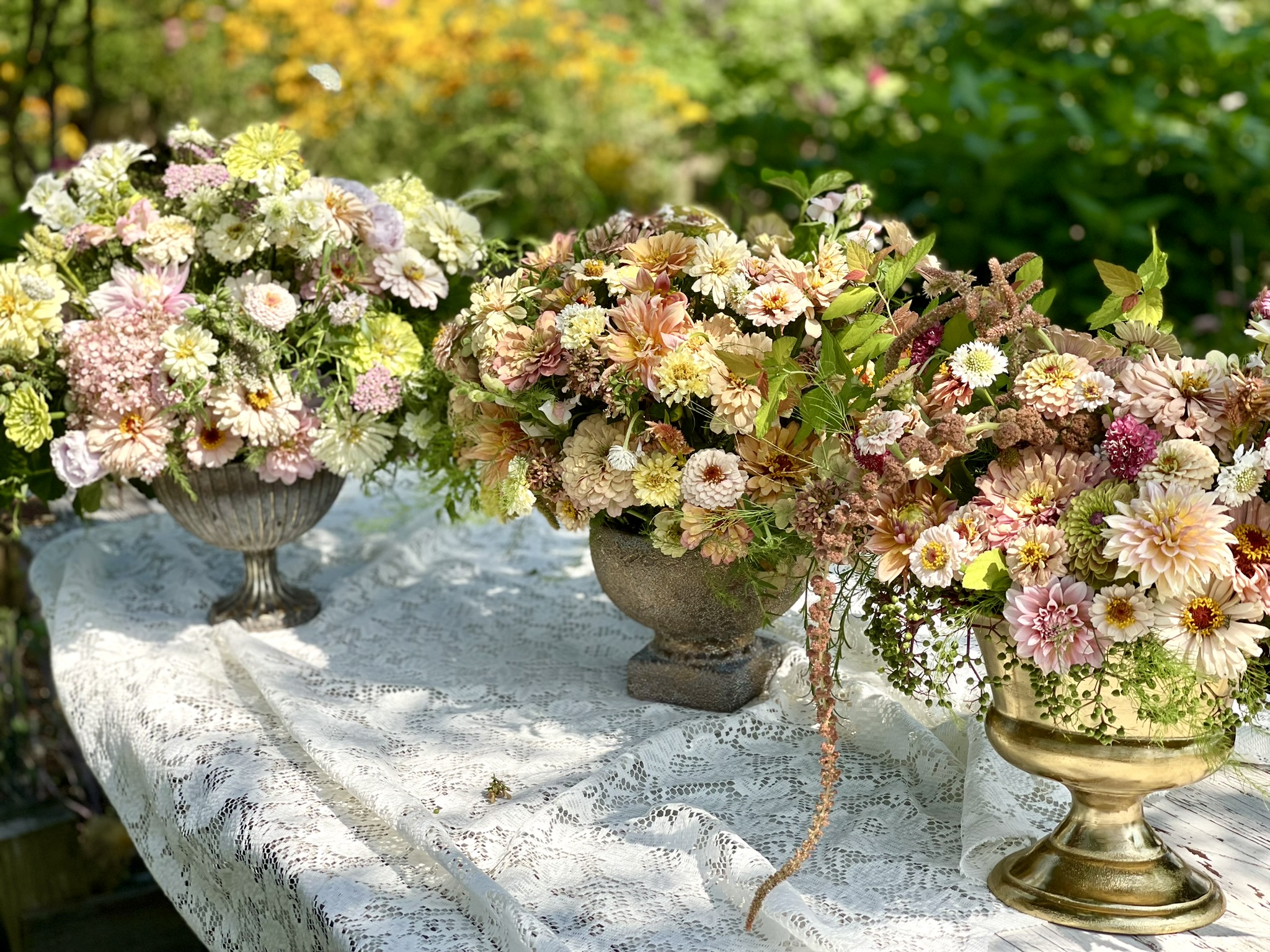
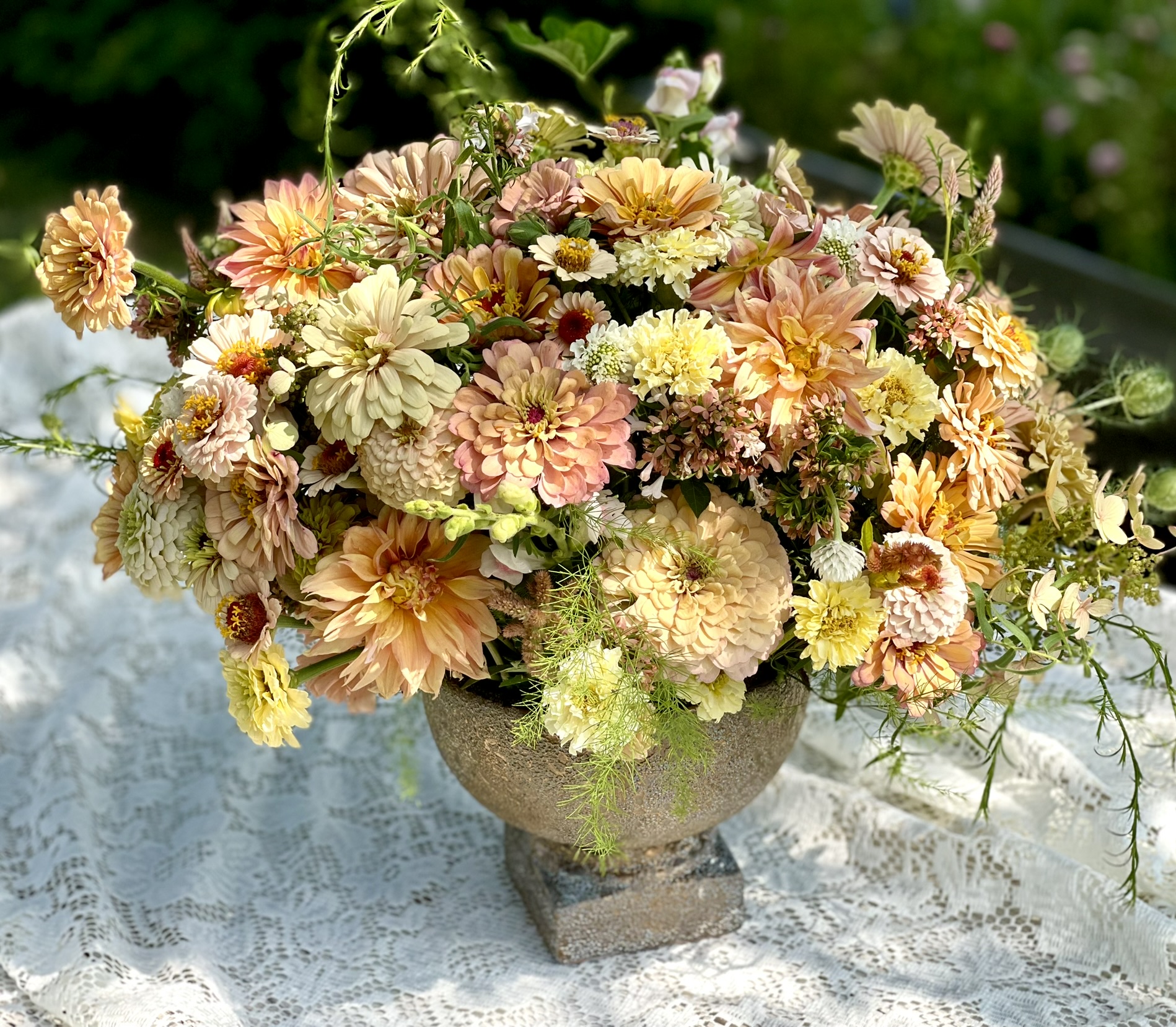
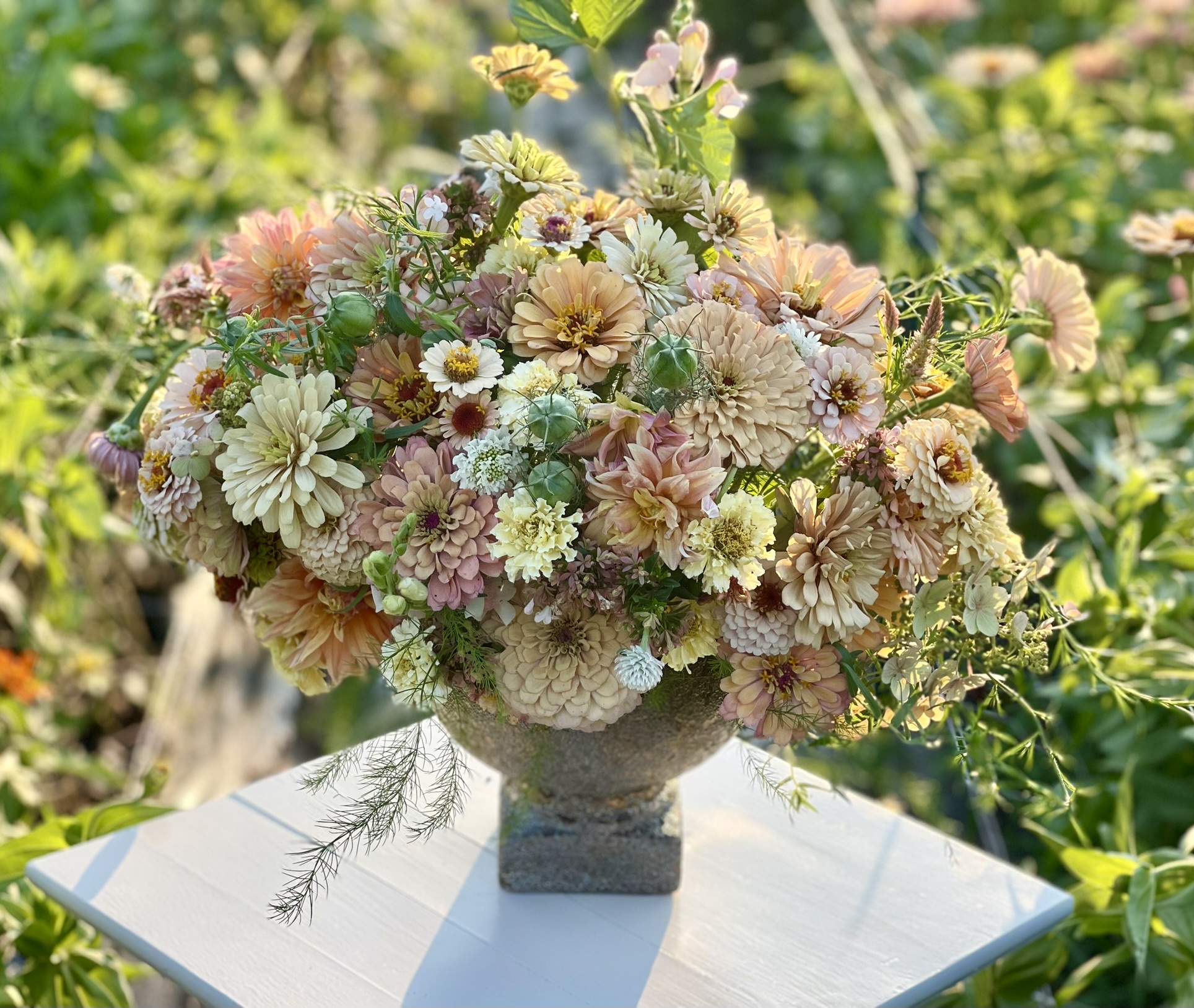
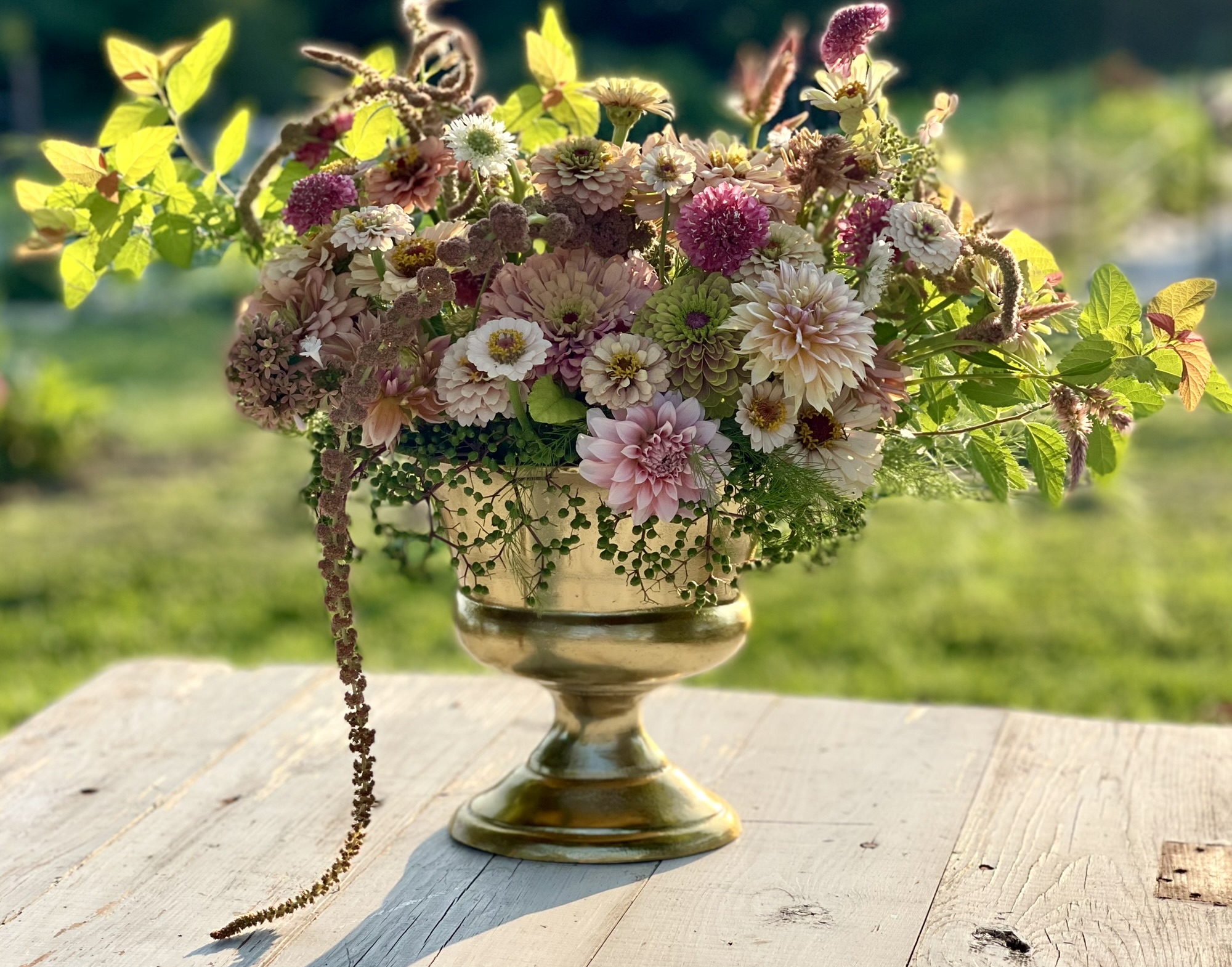
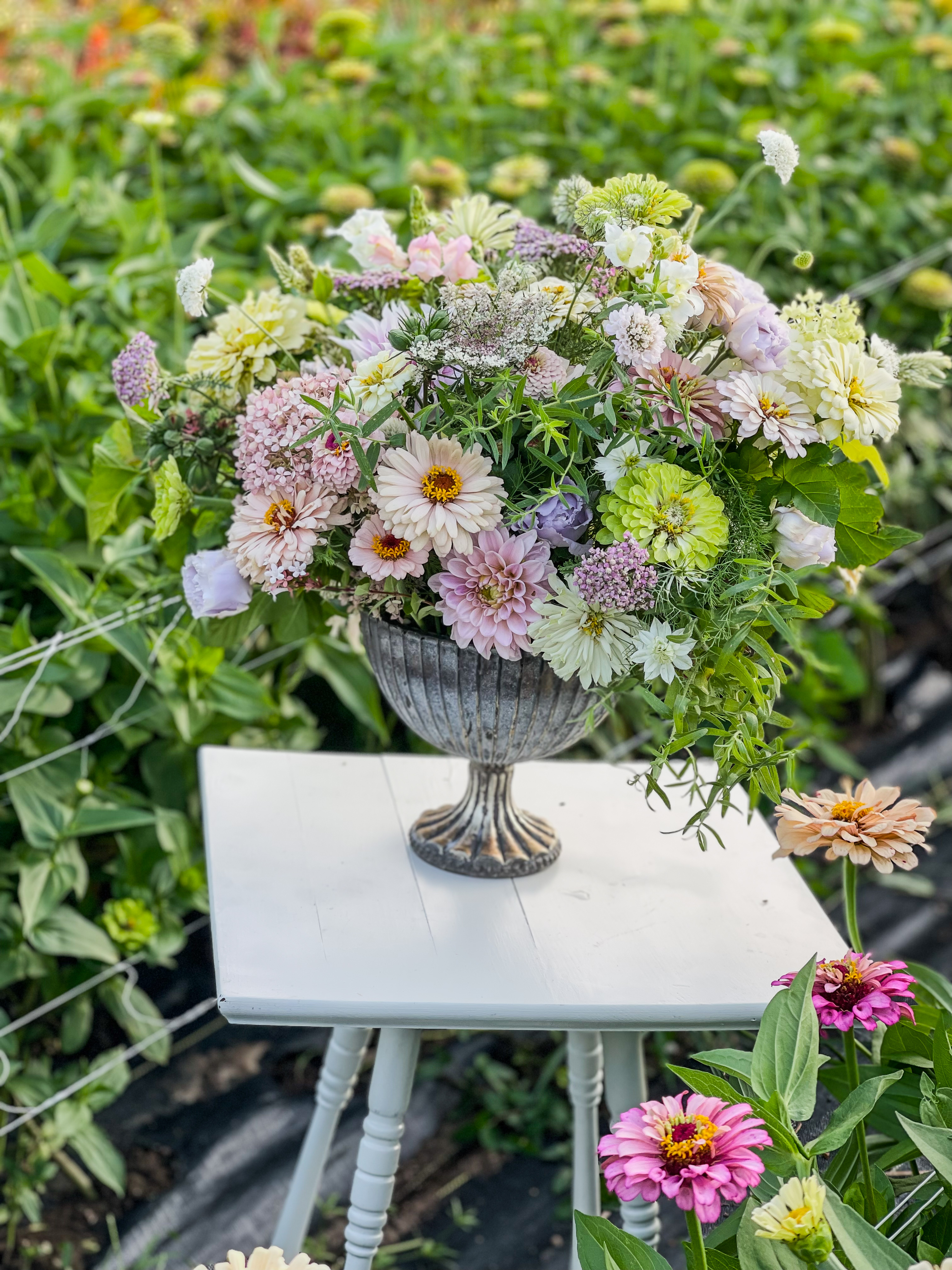
The zinnia table — twelve steps, one kenzan, one season's crop
The same wire that sits invisible in a vessel holds the coneflower upright, keeps the fern arching at its angle, anchors the seedhead that trails over the rim. Vessel by vessel, the frog disappears and the arrangement remains.
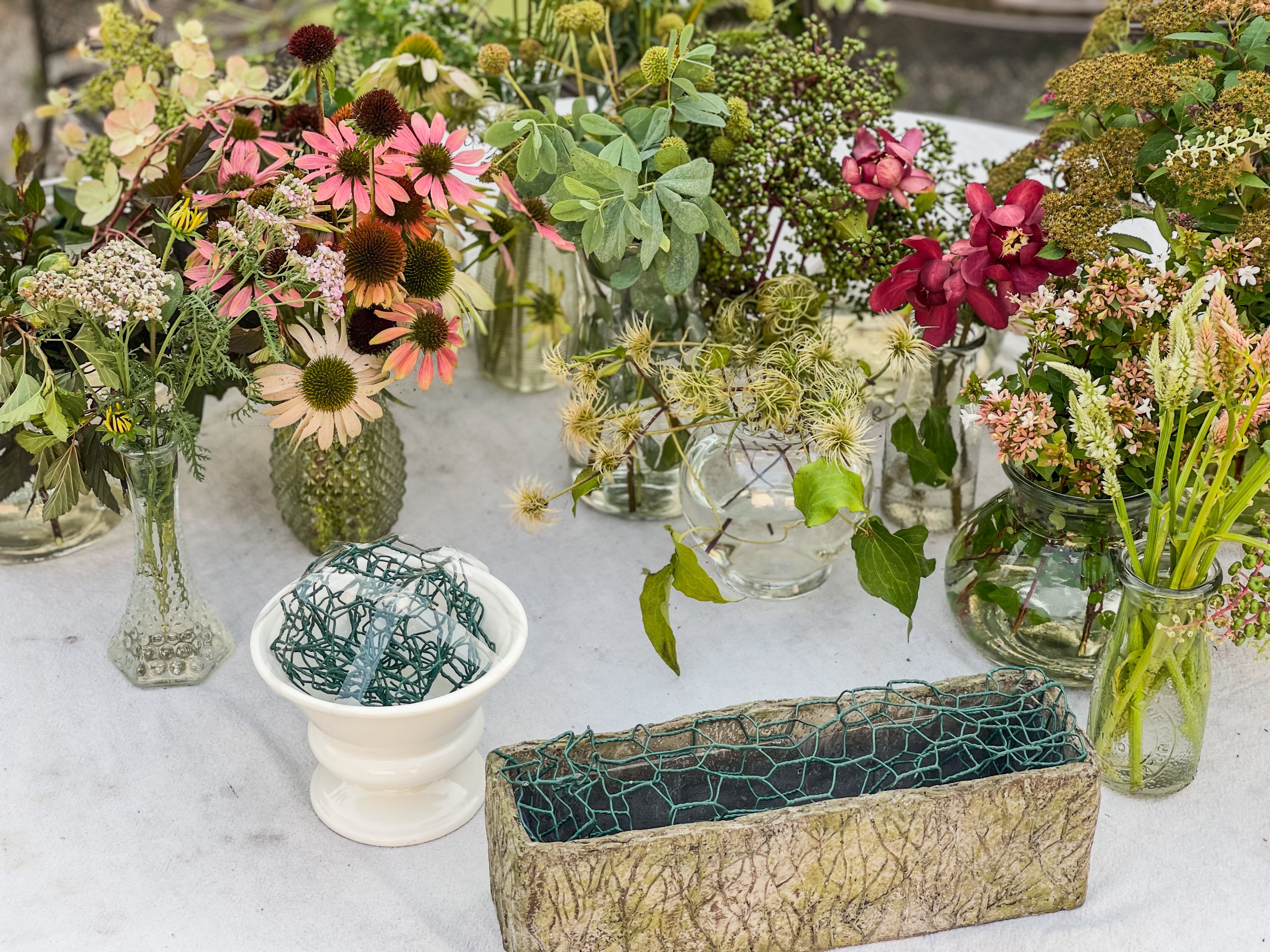
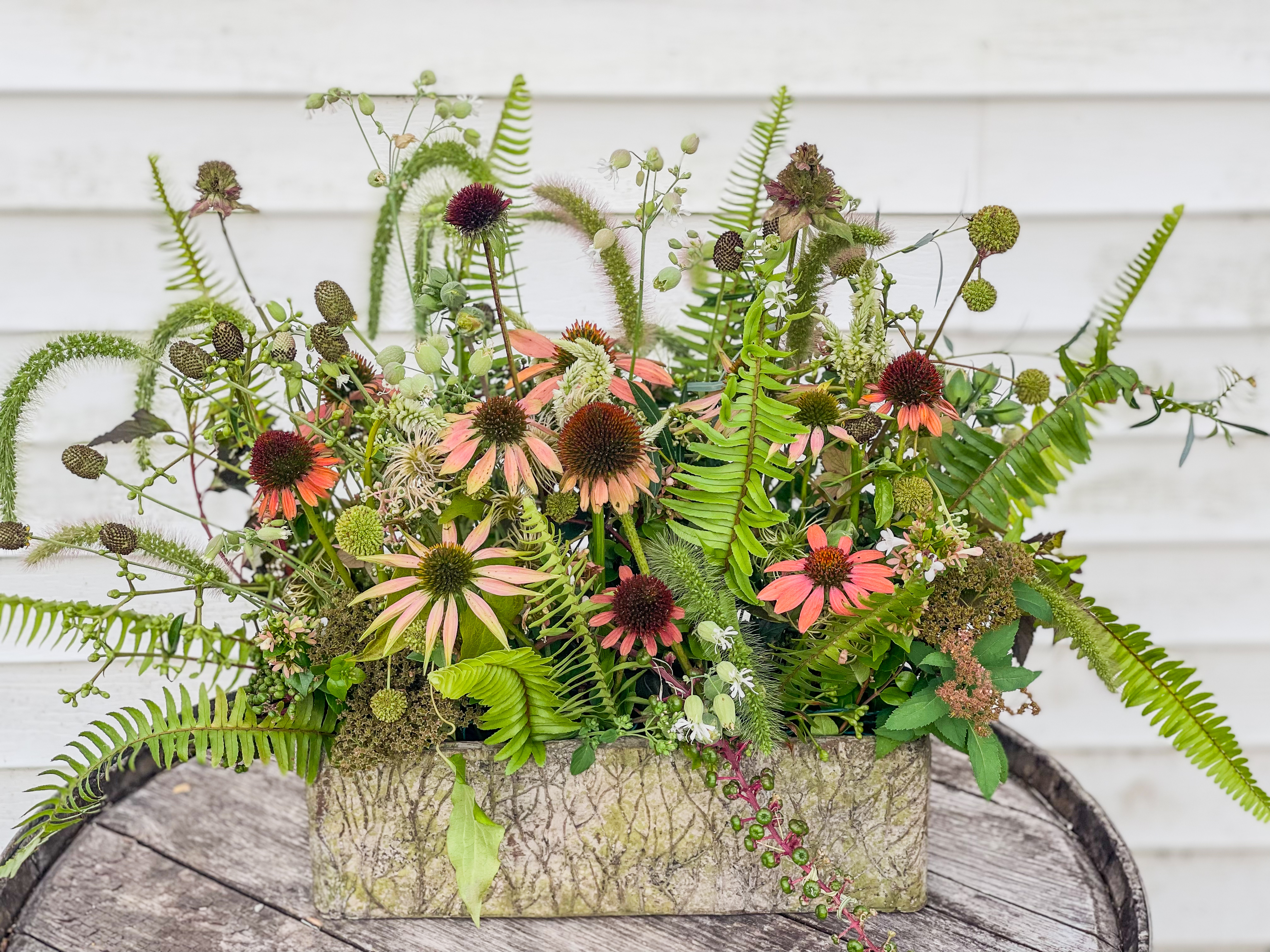
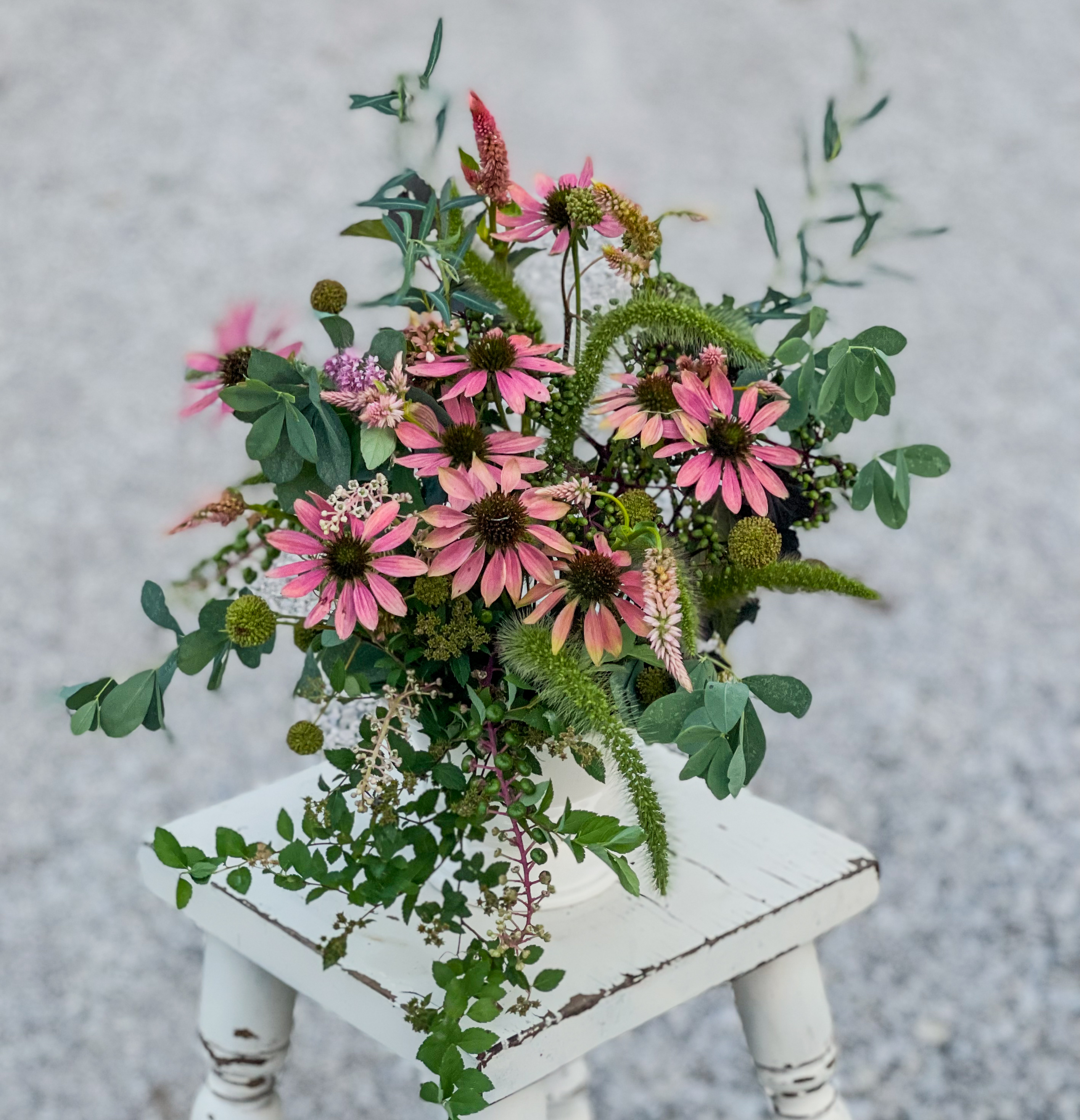
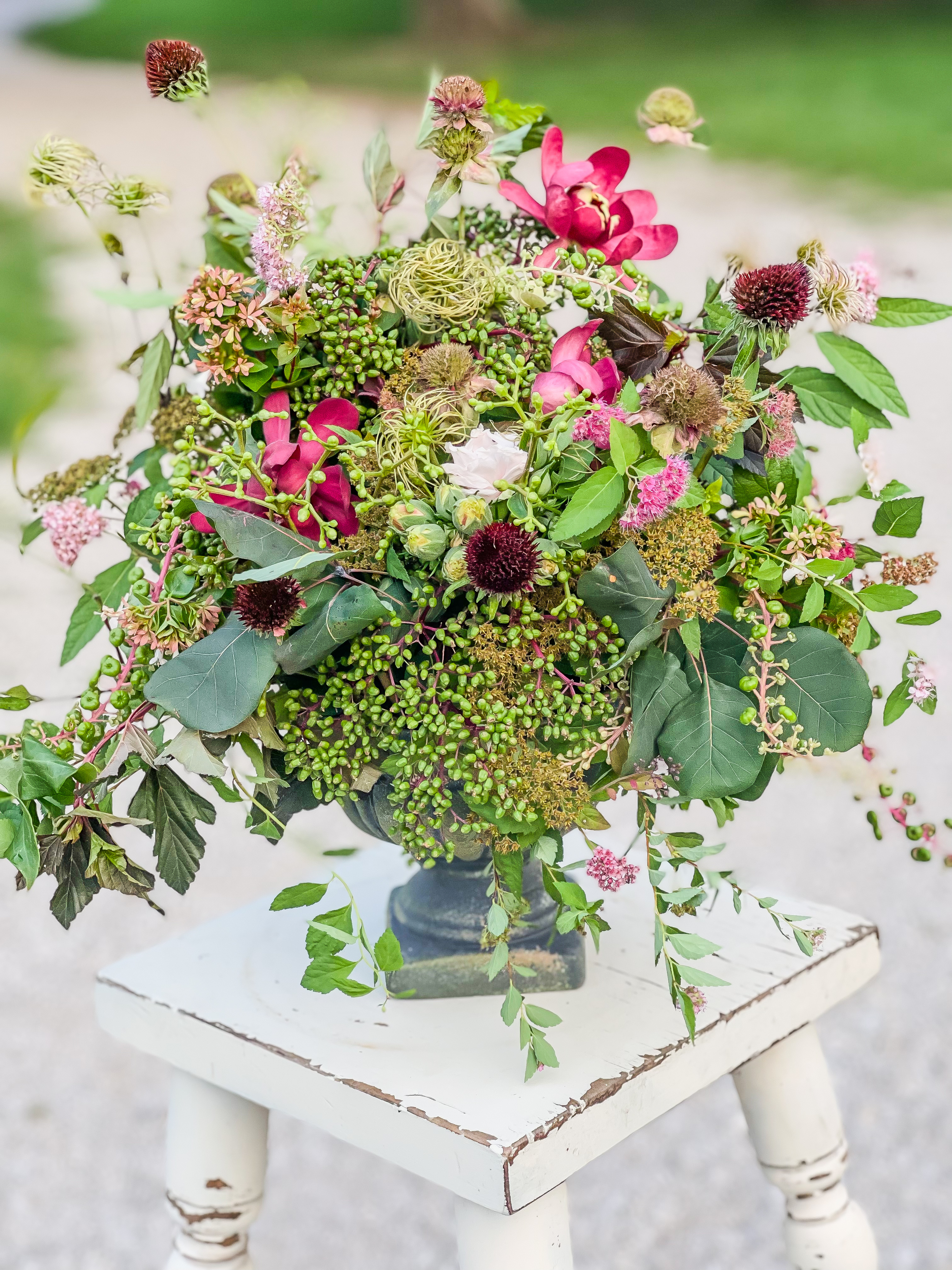
Natives, invasives, weeds — foraged entirely on property. Stop using the labels. See the beauty.
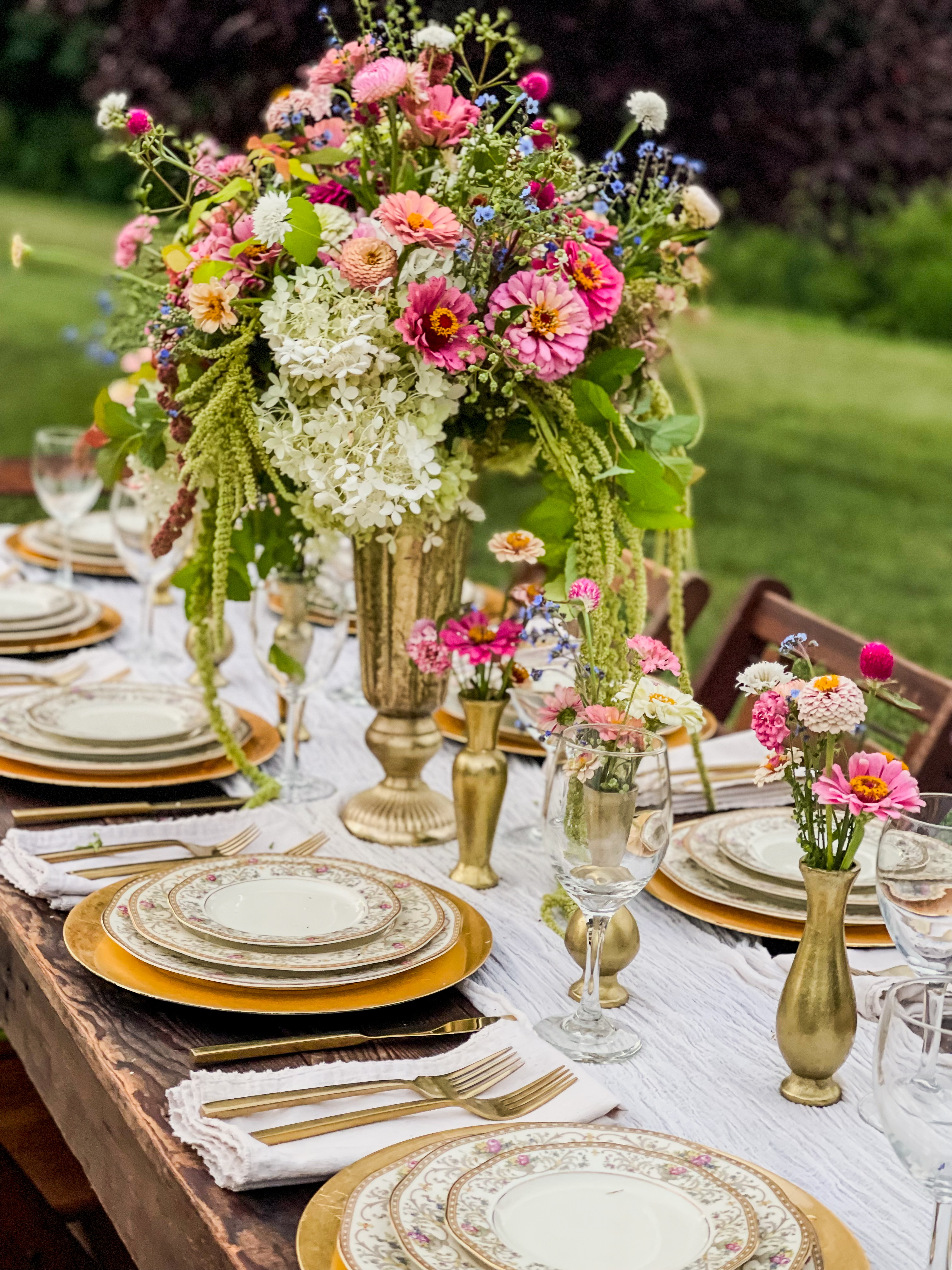 The formal table — a kenzan in every vessel, every stem placed
The same logic that holds a stem in a vase holds a hundred stems in a bouquet. The chicken wire base inside a held bouquet is shaped like a frog, works like a frog — stems anchored, water held, the structure invisible once the flowers fill in. You build the armature first. Then you build on top of it.
And then you scale further. Chicken wire wrapped around the legs of a dining table, wired and stabilized, dressed with an entire season's crop. The same mechanic, scaled to furniture. The same logic, served to a hundred guests.
The mechanic is the same one that fits inside a four-inch kenzan. The scale is not.

The base is chicken wire formed into a collar, wired closed, stems fed through until the whole structure holds itself. Then it goes into a bucket, travels to the venue, and no one will ever know it isn't just flowers.
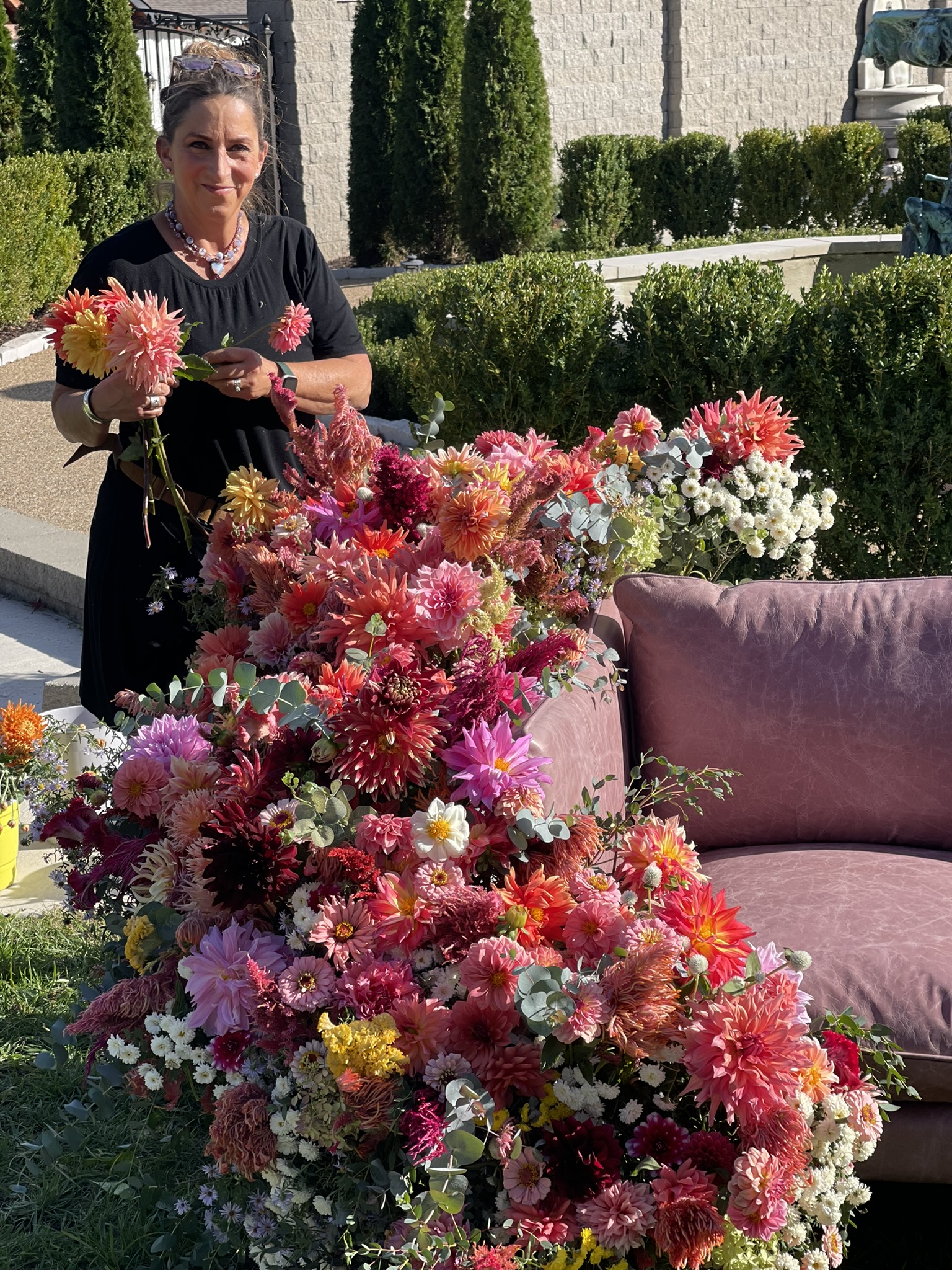
Chicken wire shaped to the sofa frame. Every wire end tucked. Every stem placed by hand into a structure that disappears the moment the camera fires. The mechanic scaled to furniture. The logic unchanged.
Nothing was prepared in advance. The farm came with me — a Gator loaded with dahlias, celosia, and eucalyptus, parked at the bottom of the hill while the editorial shoot happened on the estate above. I designed all the jewelry. I designed all the floral. And for each look, someone ran downhill to tell me what the editor and publisher wanted after the bride was dressed, her hair done, her gown on.
I had less than ten minutes each time. A different palette, a different mood, a different bride. The bouquet had to be right. The armature had to hold. The stems went into chicken wire I had already shaped and rigged, because the only way ten minutes is enough is if the foundation is already there waiting.
I nailed every one. It was an epic issue. It was an epic spread.
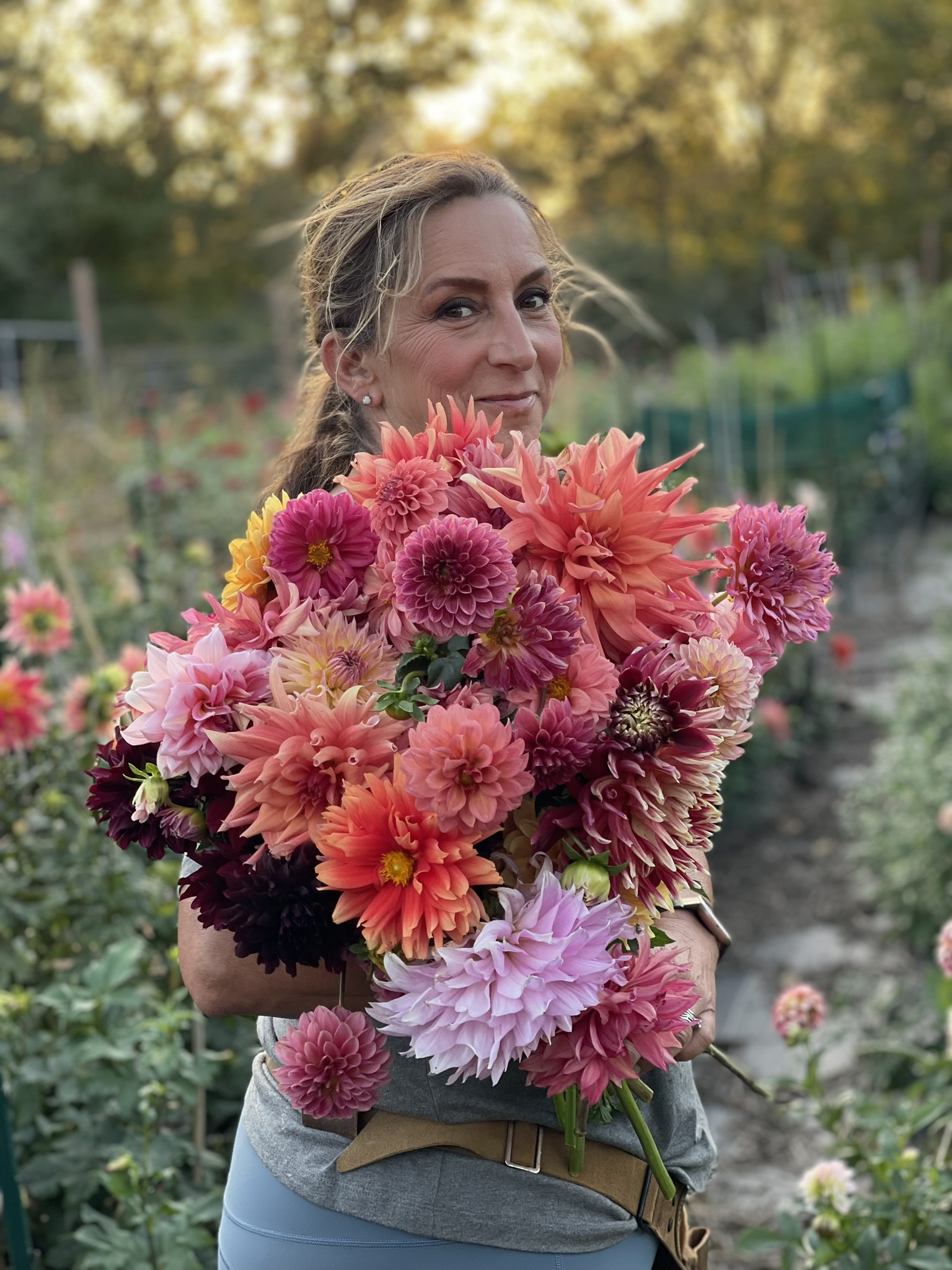
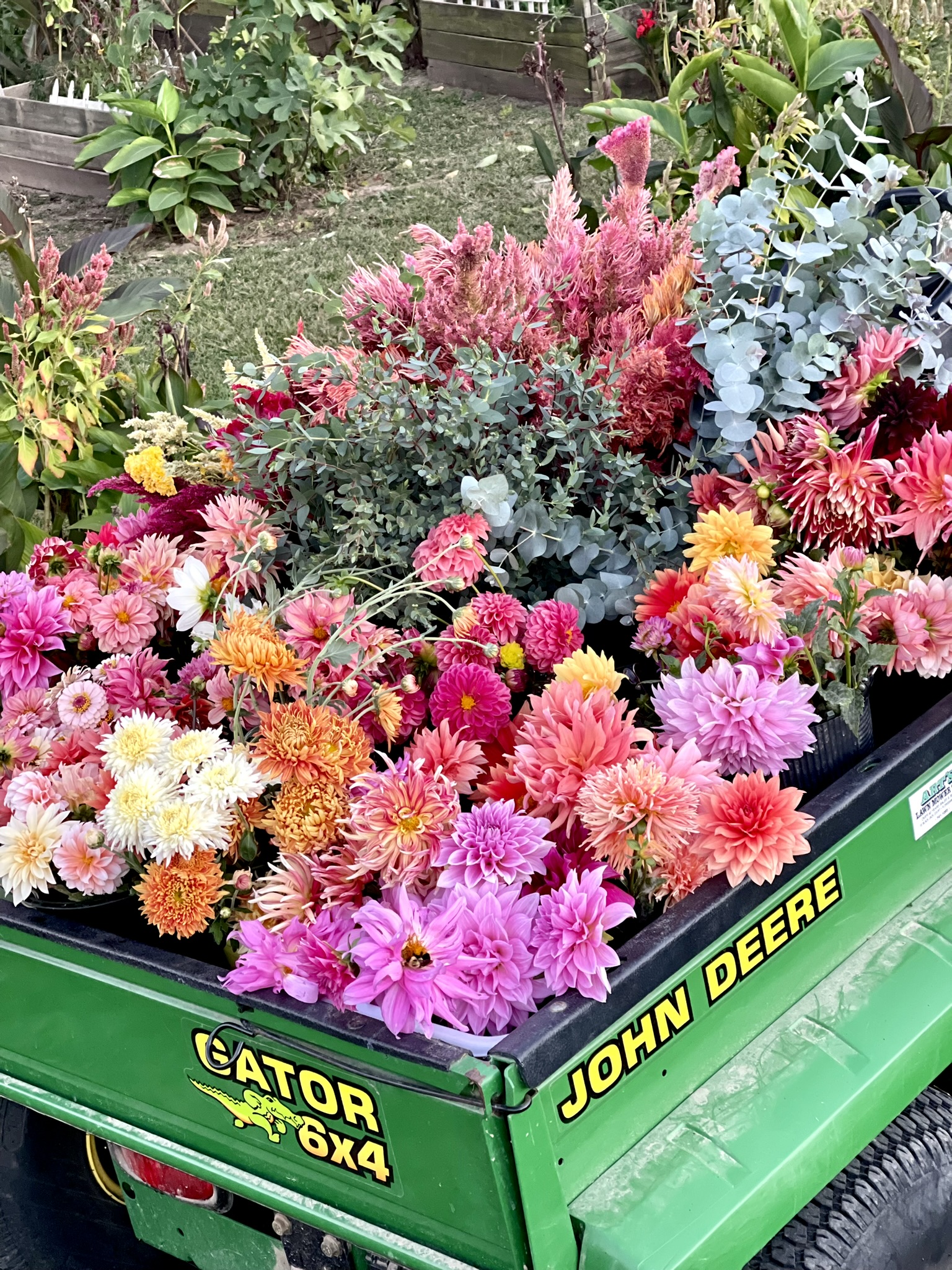
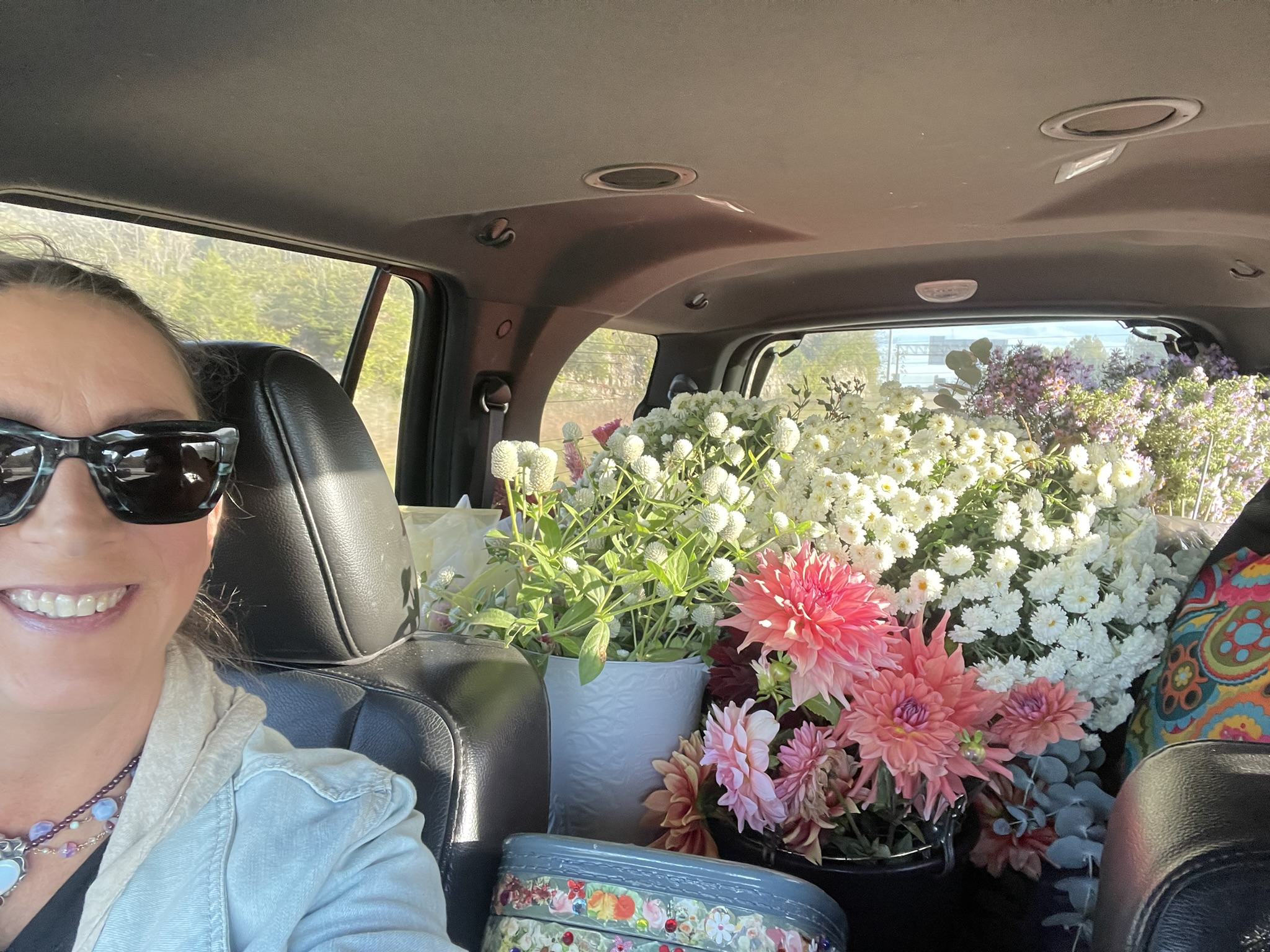

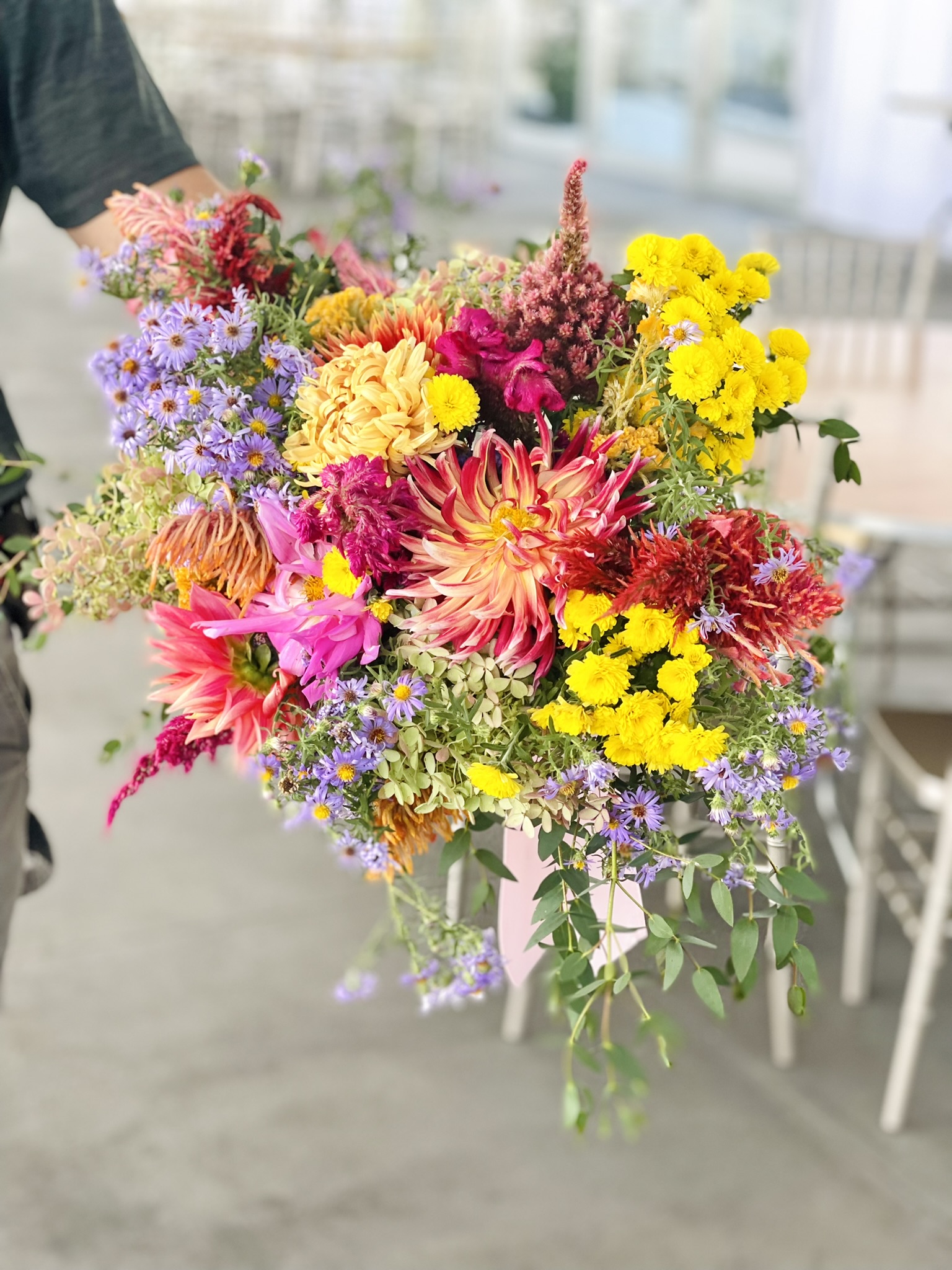
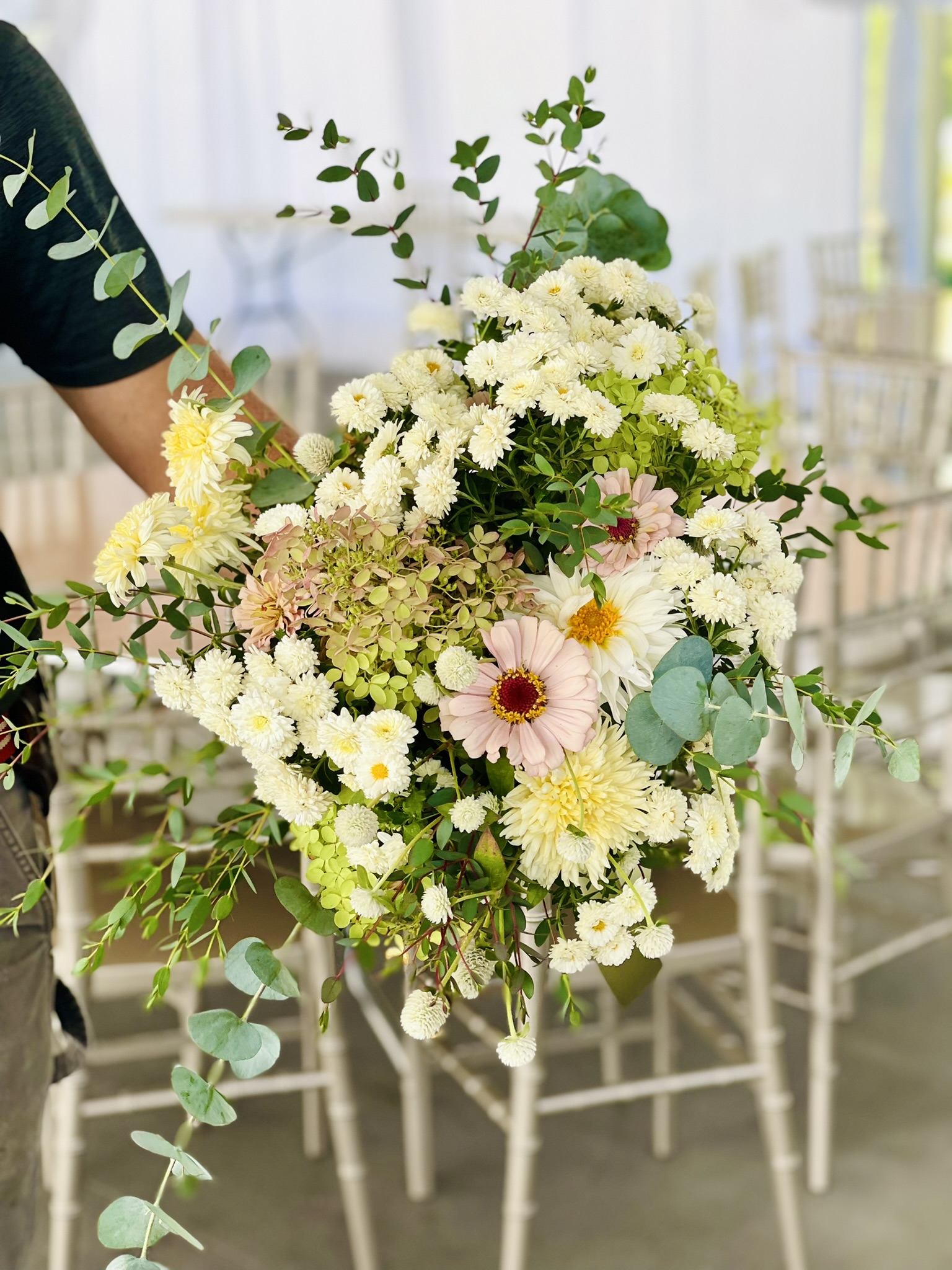
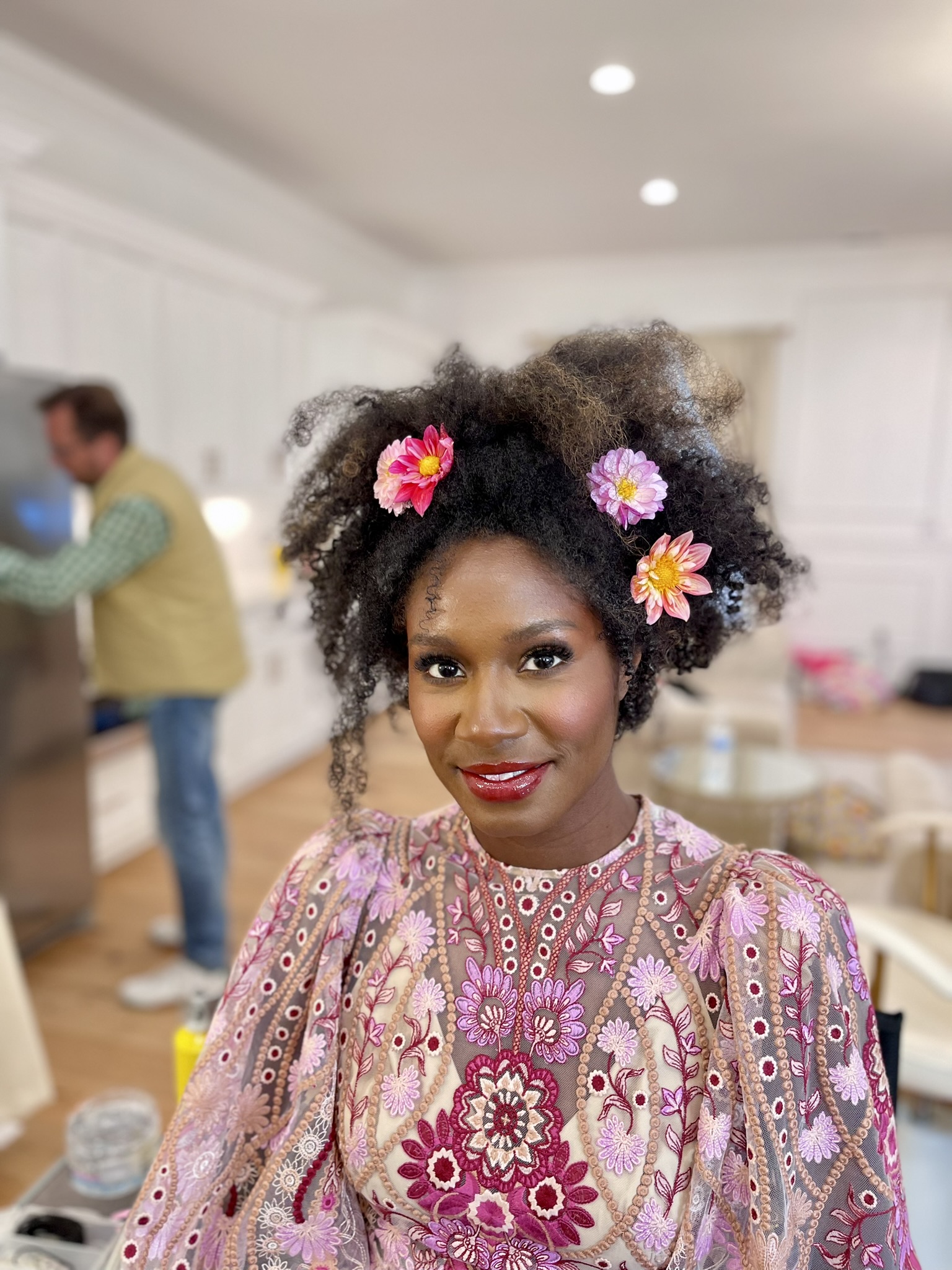
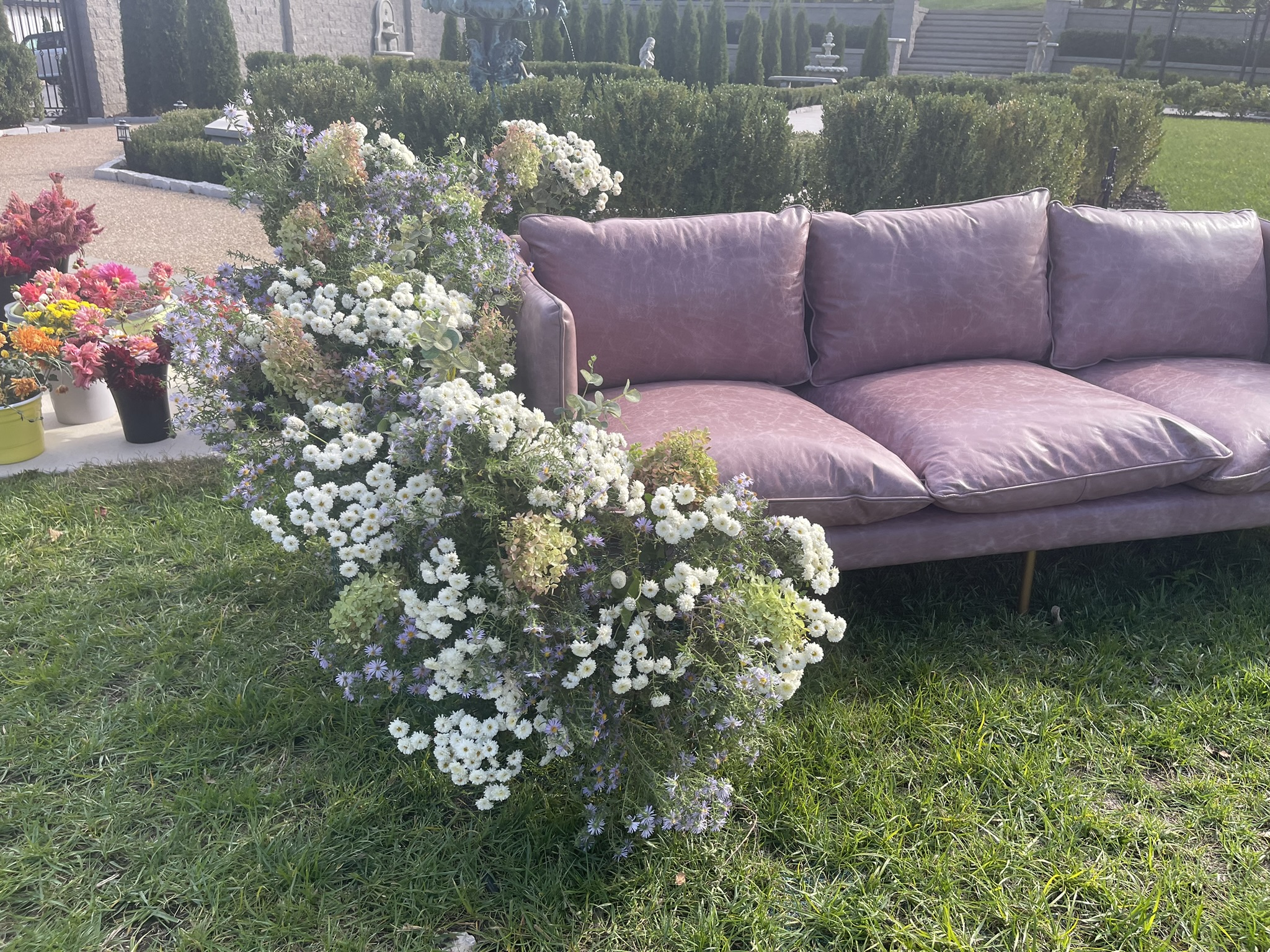
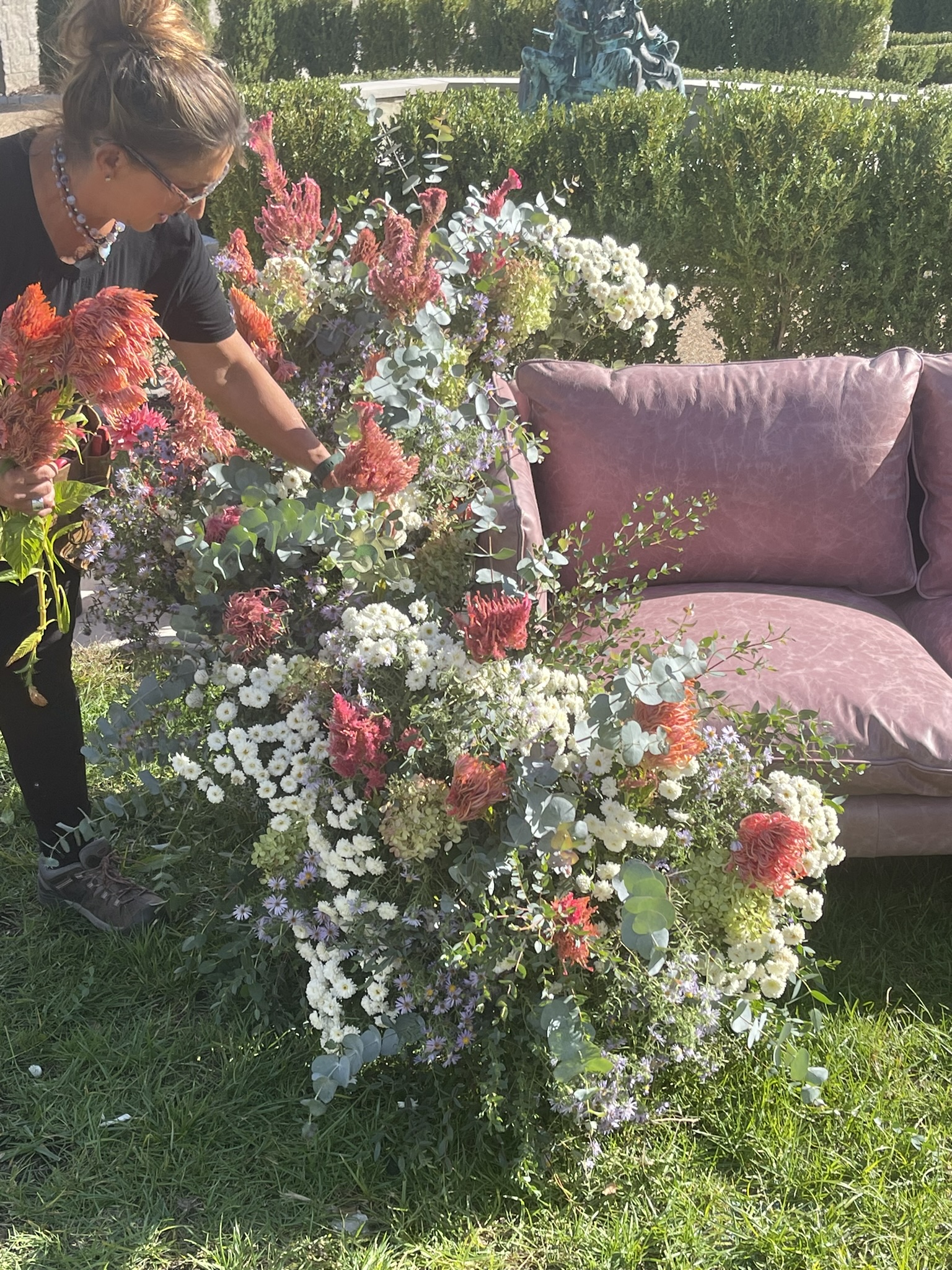
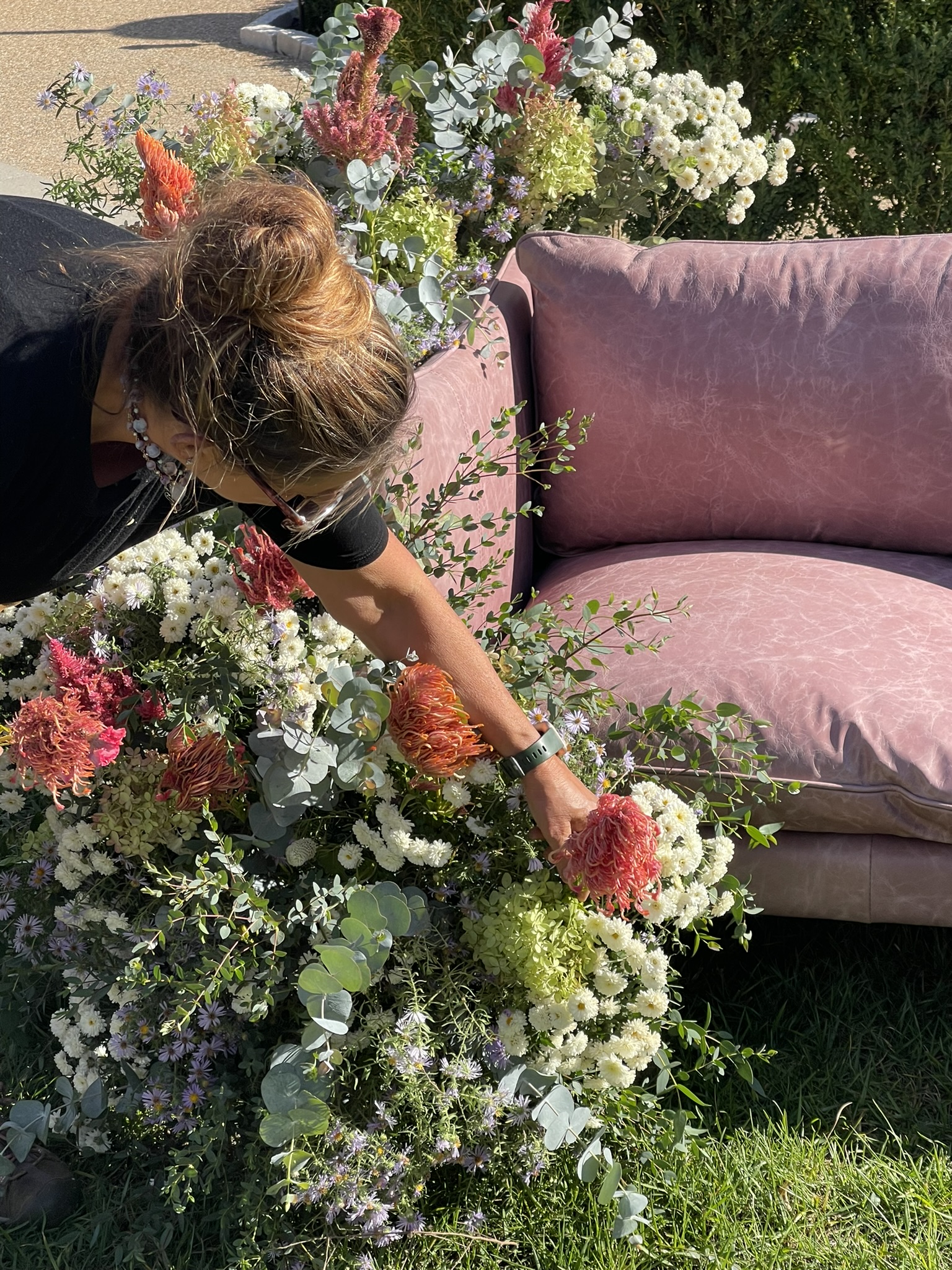
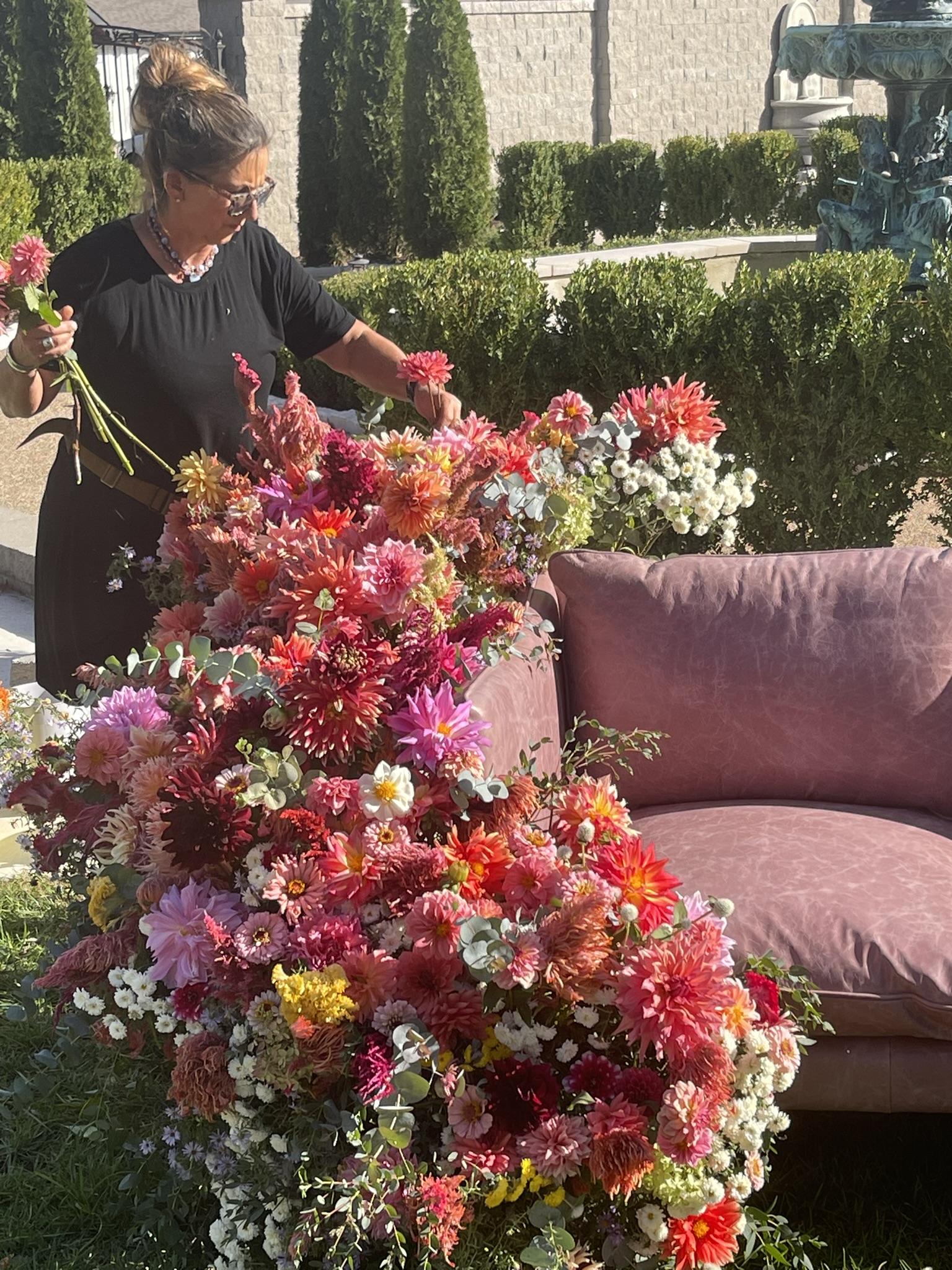
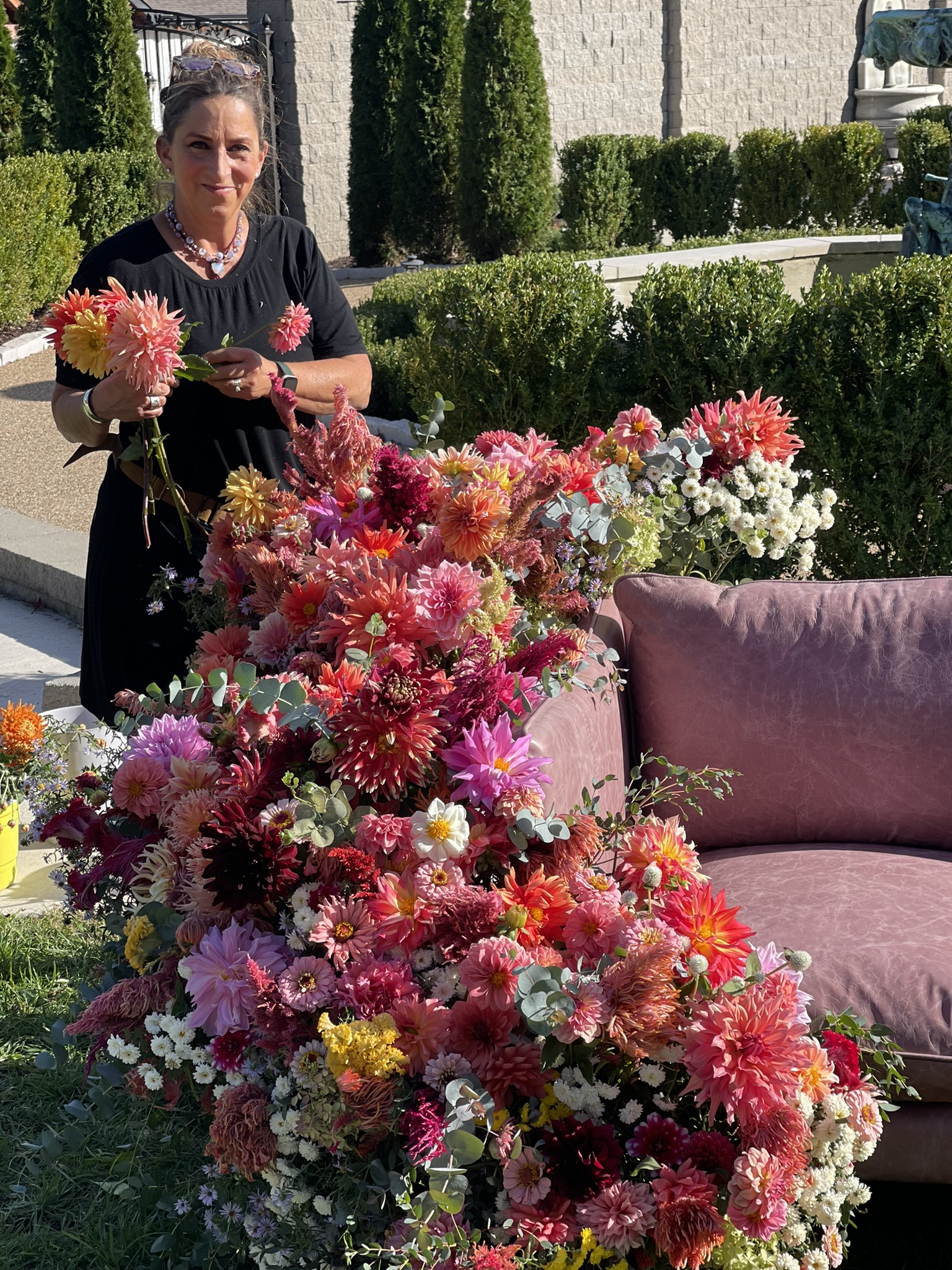
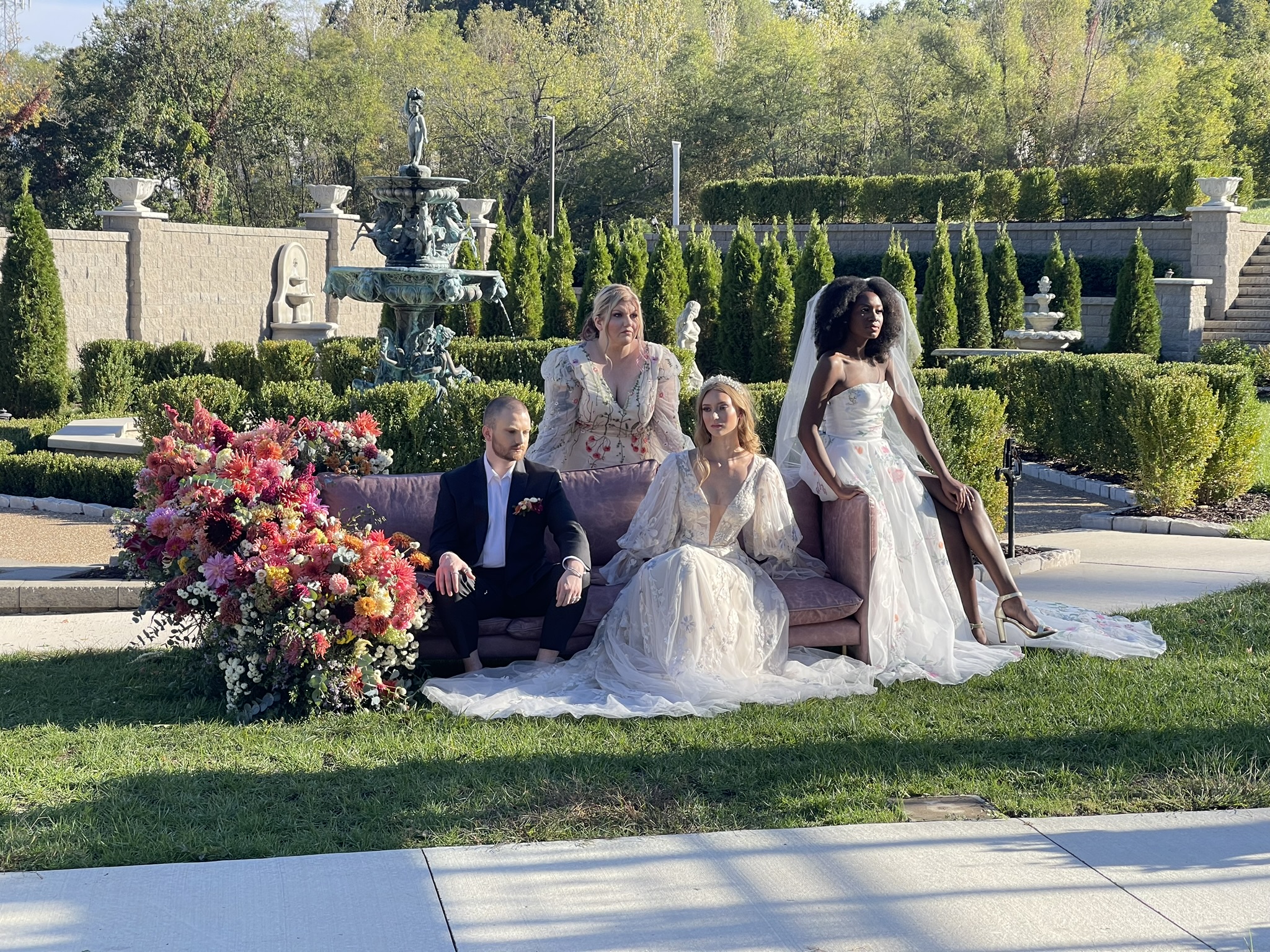
Saint Louis Bride — cover editorial. Florals, jewelry, and armature by Luli. Every stem placed in under ten minutes, per look, from the bottom of the hill.
The frog disappears. That is its whole purpose — to hold the flower so well that you forget it is there.
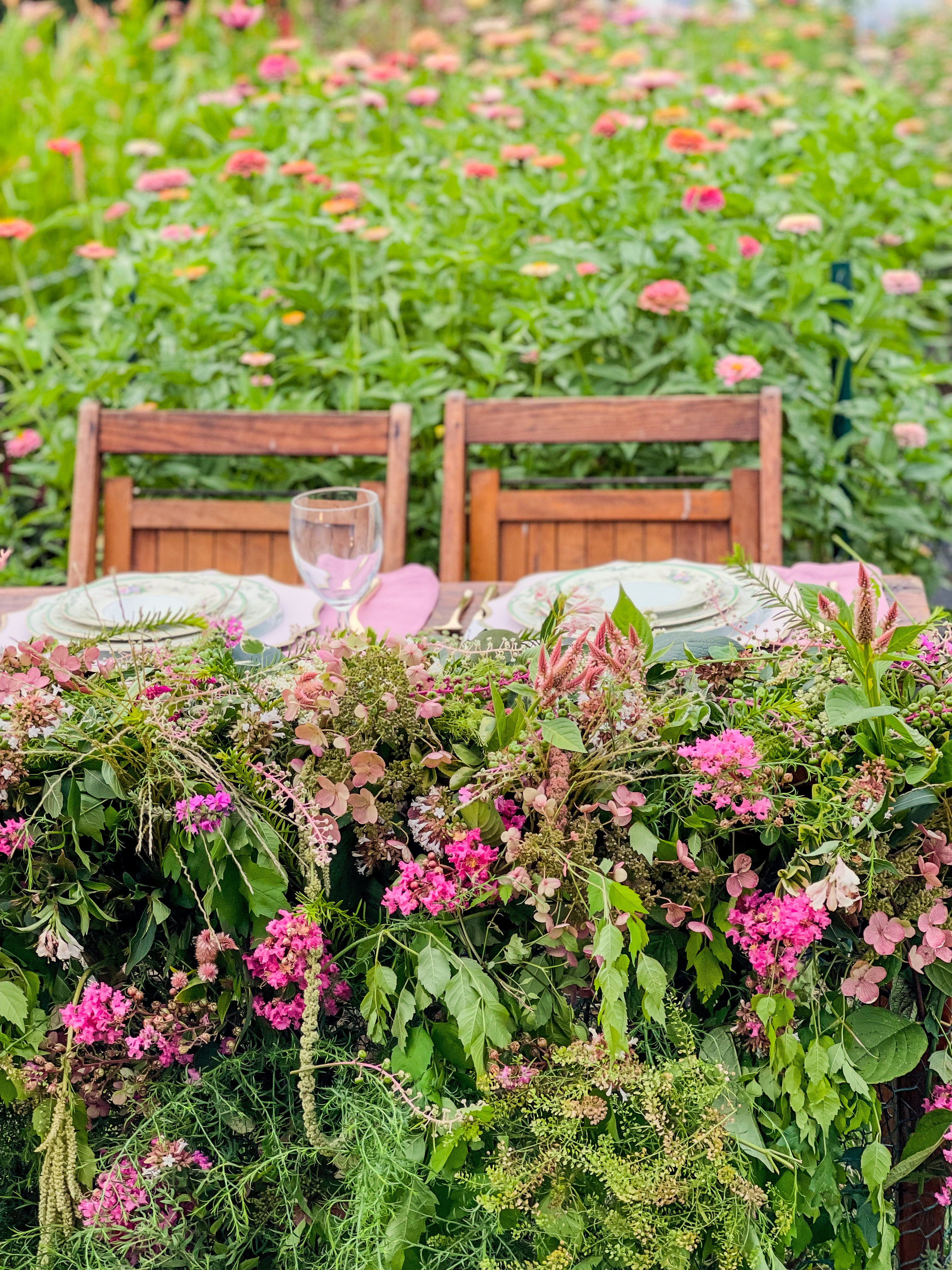 Table in the field — chicken wire armature wired to the table legs, built upon, then dressed with the zinnia crop
And then you are in the zinnia field. The table is set. Before the flowers, there was the armature — chicken wire shaped around the table legs, wired and stabilized, built to receive. The whole front of the table is structure. You would not know it to look at it.
That is what all of this is. The frog before the arrangement. The armature before the cascade. The mechanics placed first so that the beauty has something to hold onto. Not visible when the work is done. Not meant to be.
I keep the old frogs because they work. I keep collecting them because every vintage kenzan in a drawer somewhere was once part of someone's version of this — their table, their flowers, their arrangement made with intention. That history travels with the tool. When I press a stem into a kenzan that is sixty years old, someone before me pressed a stem into it too. That is worth something. That is worth quite a lot.