A grimoire is a book of spells. But before it was that, it was something simpler: a record of what plants do. Long before pharmacology, before chemistry, before the Latin binomial names that turned living things into catalog entries, there were people — mostly women — who paid close attention to the plant world and wrote down what they learned. What heals. What harms. What invites sleep, clarity, courage. What, placed at the threshold, keeps something out. The grimoire is the oldest form of botanical science.
The green witch tradition is not a religion. It is a practice of attention — a discipline of noticing what the plant world offers and receiving it with intention. It asks for nothing more than presence, and patience, and a willingness to learn from something that has been alive far longer than you have.
This is my version. Not a spell book. Not a field guide. A record — of what I have grown, what I have noticed, what I carry with me from the field into the studio, from the seed into the piece. Thirteen years of attention laid down like pressed specimens between the pages of something I am still writing.
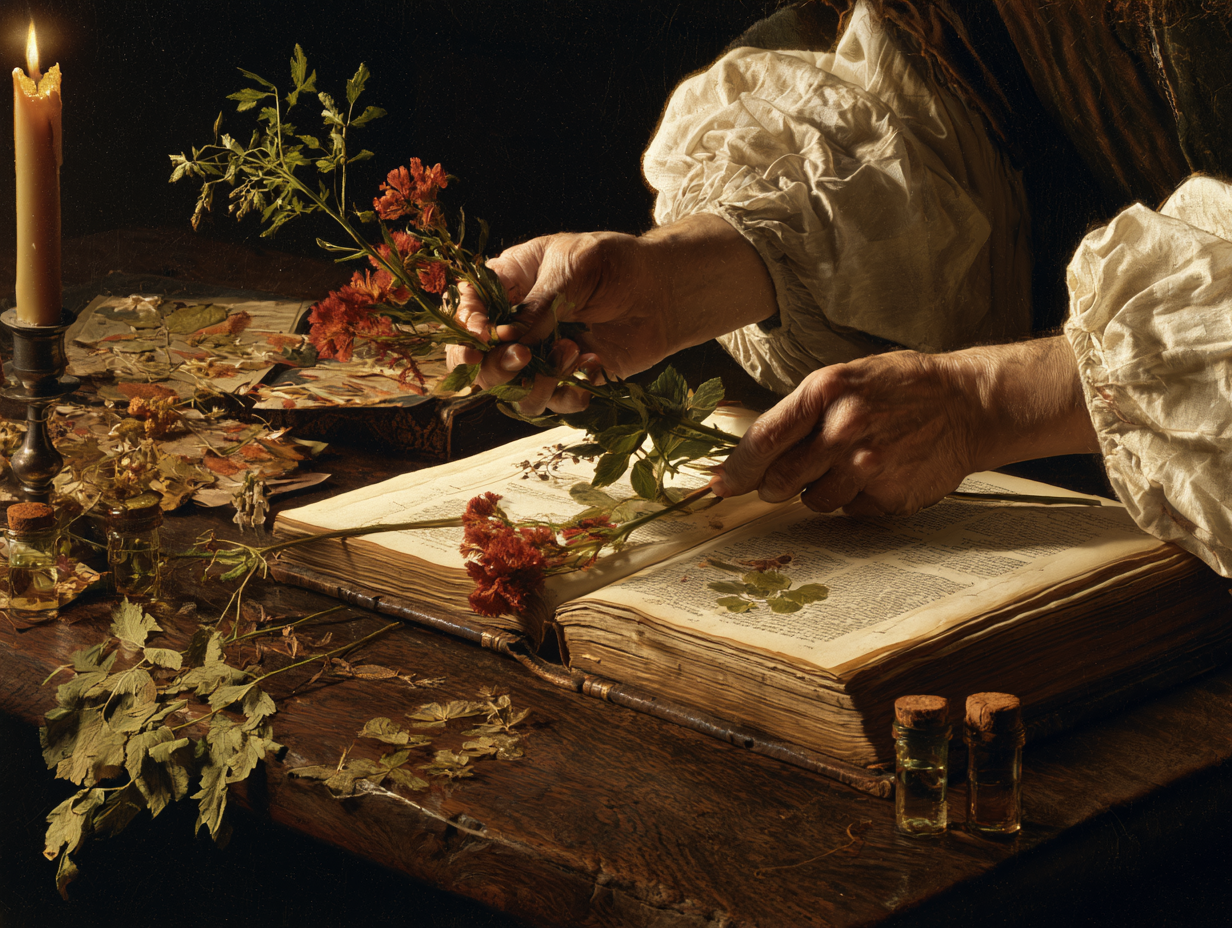
The record begins with a plant
The Language Before Language
Flowers were understood as communicators long before the Victorians formalized floriography. In folk medicine and ritual practice across every culture, specific plants were associated with specific effects — not just physical but emotional and spiritual. Rosemary at the door for protection. Lavender under the pillow for dreams. Bay laurel for clarity of thought. The plants were prescriptions. The gardens were pharmacies.
What the green witch tradition preserves is the intuitive knowledge that developed over millennia of close observation — the understanding that a plant's properties are not accidental, that form carries meaning, that a plant which smells like comfort often provides it, that a plant which looks like fire often warms or purifies or transforms. This is not mysticism. It is pattern recognition refined over ten thousand years.
The doctrine of signatures: a plant shaped like a heart supports the heart. A plant that bleeds red when cut has something to say about blood. A plant that burns your tongue will clear congestion in the lungs. Medieval herbalists used this system as their primary diagnostic tool. The modern pharmacopeia quietly borrowed from it — not the metaphysics, but the plant selection — for centuries before it admitted to doing so.
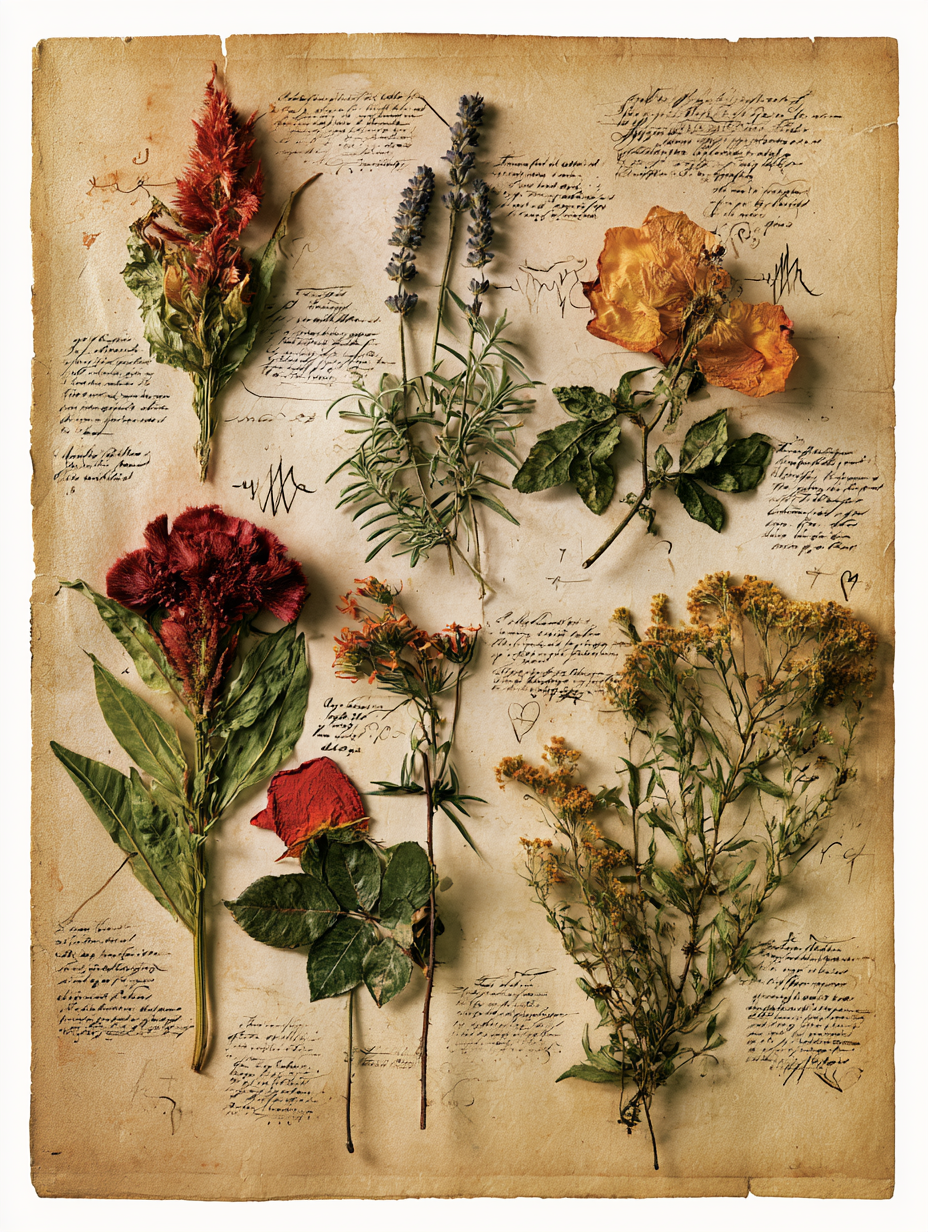
Doctrine of signatures — the annotated record
"The land knows you, even when you are far away, and that you know the land."
Botanicals in Ritual
Smudging — the burning of dried herbs to cleanse a space — is among the oldest known ritual practices. White sage, cedar, sweetgrass, lavender, rosemary, mugwort: each one carries its own specific intention. Sage clears. Cedar grounds. Sweetgrass invites. The smoke is understood not as symbolic but as active — as a physical change in the energy of a space.
Infusions, tinctures, and tisanes: the ritual cup of tea is a daily act of plant medicine. Chamomile is not merely pleasant. It is anti-inflammatory, nervine, mildly sedative, and has been used as such for recorded history. Ritual and remedy were never two different things. They were the same act performed with different amounts of attention.
Flower essences — water infused with the energetic imprint of a living bloom, not the botanical substance itself — occupy the most mystical end of this tradition. Developed formally by Dr. Edward Bach in the 1930s but practiced in various forms far earlier, they work, if they work, on the premise that a flower's form carries an intelligence that can be transferred. This is not so different from what Floral Alchemy does. A pressed flower transferred to metal is also a kind of essence — the form preserved, the intelligence carried forward.
Celosia — Thirteen Years
I did not plan to grow celosia for thirteen years. I planted it once, because it was beautiful, because the flame-shaped plume seemed like something from another century, something that belonged in a Dutch still life or pressed between the pages of an herbalist's notebook. I did not expect it to become the center of everything.
Celosia cristata — cockscomb — has been cultivated for over four centuries. It appears in Asian pharmacopoeia as an astringent, used to treat wounds and hemorrhage. It appears in West African ritual traditions as an offering of fire, an invitation to transformation. In the Victorian language of flowers, it means warmth. Singularity. The thing that stands apart.
After thirteen years of selecting, saving, and replanting from my own seed stock, I now grow over two hundred varieties — a living collection that exists nowhere else in exactly this form. Each variety has a character. Some burn hot and fast. Some hold their color for months after drying. Some produce seeds that grow wildly different from the parent. The plant keeps teaching me what I thought I already knew.
In a Floral Alchemy piece, celosia means: the fire that does not consume. The warmth that persists. The thing that comes back after the frost takes everything else.
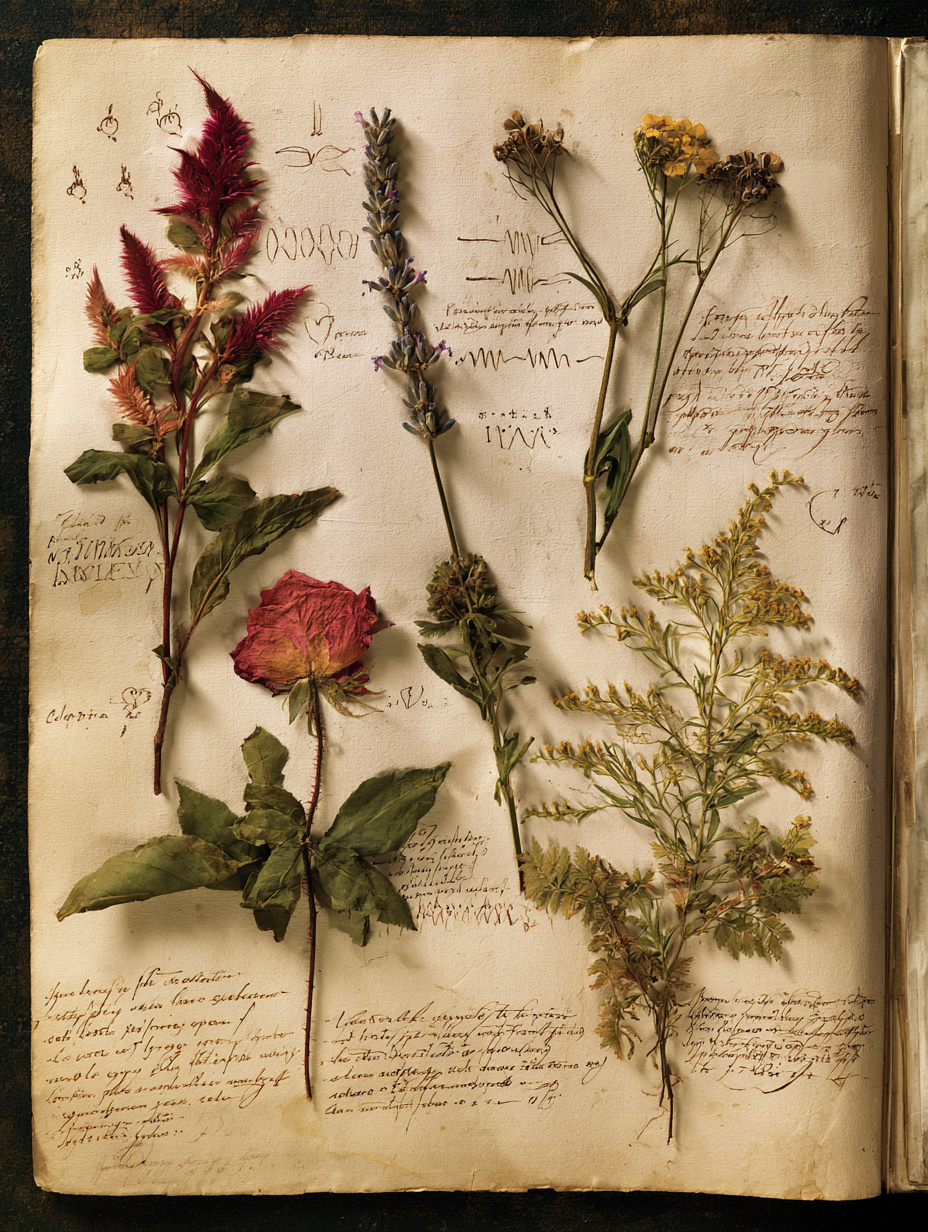
The annotated record — what the hand learns, the page holds
What They Are — Not What We Made Them
There is a place on this page where I would have listed what each flower means. The language was already written: lavender for calm, rosemary for remembrance, forget-me-not for exactly what it says. A whole system of emotional outsourcing — where flowers were expected to say the things people couldn't bring themselves to say directly.
I don't cut flowers to make them do that work for me anymore. Because it was never their job. Communication is mine. If I cannot say a thing, I need to learn how to say it. That is my work, not theirs.
And there is something else: cutting a flower mid-process to harvest its beauty is a little like interrupting Einstein before he finishes a sentence. You get something lovely for the vase. You lose everything he was about to tell you. The wisdom is in the watching — in letting the full arc happen. The way a celosia deepens as the season turns. The way goldenrod knows something about the light that nothing else seems to know. These are not decorations. They are teachers. And you can only receive what they have to offer if you stop talking long enough to be still. Grow flowers because they will make you better. That is the actual reason.
What they communicate, in my experience, is not a meaning. It is an invitation. Come back. Come closer. Stop explaining. Stay a while. Learn how things are connected when you are not trying to be the center of them.
The flowers preserved in these pieces carry their essence forward — not a translated message, not a sentiment we assigned them. A presence. And that presence, if you let it, does something to you that I do not have accurate enough words for. That is the alchemy. That is what it means to be alchemized by a flower.
The green witches always knew this. They did not domesticate the plant world into vocabulary. They entered into relationship with it — learned its rhythms, its silences, its preferences. Treated what they learned with reverence, not as data to extract and label. Once you have lived in that kind of community with something foreign to you, you gain a whole new perspective. You catch yourself from old ways of thinking. And it is in that state — released from the need to explain — that the flowers can do their work on you.
You have to let go of the human baggage. Be willing to simply be among family. Earth family. Other living things family. Instead of talking so much, just listen. Watch. Learn.
That is home. And that is where I am trying to take you.
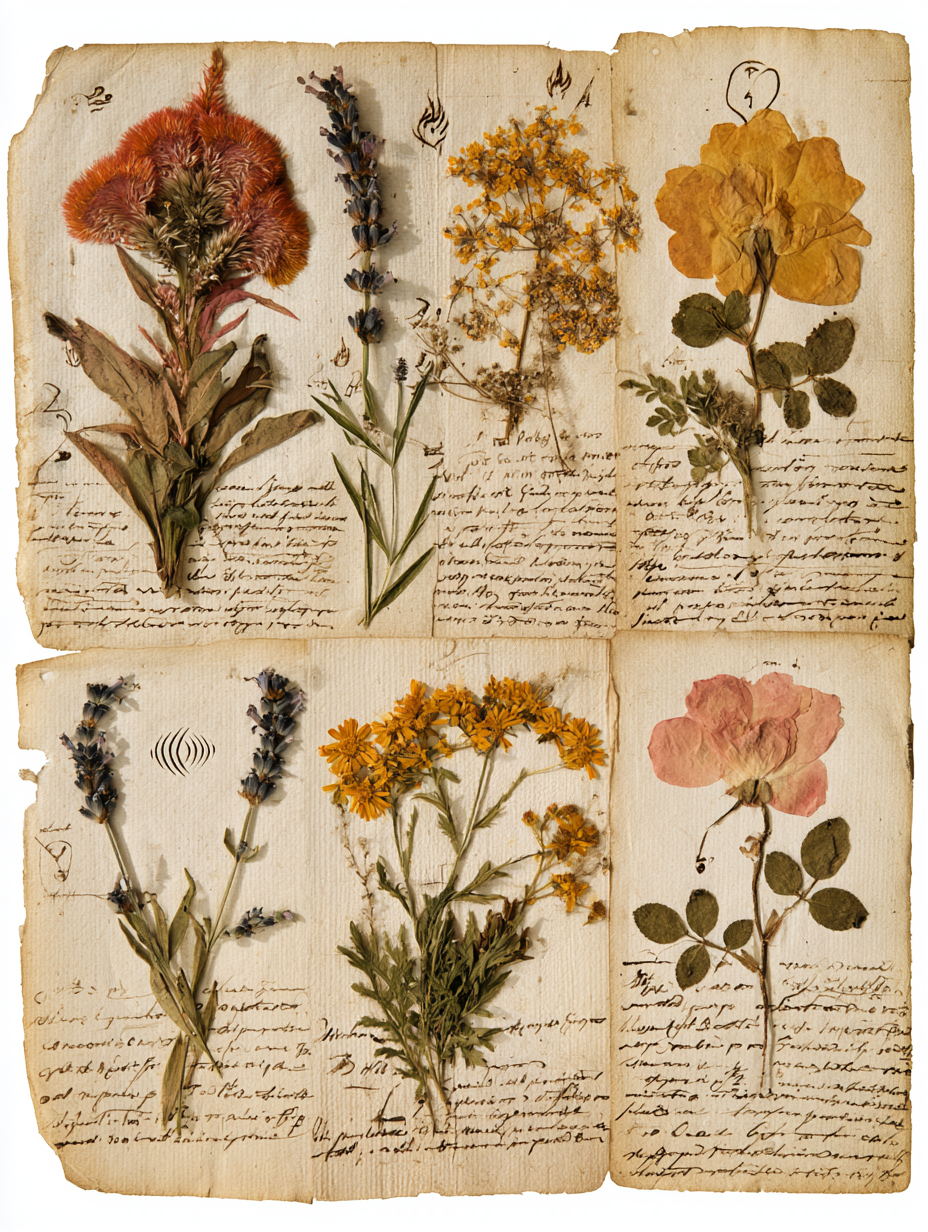
The annotated record — fire, water, earth
The Seasonal Record
The grimoire tradition was always seasonal. You do not write the same entry in January as you do in July. The plant changes. You change. The act of observation changes what is observed.
These are the four stages of the year as I know them from this land.
Nigredo
Winter — the dissolution
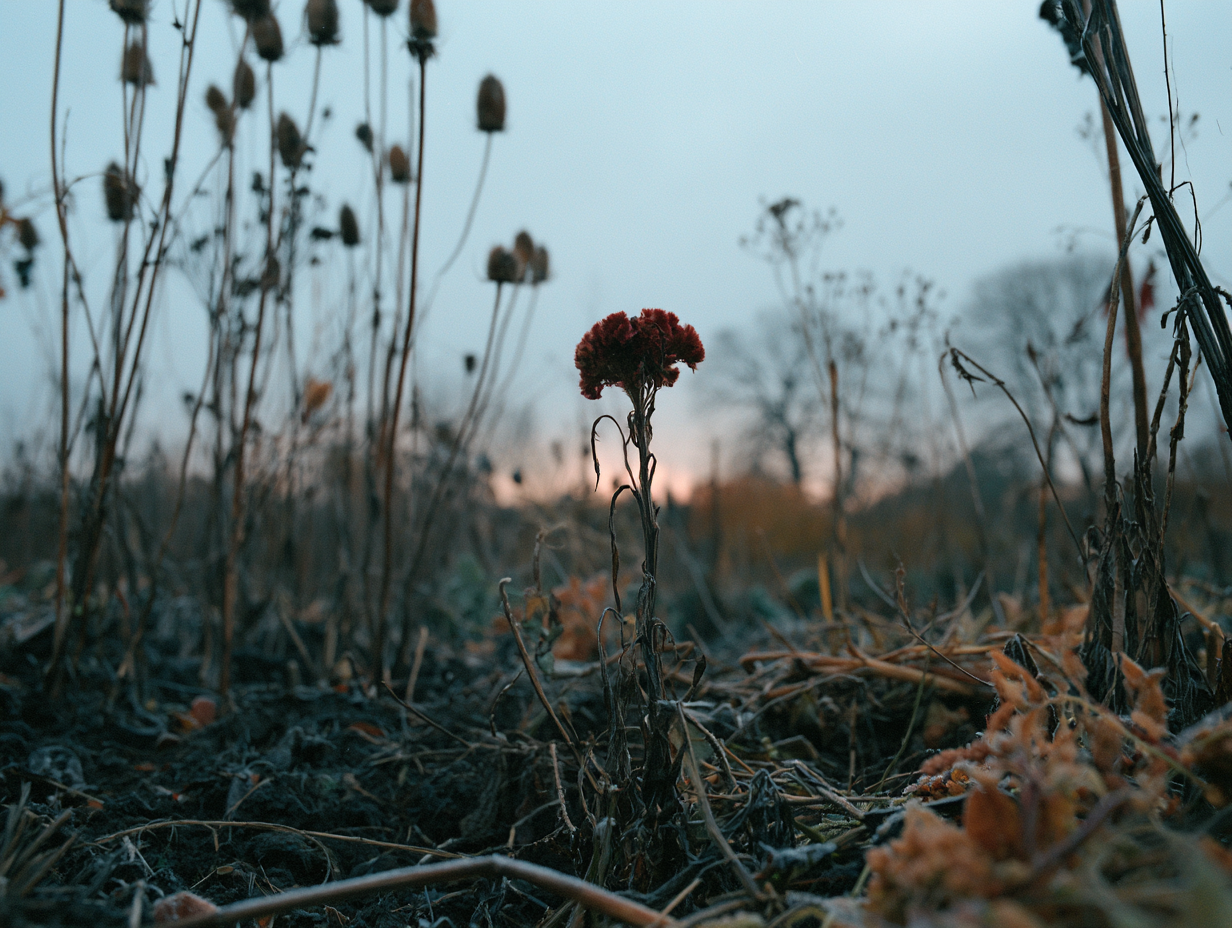
After first frost — the field at dawn
The field goes quiet. The celosia stays. After everything else has released and gone brown and folded into the ground, the celosia stands. Its color does not fade the way other flowers fade. It deepens — darkens from crimson to something closer to burgundy, to dried blood, to the color of old velvet. This is not death. This is concentration. Everything unnecessary has been removed.
I walk the field in January and take notes on what held its form. This is the Nigredo of the year — the dissolution, the stripping down to essential matter. The grimoire tradition calls this the precondition for everything that follows.
Albedo
Early spring — the first return
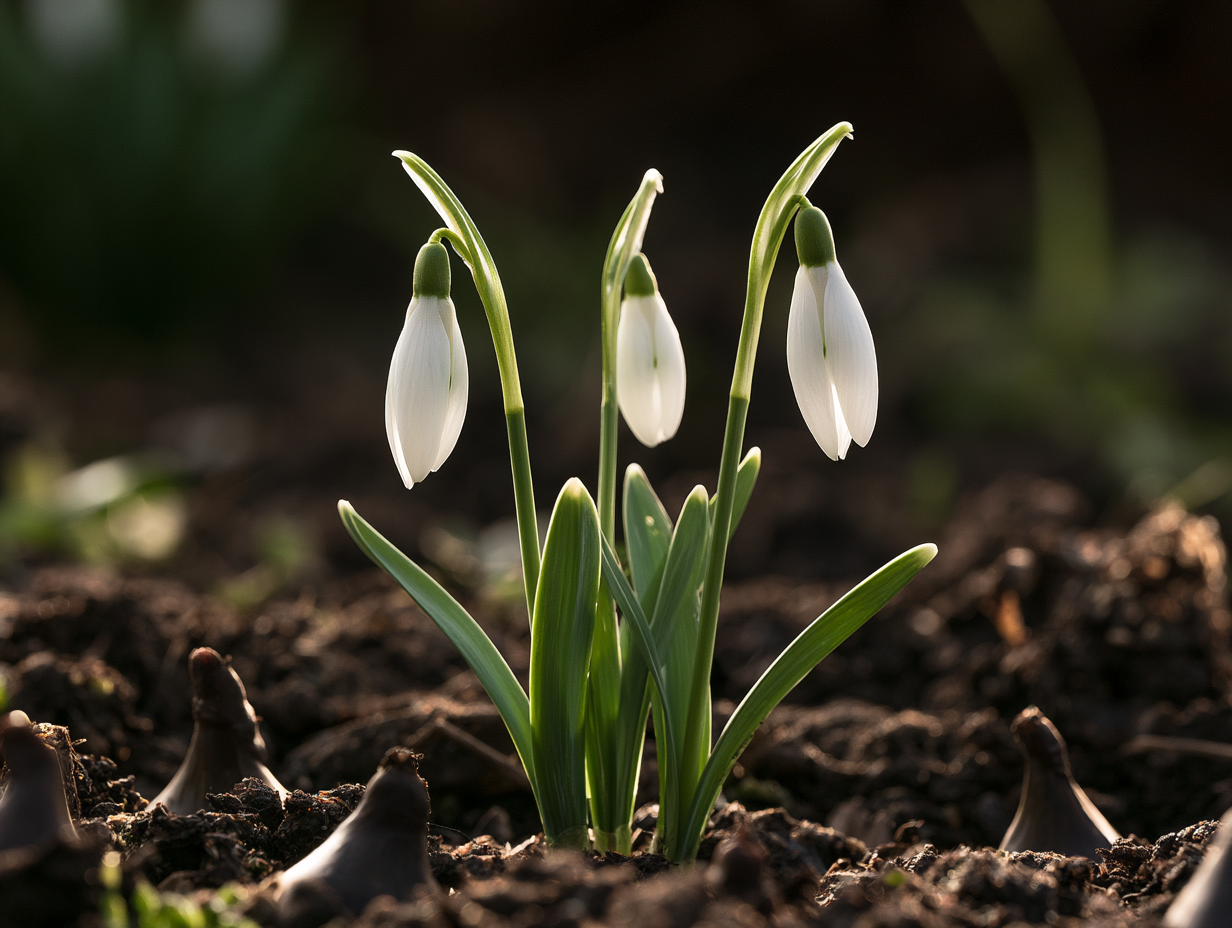
Galanthus — the land keeps its word
The snowdrops come before anything else. Before the soil has warmed. Before there is any reason, from a botanical standpoint, to take the risk. They push through frozen ground with a confidence that belongs to something that has done this ten thousand times before. The land keeps its word.
This is the Albedo — the whitening, the return of light, the first proof that the dissolution was not permanent. The grimoire entry for February is always the same: they came back. They always come back.
Citrinitas
Late summer — the ripening
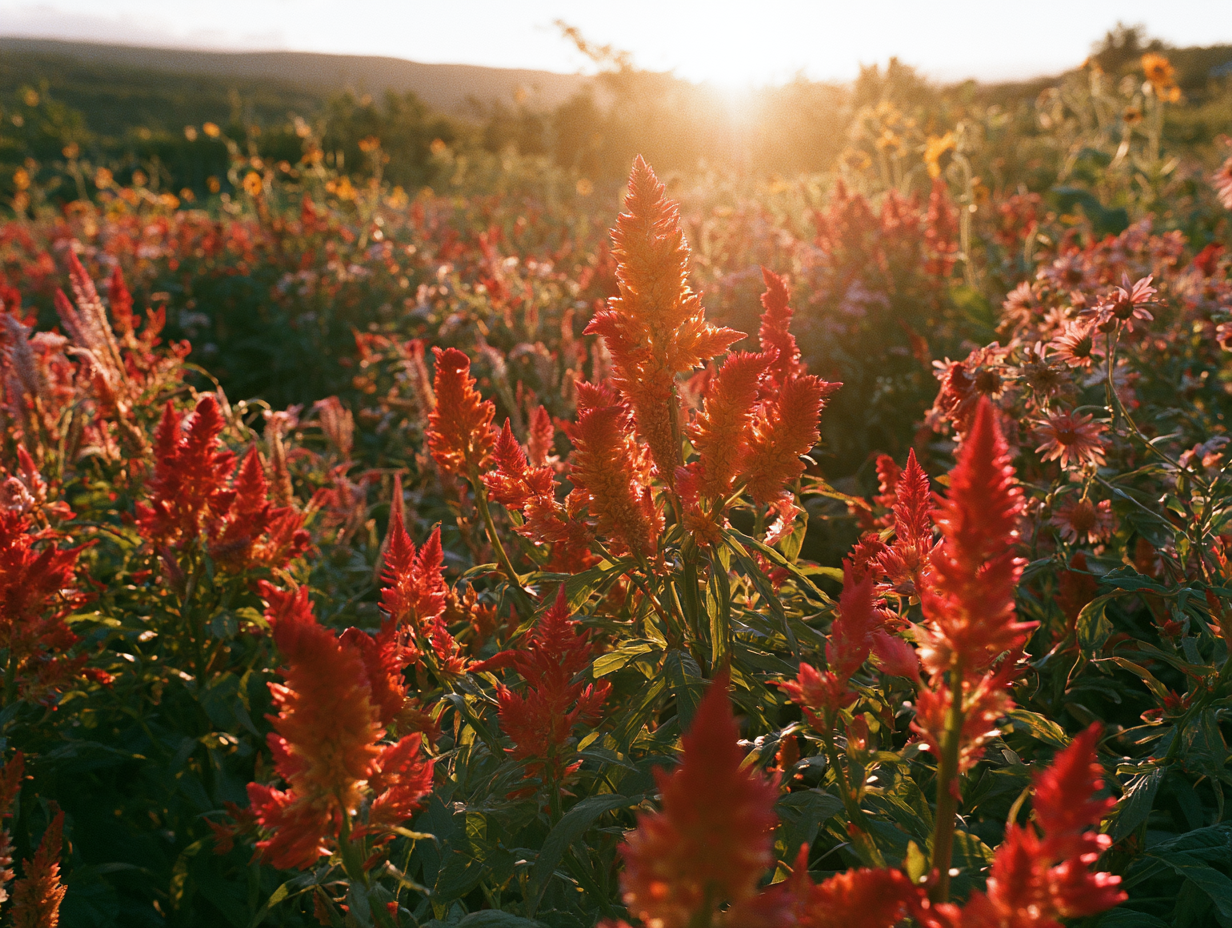
Peak bloom — the whole field at once
By August everything is at its fullest. The celosia is chest-high. The goldenrod is beginning to go gold at the tips. The echinacea are spent but still standing, their seed heads like small dark crowns. The field looks like it cannot possibly hold more — and then it does. This is the Citrinitas, the yellowing, the moment of peak saturation before the turning.
I walk it at dawn and again at dusk. The light at those hours does something to the celosia that I have never been able to fully describe — it goes translucent. The plumes catch the last horizontal light and glow from inside. Every year I think I am prepared for it and every year it stops me in the middle of the field.
Rubedo
The harvest — the completion
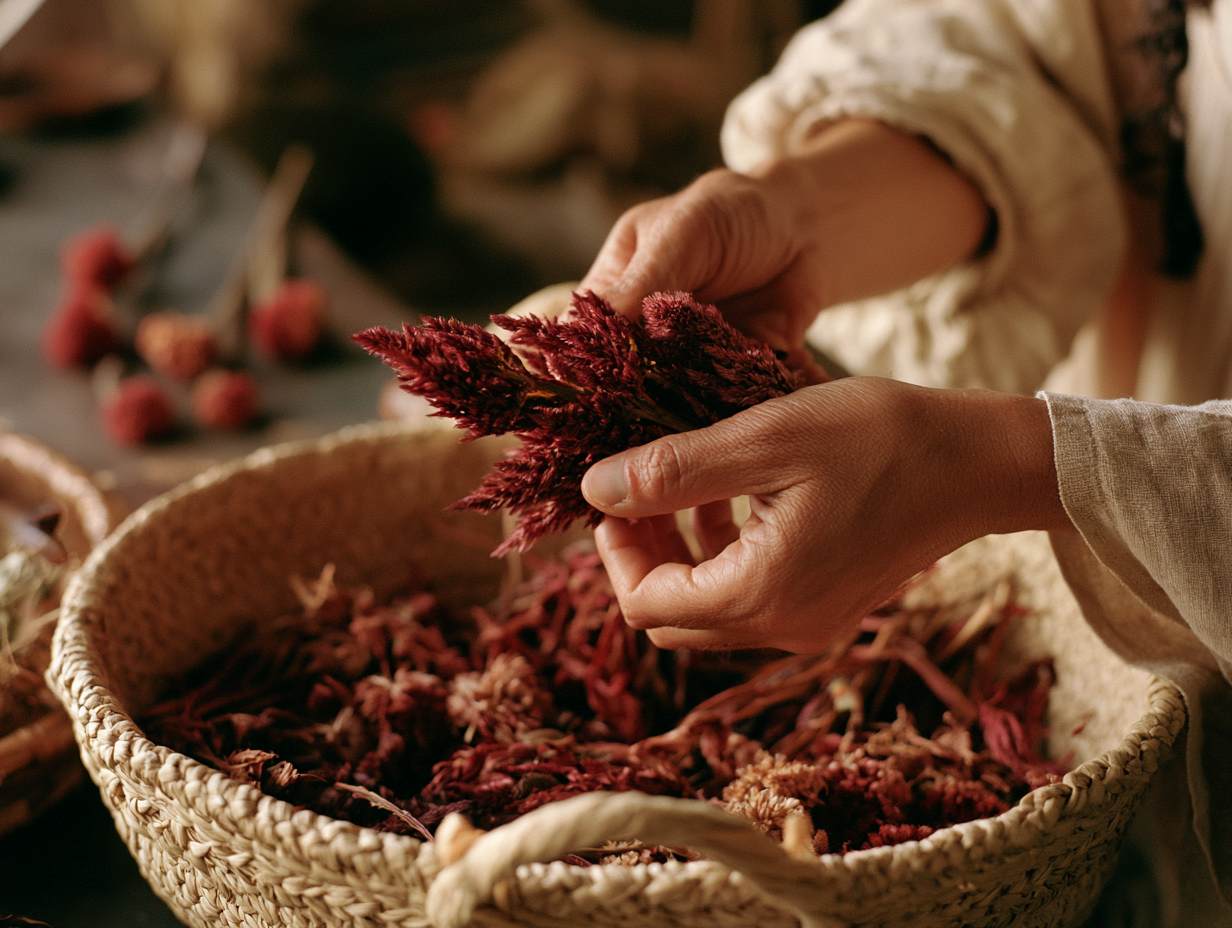
The harvest — sorting by color, form, season
The Rubedo is the final stage — the reddening, the moment when all the dissolved and purified and ripened material takes its final form. The harvest is when the year becomes material. Everything that was planted, tended, watched, worried over — it is here now, in these baskets, in these hands. Celosia sorted by variety, by color depth, by form. The field compressed into something you can hold.
I sort by color, by form, by season. I notice which varieties surprised me. I save seed from the ones I want to carry forward. This is the part of the practice that looks like work but feels like prayer.
The Practice
A practice is not a belief. It does not require you to believe anything in particular about the nature of plants or energy or the cosmos. It only requires you to pay attention, consistently, over time, and to notice what you notice.
This is what mine looks like:
I walk the field every morning when the plants are growing. Not with a notebook, usually. Just looking. The plant communicates through form — through the angle of a leaf, the direction of a lean, the speed at which a flower opens or closes. You learn to read this the way you learn to read a face: slowly, then all at once.
I press in season. Whatever is at its peak, I press. The point of pressing is not preservation alone — it is documentation. A pressed specimen holds a moment. The grimoire entry for that moment lives in the pressed flower itself: this day, this light, this plant, this version of the year.
I save seed from the ones that teach me something. A celosia that produces a color I have never seen before. A form that diverges unexpectedly from the parent. These are the specimens worth carrying forward. The seed is the grimoire entry that writes itself.
I note what persists. After a hard frost, after a drought, after a particularly strange season — what held its form? What came back? What volunteered in a new location, uninvited but clearly knowing something? The plant world runs on a logic that rewards attention. The practice is the attention.
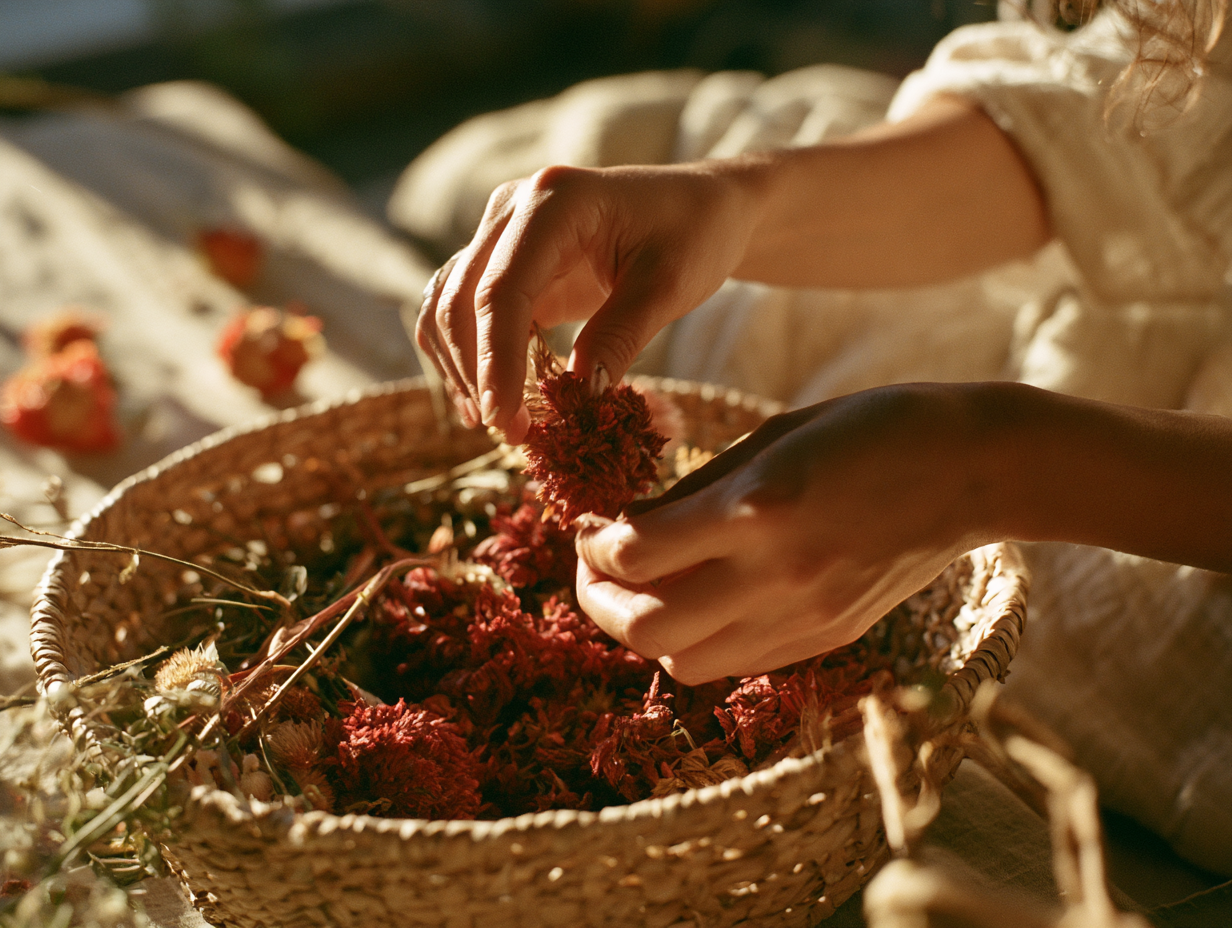
Selecting the specimens that will carry forward
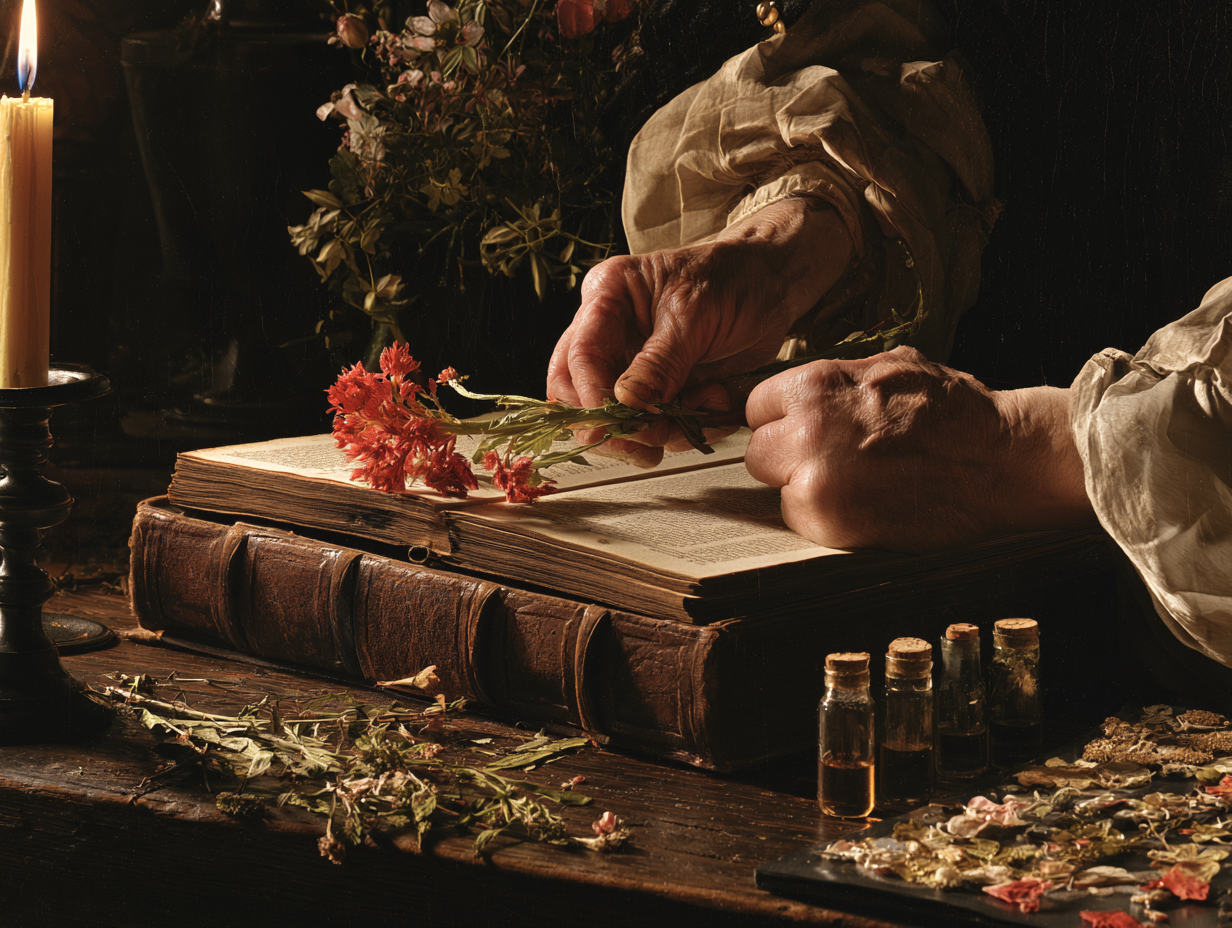
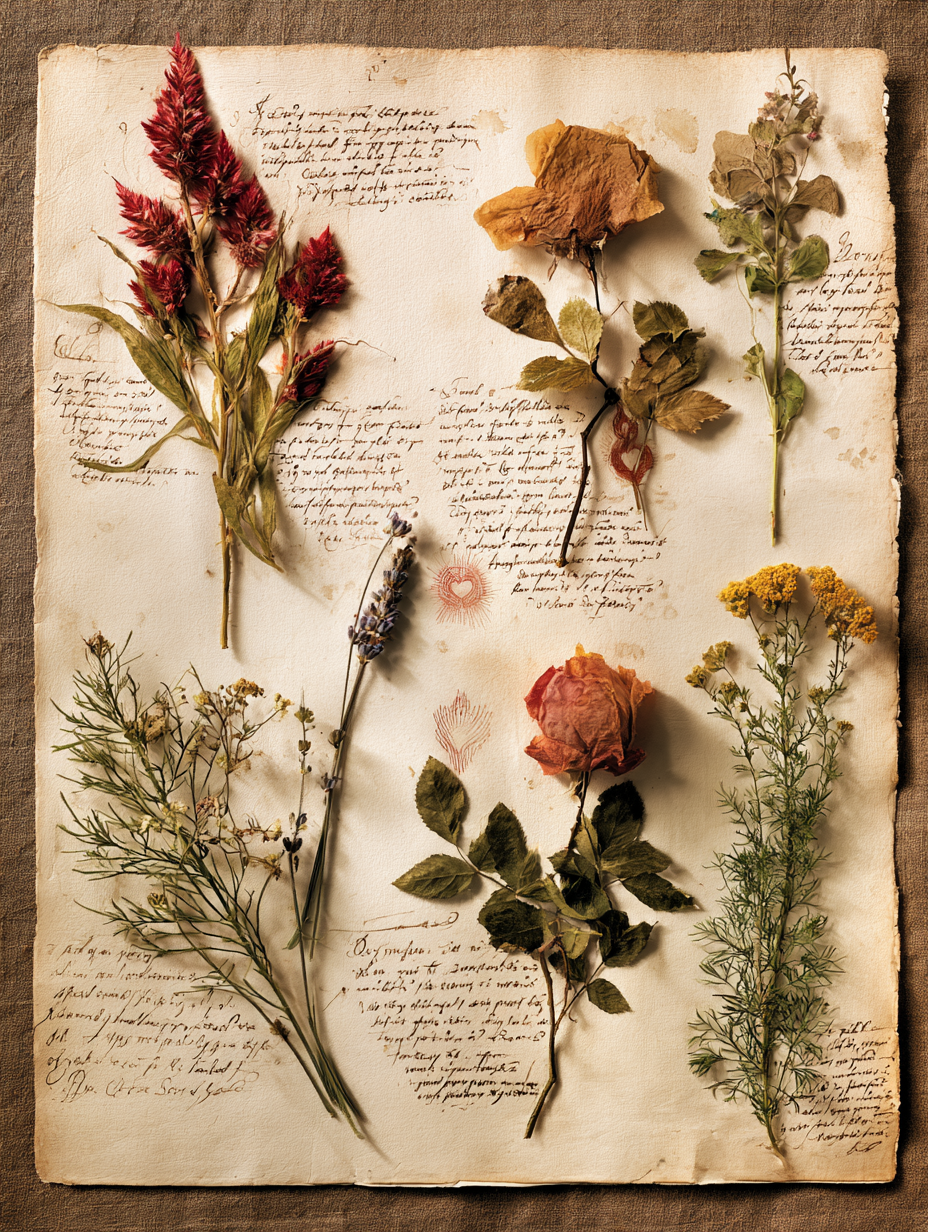
The record and the plant — two halves of the same gesture
The Chain of Custody
There is a line that runs from seed to field to frost to harvest to studio to piece to you. Every link in that chain is documented. Every botanical that enters a Floral Alchemy piece was grown here, by these hands, from seed stock selected and saved over thirteen years. No suppliers. No wholesale. No floristry market.
The chain of custody matters because the plant's meaning travels with the plant. A celosia grown in a warehouse under artificial light, shipped across three countries, is not the same object as a celosia that grew in a field you can stand in, that was touched by the same frost you can feel, that was harvested and pressed by the same hands that made the piece you wear.
This is not sentimentality. This is the grimoire tradition: provenance is part of the medicine. The source is part of the meaning. The land where a thing was grown is inside the thing.
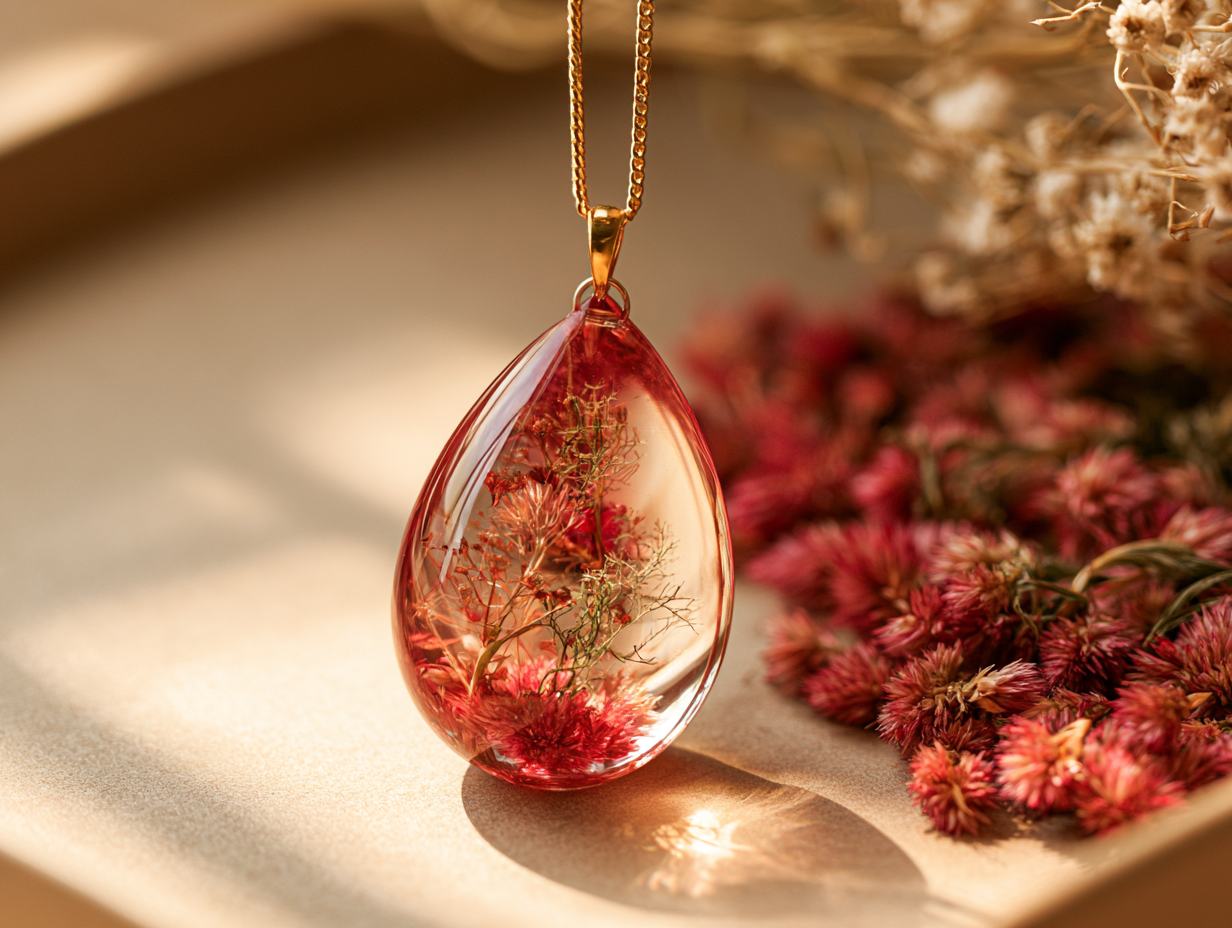
Seed to field to frost to piece — the full chain
The Grimoire Library
Braiding Sweetgrass
Not strictly a grimoire — but the most important book about the intelligence of plants written in our time. Kimmerer, a botanist and member of the Citizen Potawatomi Nation, weaves Western science and indigenous knowing into something that changes how you see every plant you encounter.
Find on Amazon →Plant Witchery
A contemporary guide to working with plant spirits and botanical magic. Practical, warm, and grounded in genuine respect for the tradition. Covers plant allies, ritual use, and how to begin a relationship with the plant world.
Find on Amazon →The Witchcraft of Dame Darrel of York
A facsimile of an actual 17th-century English manuscript — a working grimoire with recipes, charms, and botanical remedies. One of the most direct windows into what folk botanical knowledge actually looked like in practice.
Find on Amazon →The Green Witch
The clearest and most practical introduction to the green witch path. Covers herbalism, seasonal ritual, plant communication, and how to build a practice rooted in your actual landscape.
Find on Amazon →The grimoire is never finished.
You are always in the middle of writing it.