The history of color is the history of the plant world. Indigo from the leaves of Indigofera tinctoria. Red from madder root, from the cochineal insect, from safflower. Yellow from weld, from onion skins, from goldenrod. Green from nettles, from bracken fern, from the copper that forms when iron interacts with tannin-rich plants. Every color that clothed the ancient world, that illuminated medieval manuscripts, that painted the Renaissance, came from something that had first been alive.
Synthetic dyes were invented in 1856, when an eighteen-year-old chemist named William Perkin was trying to synthesize quinine and accidentally created mauveine — the first artificial dye. Within a generation, the plant-dye tradition that had sustained human color for ten thousand years had nearly vanished. What we lost was not just technique but knowledge — an intimate understanding of which plant, at which stage of growth, processed in which way, yields which color on which fiber.
The Plants That Make Color
These are the dye plants — the ones with a long history of yielding color, and what they give.
Walnut Hull
Rich brown to near-black
One of the oldest and most permanent dyes. No mordant needed. Stains everything, including hands.
Onion Skin
Gold to burnt orange
The most accessible natural dye. Yellow onion skins give warm gold; red onion gives green on alum-mordanted wool.
Woad / Indigo
Pale sky to deep navy
Requires a fermentation vat. The depth of color depends on number of dips. One of the most complex plant dyes to work with.
Madder Root
Coral pink to deep red
Color shifts dramatically with mordant and pH. Alum gives orange-red; iron gives darker, cooler tones.
Goldenrod
Clear, bright yellow
Excellent lightfastness for a yellow dye. Harvest at peak bloom. One of the most reliable native dye plants.
Nettles
Soft sage to olive green
Best harvested young, before flowering. One of the few plants that yields a true green directly.
Elderberry
Violet to grey-purple
Beautiful but fugitive — fades with light. Best used on protein fibers (wool, silk) with an alum mordant.
Larkspur
Pale gold to warm buff
The blue petals yield surprising warmth rather than blue. The ancient Egyptians used larkspur for a blue pigment — that requires a different extraction process entirely.
Mordants — The Chemistry of Fixing
A mordant is a metallic salt that bonds with both the dye molecule and the fiber, creating a bridge that holds the color in place. Without a mordant, most plant dyes wash out or fade quickly. With the right mordant, a natural dye can last centuries — the colors in medieval tapestries, still visible today, were fixed with alum and iron and copper.
Alum (potassium aluminum sulfate) is the most common mordant, producing clear, true colors. Iron (ferrous sulfate) saddens colors — shifts them darker, greener, colder. Copper brightens greens and teals. Tannin, found in oak gall and sumac, is used as a pre-mordant on plant fibers. The mordant does not change the dye — it changes what the dye is capable of becoming.
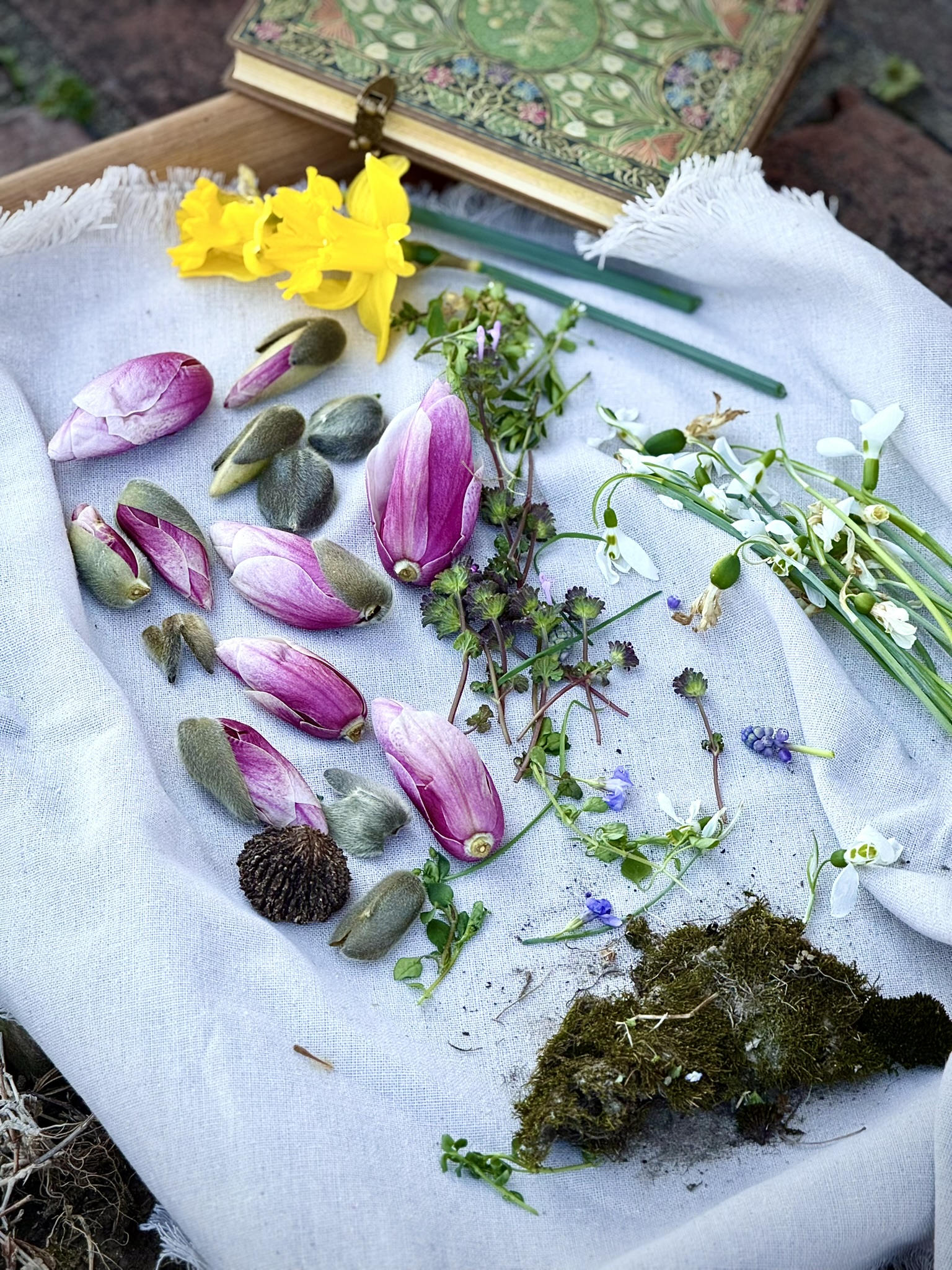
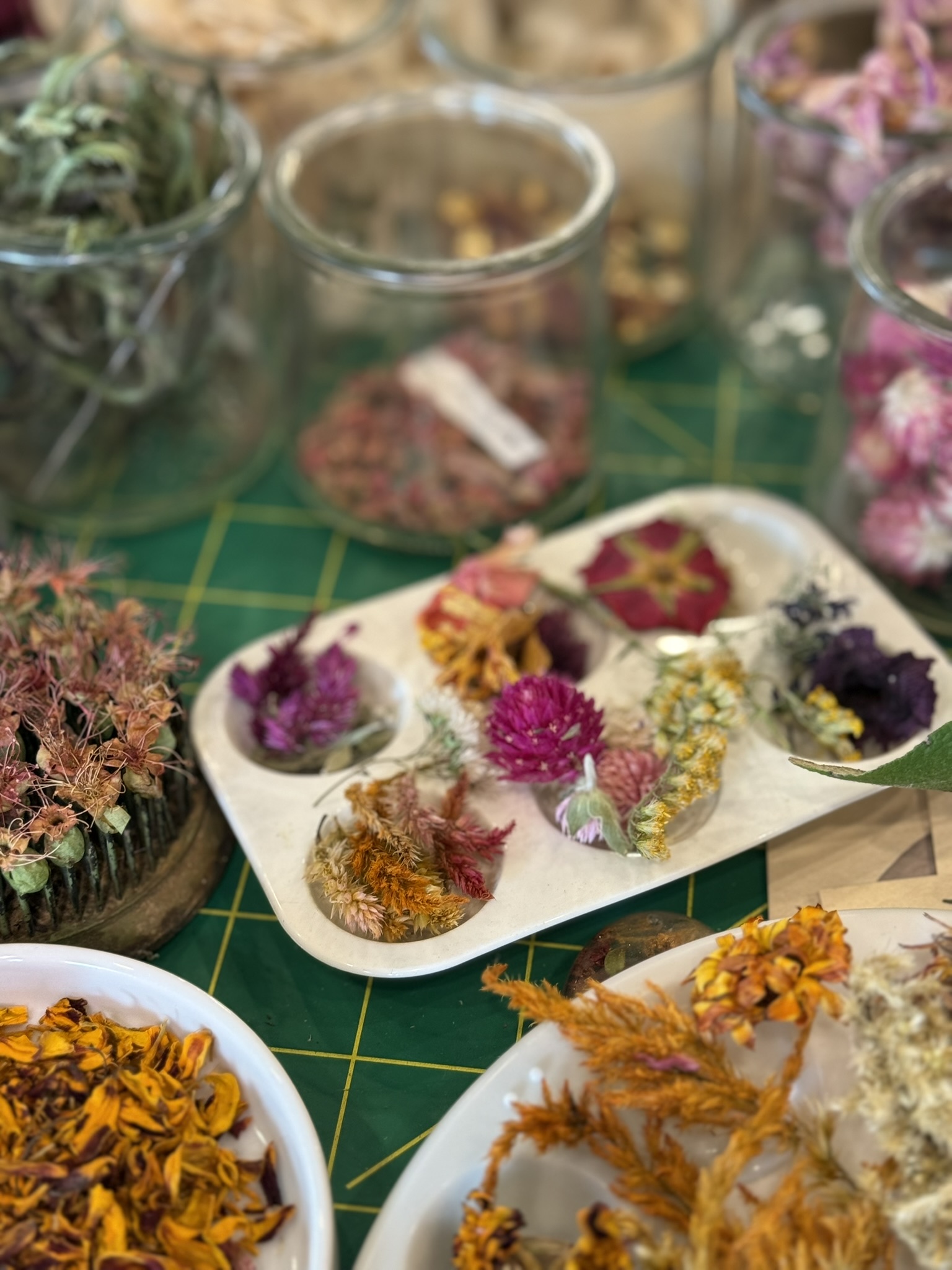
What is gathered — and what it becomes
Color in the Practice
Natural dye is not a primary material in the Floral Alchemy pieces — the color in the work comes from the flowers themselves, preserved as they were. But the understanding of how plants make color informs everything. Why certain botanicals hold their color in press and others shift. Why goldenrod stays gold when larkspur fades to straw. Why a celosia's crimson holds across years in resin when a zinnia's pink does not.
Every flower is a dye plant in waiting. Its color exists because of pigment chemistry — flavonoids, carotenoids, anthocyanins, chlorophyll — and understanding that chemistry is understanding why the press does what it does to each one. The mortar and pestle on the table is not decorative. It is the symbol of the oldest question in color: what is inside this, and how do we bring it out?
"The natural dyer's skill is to find, in the plant world, the colors that civilization forgot it had."
On Color & Plant Pigment
A Weaver's Garden
The most practical and beautiful guide to growing and using dye plants. Covers which plants to grow, how to harvest, mordant, and dye — written by someone who has actually done all of it.
Find on Amazon →Chromatopia: An Illustrated History of Color
An extraordinary visual history of pigment and dye — where each color came from, how it was made, and how it changed human culture. Stunning to look at, surprising to read.
Find on Amazon →The Golden Thread
A history of fabric, fiber, and color across human civilization. Includes deep material on natural dyes, the indigo trade, and what plant color has meant to cultures around the world.
Find on Amazon →