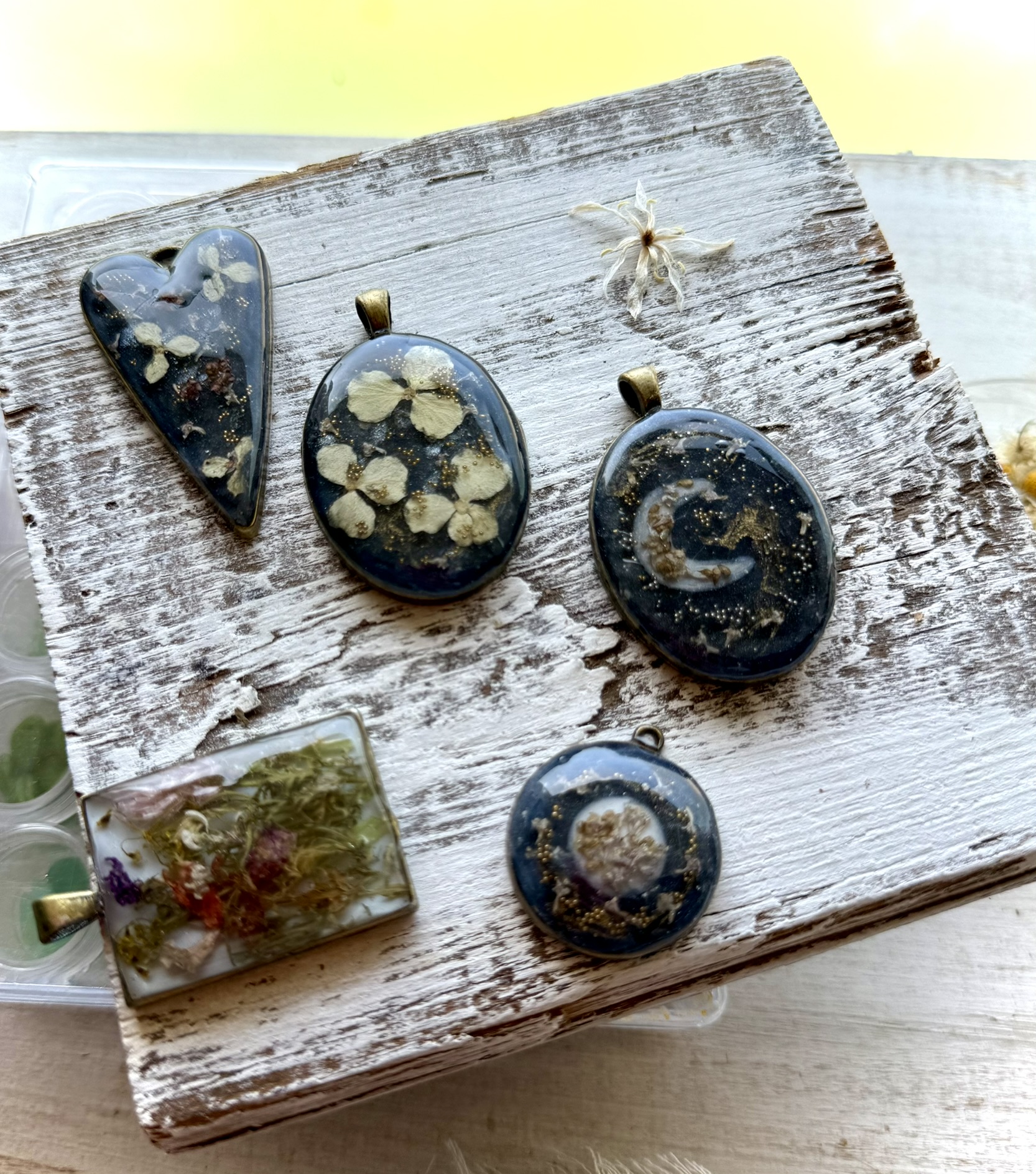
The collections and the pieces pages show you what something became. This page shows you what it was in the transformation — the work table covered in components, the pressed specimens laid out on weathered wood while messages come through and the flowers decide who they want to stand next to for eternity.
The alchemy doesn't happen here. It has been happening all season.
A seed, grown by my own hands. Planted here, grown here, full of the sun, water, wind and rain of this place. All the magic transmuted from the ancient below — up through the roots and into the genetics of the emerging beauty. It is not just what the seed brings in all its tightly bundled possibility. It is a season of it being grown here. In this ground, in this place, in this moment in time. After a season of being infused with a magic that doesn't live in a bag of cut flowers at Trader Joe's.
There is no floral or vegetative material used that is not infused with love, with these seasons, and with the magic that only this place can add. There are so many more types of flowers and colors and textures out there — and if I didn't care about the importance of the magic of my soil, every flower would feel like a candy store to me. But it doesn't. These flowers are a part of me and I am a part of them and we are in relationship to each other. The alchemy is not me transforming them. It is how they are transforming me. Other flowers don't have the power to do that.
I had been a wedding and floral designer for over a decade. But it wasn't until I started growing my own blooms that things began to change. The flowers became infinitely more beautiful to me, and the process began before I even imagined such a thing could happen.
Flowers are of a season. Nothing blooms all year. I immortalize them at their pinnacle — and to thank them, I collect their seeds, and by way of a seed company, I send the future offspring of my flowers to grow out all over the world. Something that can only happen in partnership, in the committed relationship in which we both thrive.
"The flowers decide who they want to stand next to for eternity. I get the message. We simply begin."
The Preservation
Every piece starts in the garden and ends in the studio. Whether it's hung to dry naturally, pressed, bathed in silica, dehydrated quickly, or open-air flat dried — each different type of flower has its own range of outcomes from each preservation method. By now, through enough seasons of trial and error, we simply know who goes where and why and for how long. The trial and error period is long passed.
I already know when to be ready, and for who, when to gather and what the plan is. I design within the season. I want to preserve their beauty and essence as close to their natural season peak as possible — the results are best while the color is at its freshest. After the blooms decide the design and the seating arrangements, I get the message. We simply begin.
The Harvest
Color at its peak. Each flower gathered at the precise moment it has the most to give. The window is always shorter than it looks.
The Preservation
Pressed, hung, silica-dried, dehydrated, flat-dried — the method chosen for the flower, not the other way around. Each species has its own range of outcomes and its own timeline.
The Choosing
Specimens laid out on weathered wood. The flowers decide who they want to stand next to. The message arrives. We simply begin.
The Setting
Resin poured in layers. Stones coated, bezels filled. I pour and sculpt, darting in and out of sunlight to control the viscosity and flow until it's just right — then the pieces go back out into the garden to finish their process in the sun they know and love. Gemstone beads counted out for a chain. Nothing rushes this stage; it takes as long as it takes.
The Finish
Sanding, polishing, assembly. A piece either works or it doesn't. If it doesn't, it goes back. Some pieces take three attempts. Some take one perfect hour.
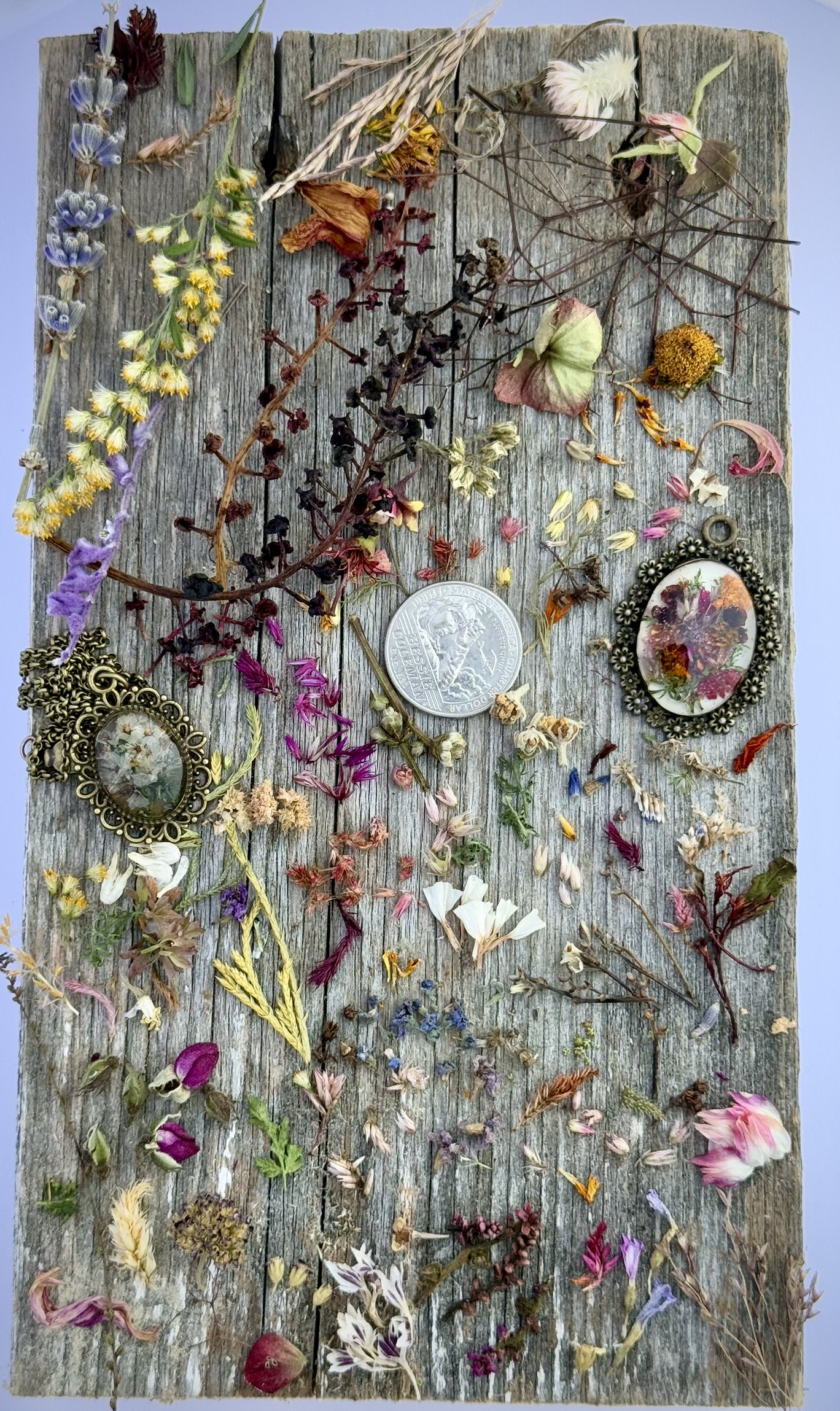
The choosing stage — every specimen a candidate, two already chosen
Grounding Stones
River stones have their own logic. Each one arrives from the water already shaped — already finished in one sense, unfinished in another. The ones that become pieces are selected for flatness, for oval geometry, for a surface that will hold a pressed flower and accept resin without running.
These are grounding stones. To anchor your energy to the millennia that have held them — and can hold you, too. A tactile reminder that even you, as a human, are a much older life force than you yet remember. The stones try to help you remember who you are.
Dark stones go one direction — deep resin, botanical silhouettes going gold against shadow. Light stones go another — pale resin, full color, the pressed flower as vivid as the day it came out of the press. Same material, two entirely different alchemy.
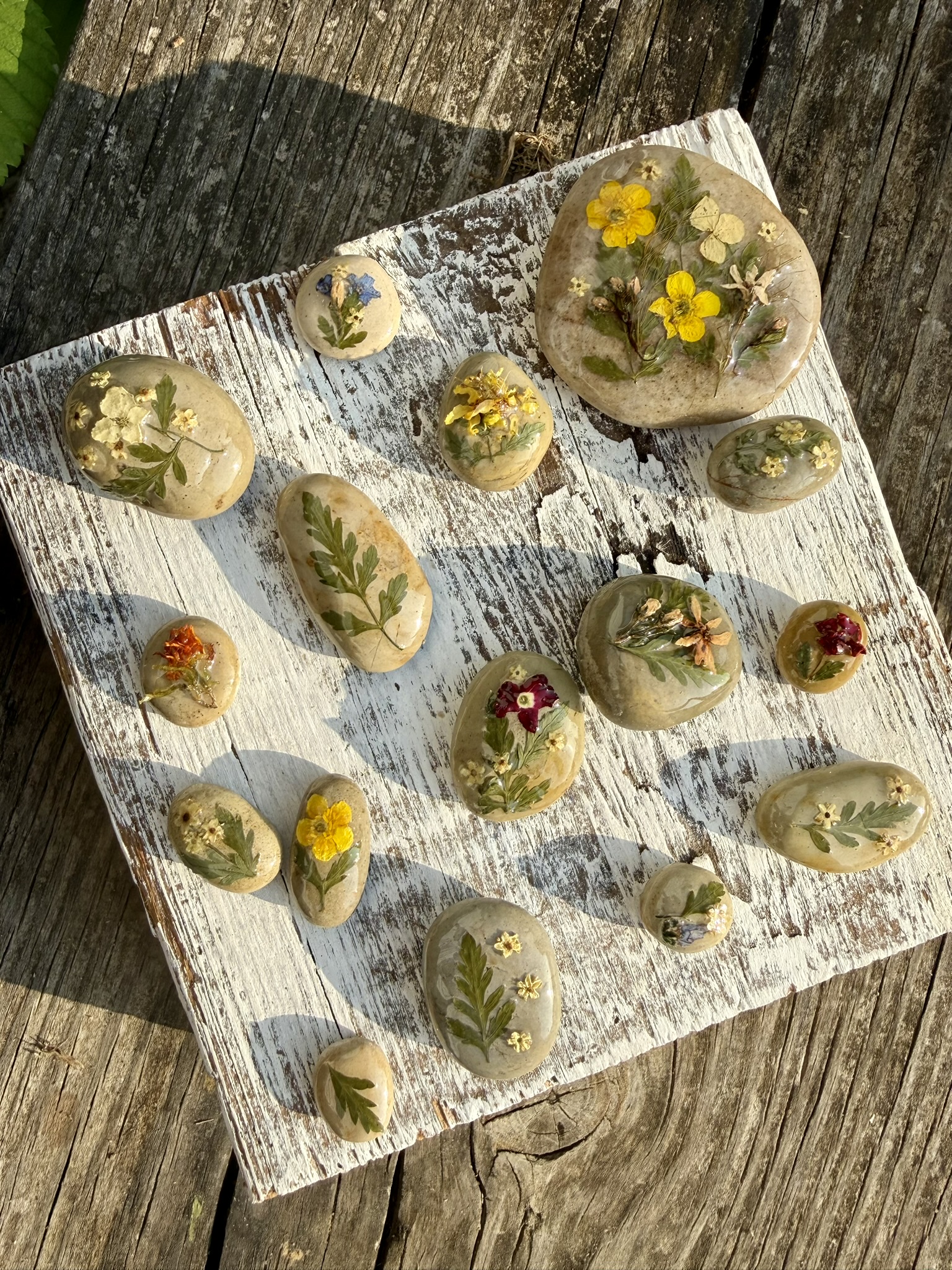
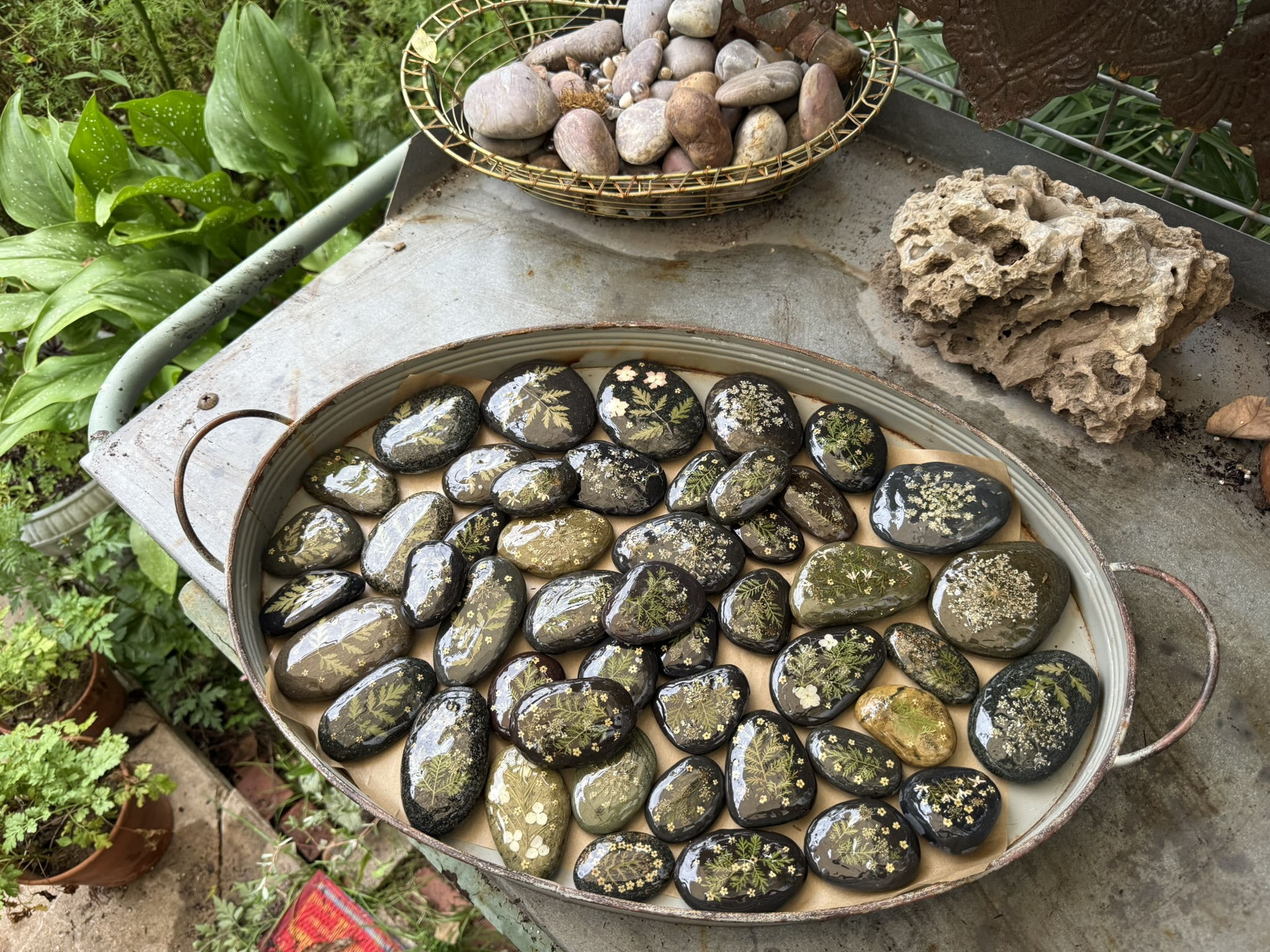
Light stones and dark — the same process, two entirely different worlds
The Workspace
The studio is entirely a workspace, studio, shrine, and archive. In spring and summer it feels more like Grand Central Station — with the comings and goings, connections, clamor, clutter, and sometimes chaos of so many things arriving and being sorted for their next destination.
A clean central table is a luxury you have to plan for. Because other than the intention of clearing it for a specific purpose, it represents all the pieces of a symphony as it is being written, still surrounded by everything that didn't work and everything that has yet to audition. It is a beautiful space because it has all the natural light needed to inspire — and to help transmute the flower forms in the most natural way possible as they ascend to their new eternal forms.
The room is filled with things not involved in the actual process, but that are essential to the environment that makes the work possible — to producing the rare jewels the universe tasked us with finding within, or so says Elizabeth Gilbert in Big Magic. This space does everything all at once. There is no linear process. It is everything everywhere at the same time, and still the magic comes through.
Or maybe because it reads as chaos, dimensionally it looks like space being actively held open for all of the possibilities. When anything is possible, everything is possible.
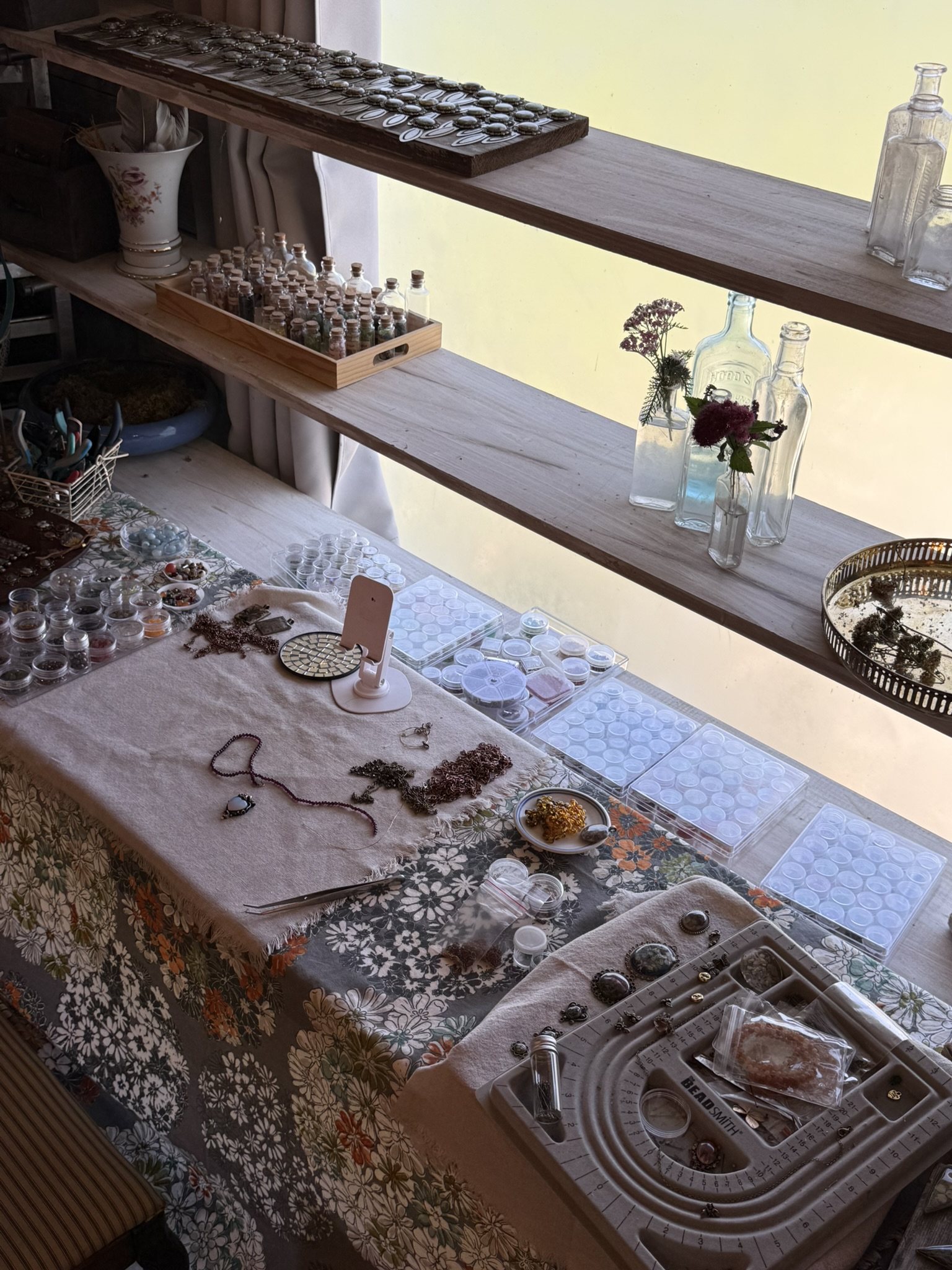
The bench — everything mid-sentence
The Setting
A bezel pendant begins as a metal frame and a pressed specimen chosen to fit it. The resin goes in layers: a base coat to seat the flower, then the finish coat that seals it permanently. Each layer cures before the next is added. The work cannot be hurried and cannot be faked.
The image at the top of this page catches something that rarely gets documented: celosia in bezels after the first pour only. Secured, but not yet encased. The flowers are still standing proud of the resin surface — still three-dimensional, still themselves, still open to the air. One more pour and that is over. The next coat will close over them and hold them exactly as they are in that moment, permanently. What the finished piece preserves is not the flower at its most alive — it is the flower at the precise instant before it became something else.
When a piece moves from pendant to necklace, the design of the chain is a separate decision entirely. Gemstone beads laid out beside the pendant, one by one, until the combination feels right — color, weight, the way the pendant will hang at the end of it. Every element of a finished piece was once a question.
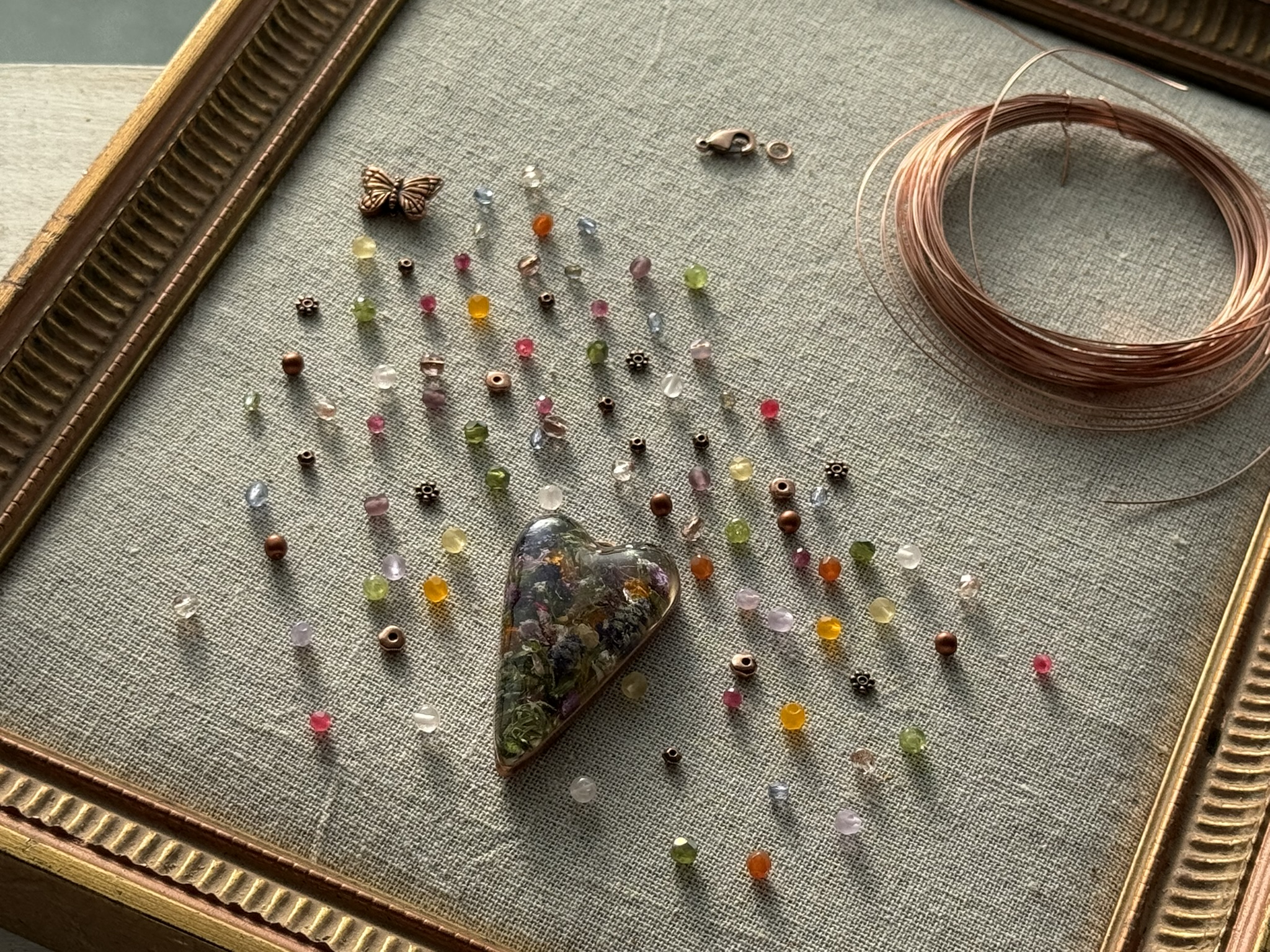
After the resin — before the chain
"The finished piece is the answer. The bench is where all the questions live."
Quality Control
The studio has an inspector. She has strong opinions and no concept of wet resin. She has never damaged a piece — she has come close — and her approval, while entirely unsolicited, is generally taken as a good sign.
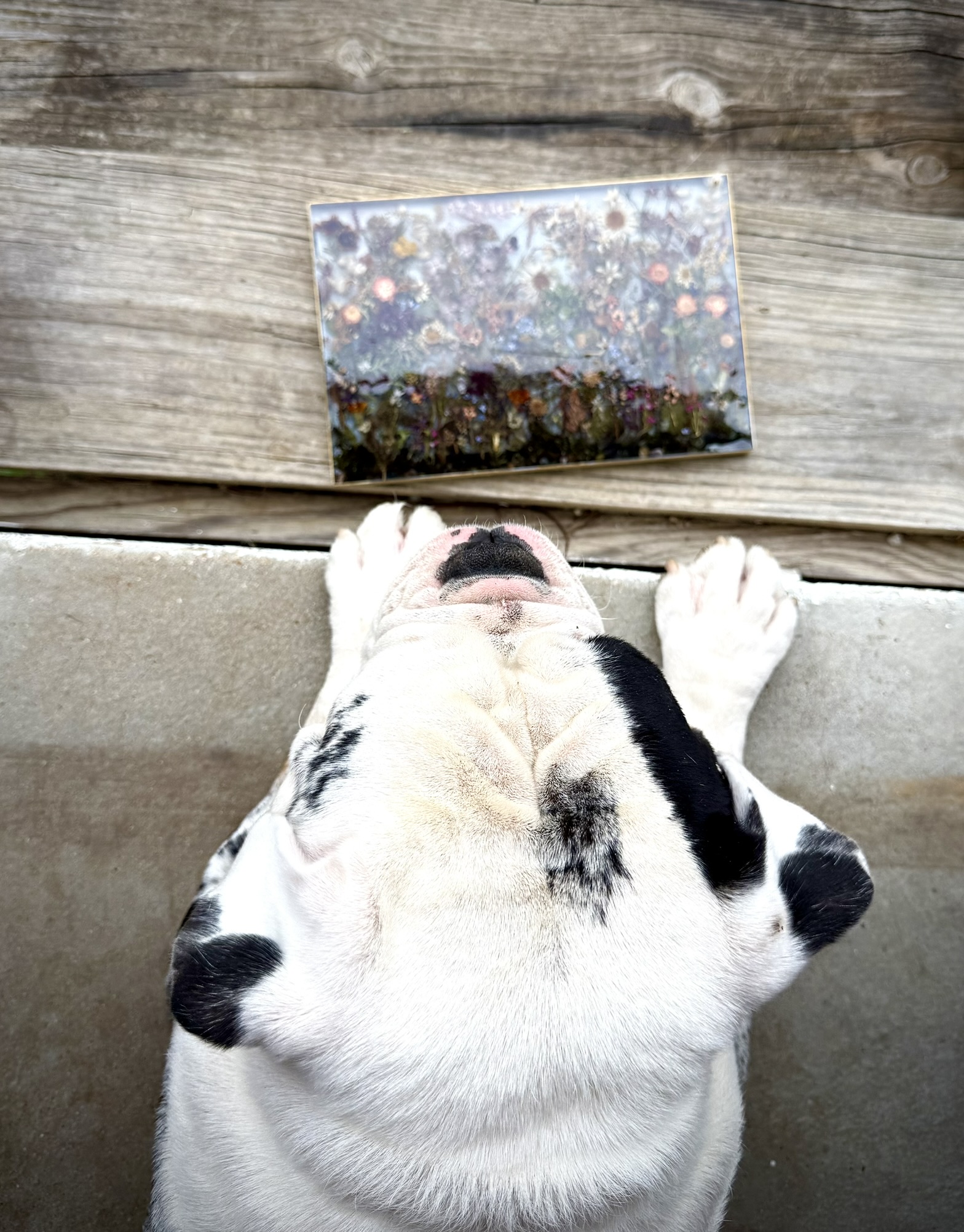
The inspector renders her verdict