Nobody hired them. Nobody posted a listing. They found the garden because the garden had what they needed — pollen, nectar, shelter, prey — and they've been showing up ever since. Every flower that became a piece moved through their care first. Every bloom that made it to the wonder table was touched, at some point, by at least one of them.
This page is for them. Not a field guide — they don't need classification. A proper introduction. Because the difference between swatting at something and stopping to look at it is almost always just knowing who it is.
Operations Lead
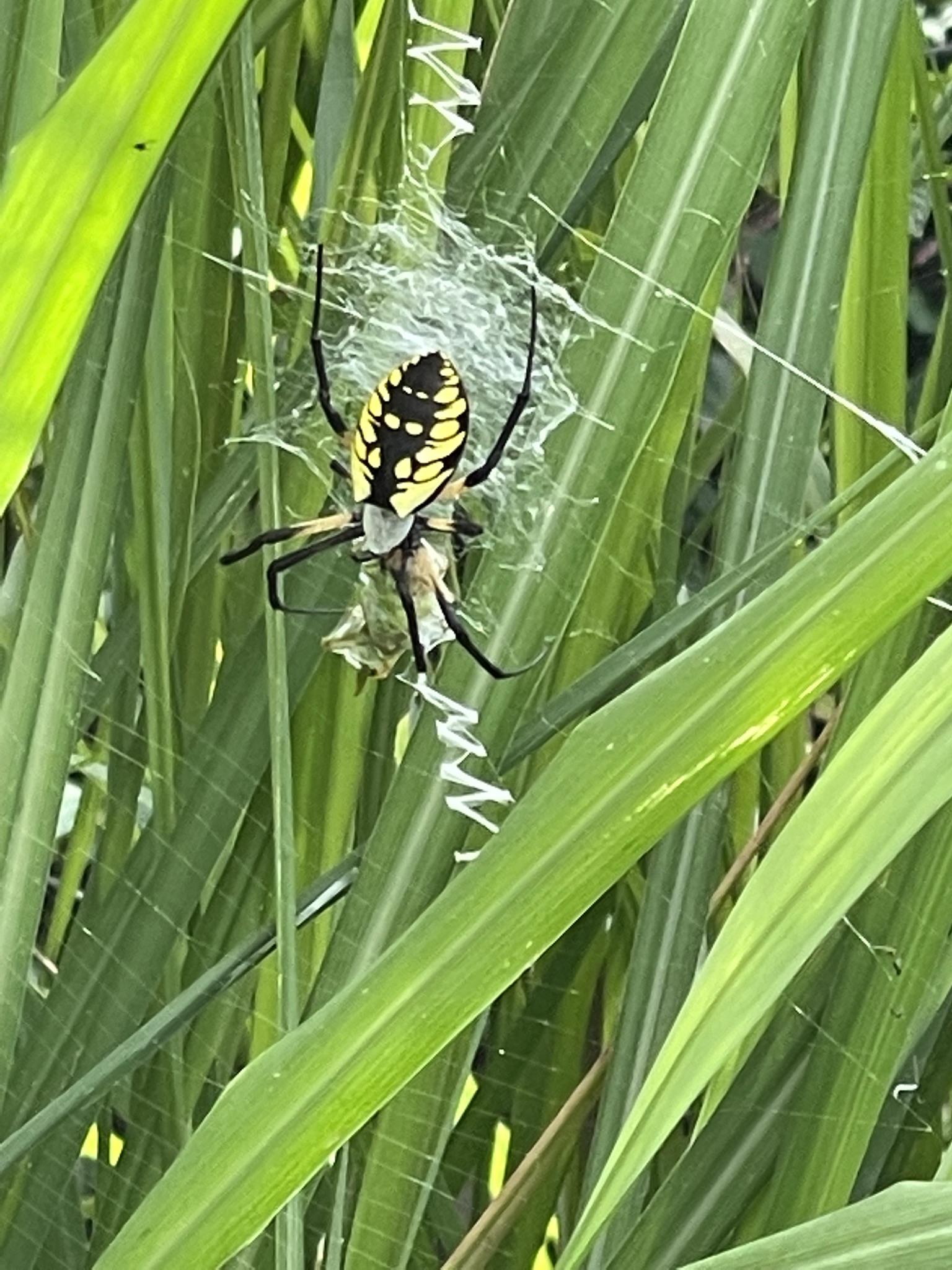
Argiope aurantia
The Garden Spider
She builds her web in the same place every year. The zigzag band down the center — called the stabilimentum — is her signature. No two garden spiders make theirs exactly alike, and nobody fully knows what it does: leading theories include that it reflects ultraviolet light to attract insects, or warns birds away from flying through the web, or stabilizes the structure during vibration. She has been making it since before there were theories about it.
Seven distinct types of silk come from her body, each engineered for a specific function: structural support, sticky capture threads, the dragline she uses to move, the wrapping that immobilizes prey, the attachment points that anchor the web to the world. She rebuilds the center of the web every night — consuming the old sticky spiral and remaking it fresh — while leaving the structural frame intact. She is not decorating. She is engineering.
The male garden spider is one-quarter her size. He finds her by following vibrations through her web. He courts her carefully. After mating, she spends her remaining energy building an egg sac — brown, papery, the size of a large marble — suspended near the web's edge, containing 300 to 1,400 eggs. She will not live to see them hatch. They overwinter in the sac and emerge in spring, each one already knowing how to build a web. She was here before the season started, and her children will be here long after it ends.
The Butterflies
Five species visit this garden regularly. Each one is doing something completely specific — a different flower preference, a different flight pattern, a different story that got it here.
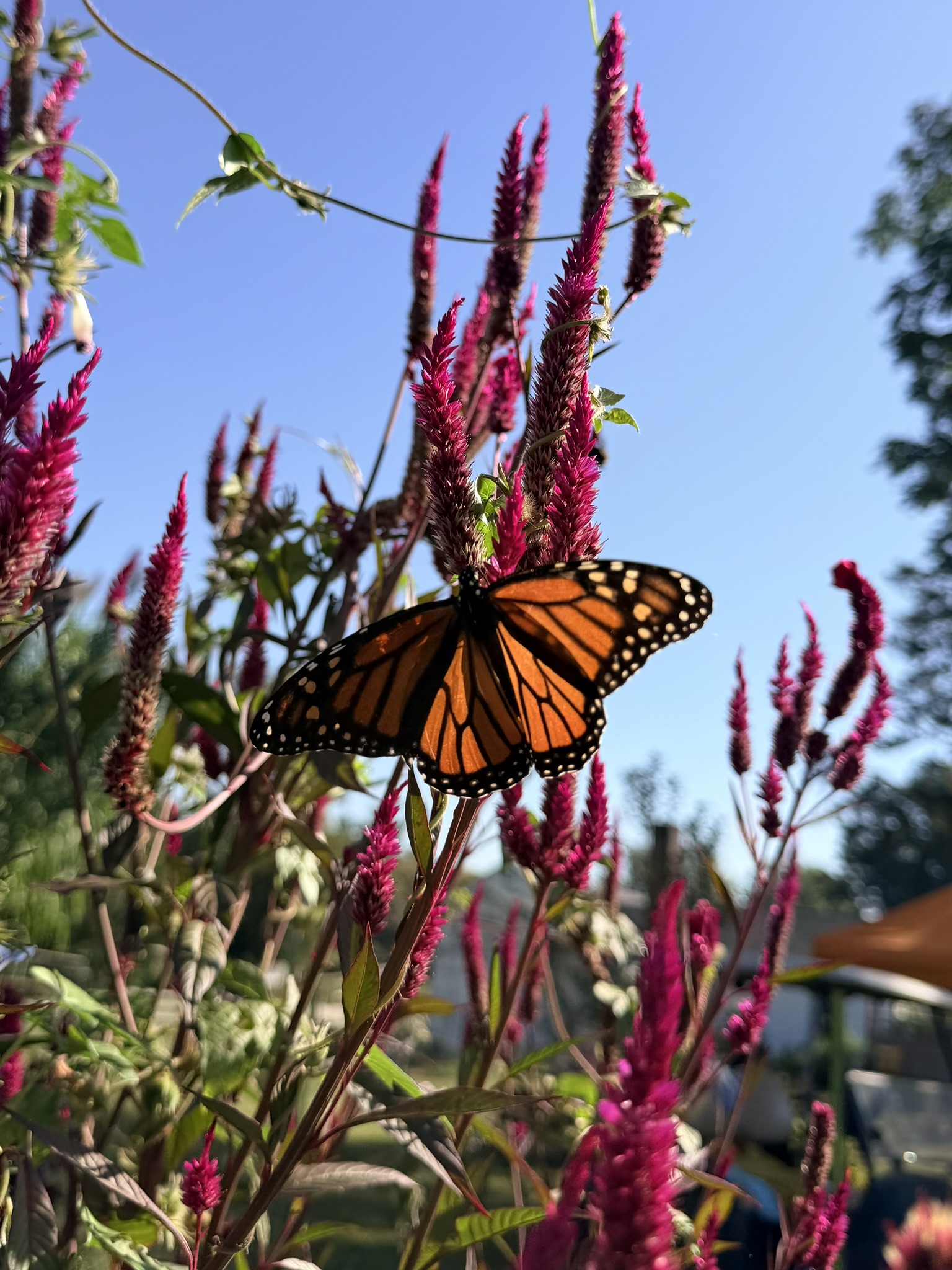
Danaus plexippus
The Monarch
There are four generations of Monarchs every year, and three of them are brief. They hatch in spring and summer, live for two to six weeks, mate, and die. The fourth generation — the one that emerges in late summer, the one most likely to visit this garden — lives for eight months. This generation is called the Methuselah generation. Their reproductive organs don't fully develop until spring. Their fat reserves are enormous. And instead of dying when the season ends, they migrate.
2,500 miles, to the same mountain forests that their great-grandparents left. They navigate using a time-compensated sun compass built into their antennae — a biological clock that adjusts for the sun's changing position throughout the day, keeping them oriented southwest regardless of the hour. No individual Monarch has ever made this journey before. They are flying to a place they have never been, guided by something inherited rather than learned.
The orange wings are not decoration. They are a warning. The milkweed they fed on as caterpillars loaded them with toxins that make them unpalatable to birds, and birds have learned the color over generations. Every Monarch that lands in this garden is one of the ones that made it. Stop and look at it. It earned the stop.
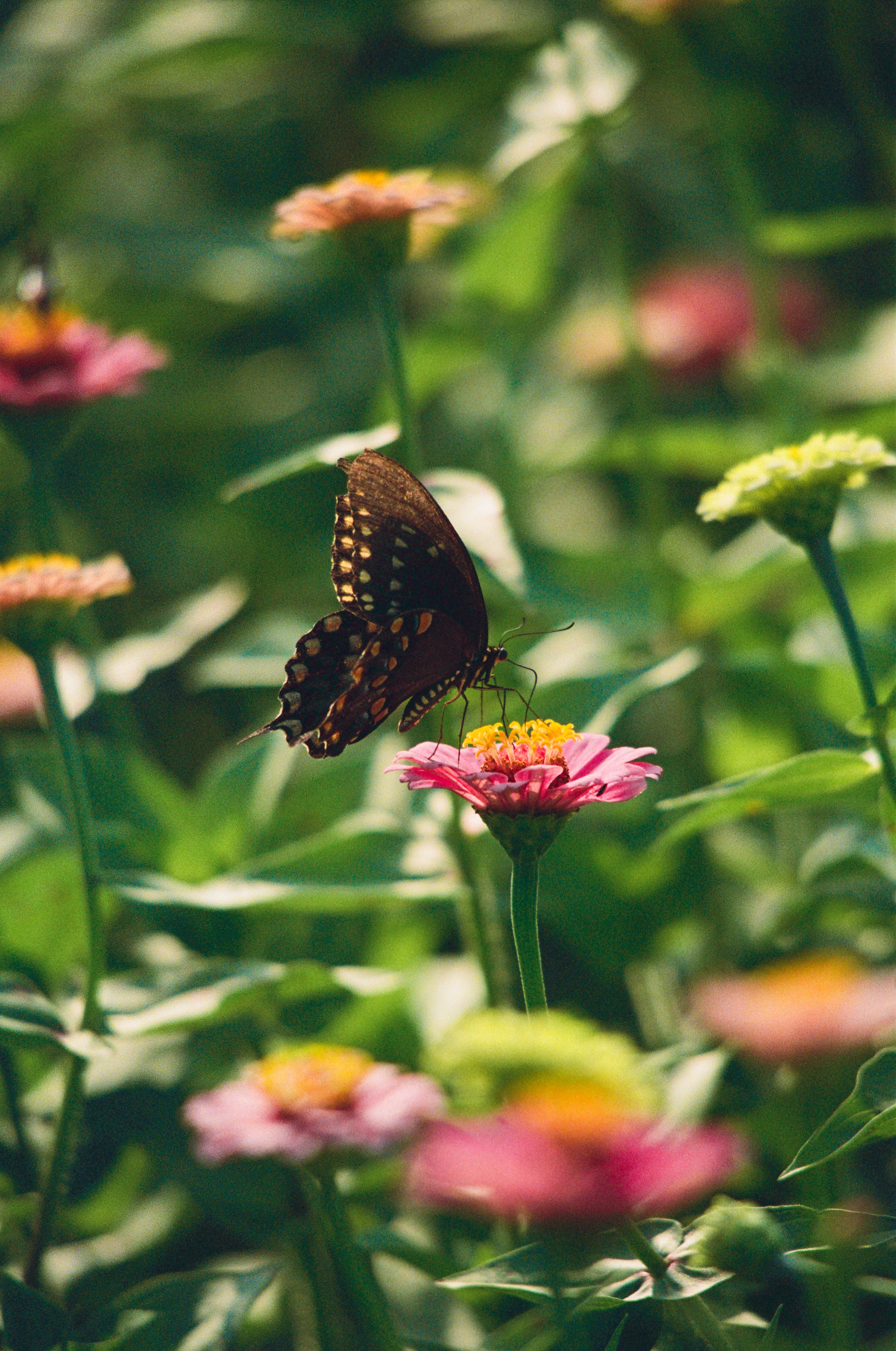
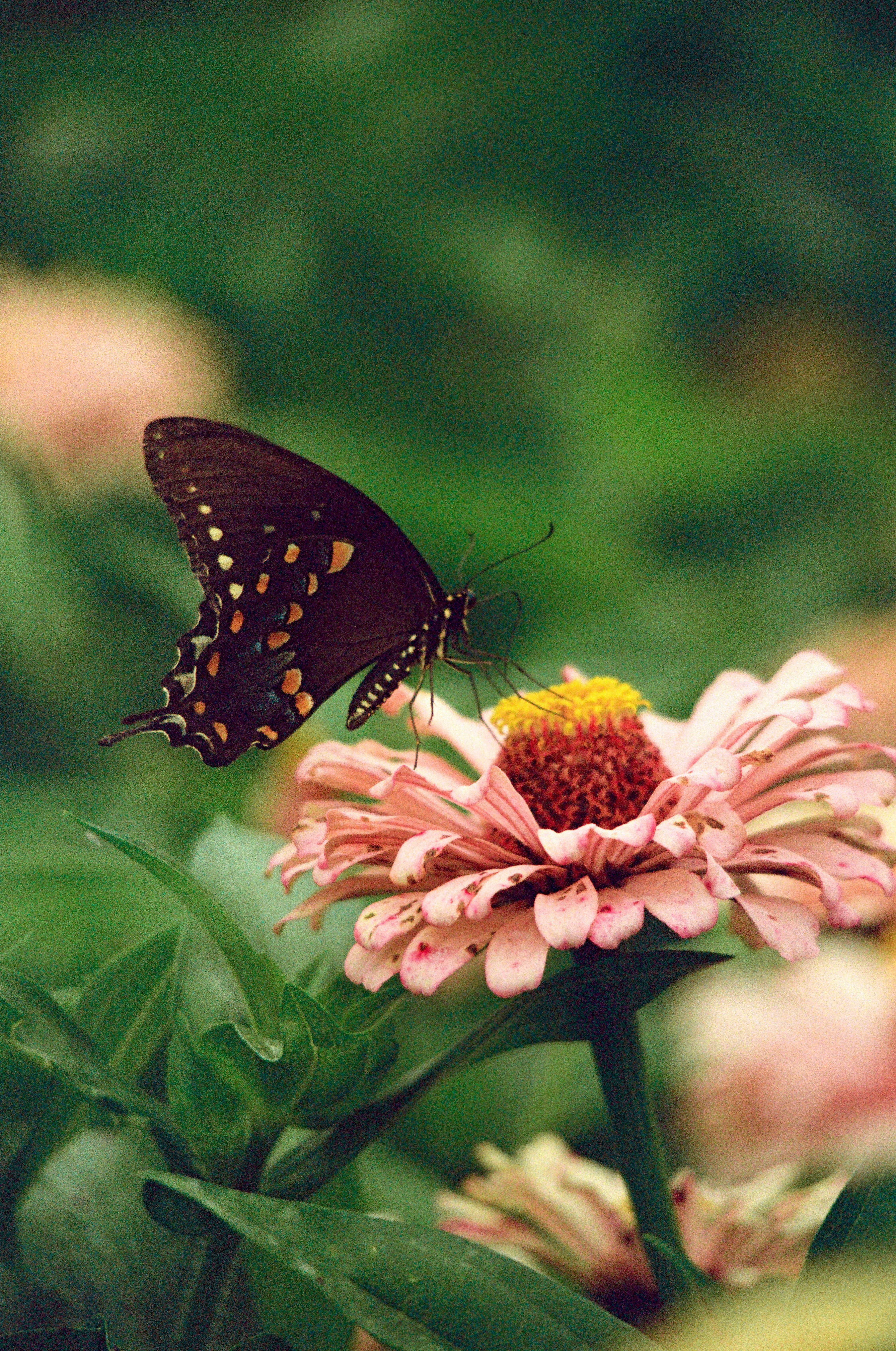
Papilio polyxenes
The Black Swallowtail
The Black Swallowtail is what slow attention looks like on wings. Where other butterflies dart and dodge, the Black Swallowtail spirals. It investigates. It takes its time on each flower — working one zinnia fully before moving to the next, often pausing between blooms as if reconsidering. Both photographs in this collection were taken on film, which means there was no preview, no delete, no second chance. The Black Swallowtail allowed itself to be caught because it is, reliably, the least likely to startle of any butterfly in this garden.
The caterpillar is a different matter entirely. Striped in green and black and yellow, it feeds on plants in the carrot family — parsley, dill, fennel, Queen Anne's lace. Hidden in a fold behind its head is an organ called the osmeterium: a bright orange forked structure that deploys when the caterpillar feels threatened, releasing a smell that repels birds and predators. The caterpillar unfurls it, the predator recoils, and the butterfly that will eventually become is preserved.
Every Black Swallowtail in this garden started life as something fierce.
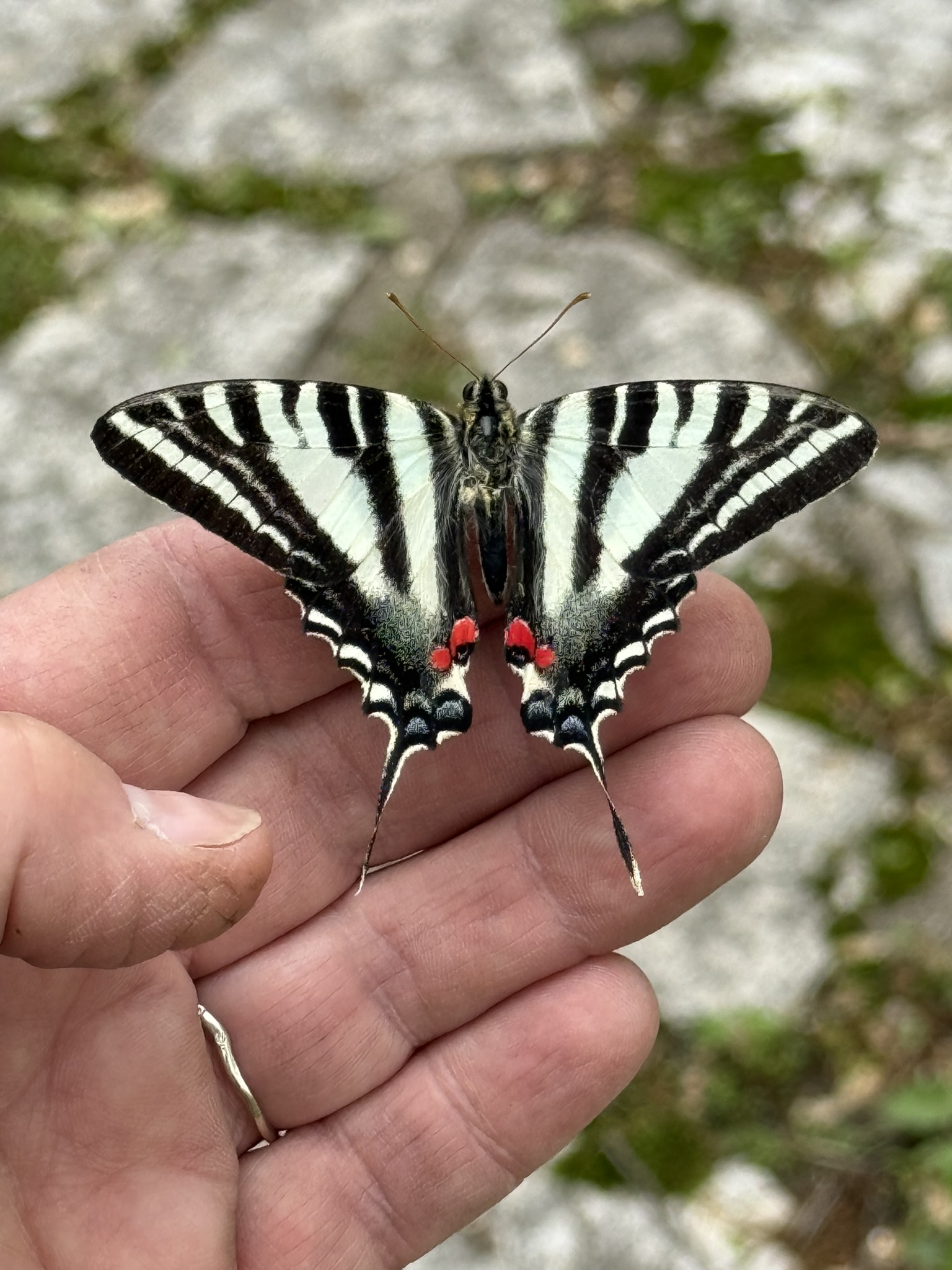
Eurytides marcellus
The Zebra Swallowtail
The Zebra Swallowtail exists only where pawpaw trees grow. Not prefers — exists. The female will only lay her eggs on pawpaw leaves, and the caterpillars will only eat pawpaw. No pawpaw tree within foraging range means no Zebra Swallowtail. Finding one means the ecosystem extends further than you can see — pawpaw is growing somewhere nearby, and the whole chain is intact enough to support this.
They are among the fastest of the swallowtails — they can disappear from a garden in seconds — and they almost never make contact with people. The long tails on the hindwings draw bird strikes away from the body, acting as false targets. The red and blue eye-spots startle when the wings are opened suddenly. Everything about this butterfly is a survival mechanism, including the beauty.
This one landed on an open hand and stayed. That almost never happens. It made its own decision to stop there, for whatever reason a Zebra Swallowtail has reasons. Then it was gone.
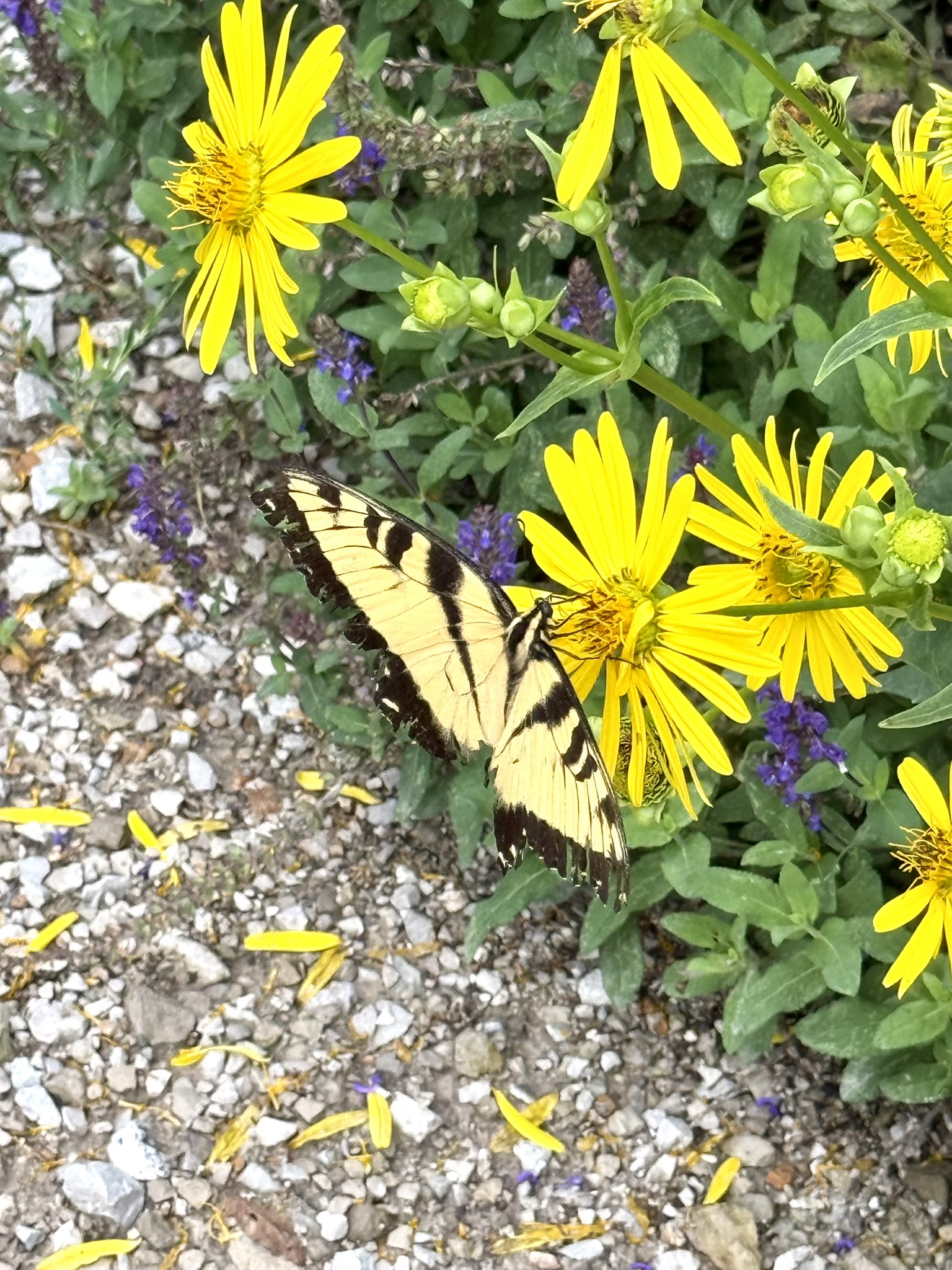
Papilio glaucus
The Tiger Swallowtail
The Tiger Swallowtail is the largest butterfly in eastern North America — wingspan up to five and a half inches. You see it before you're looking for it. It is impossible to miss and deeply satisfying to find, which is perhaps why it appears in so many childhood butterfly memories: it is the butterfly that first taught a generation of people to pay attention.
The female comes in two forms. The yellow and black form that looks like the male. And a dark form — deep brown-black, with hints of iridescent blue — that mimics the Pipevine Swallowtail, which is genuinely toxic and which birds have learned to avoid. The dark-form female is not toxic. She is wearing a costume, and it works. Male Tiger Swallowtails gather at muddy puddles in groups — a behavior called puddling — to drink mineral-rich water and sodium that they'll later transfer to females as a gift during mating.
Relatives of this species appear in fossils dating back 70 million years. They were here before flowers looked like this. They will be here after.
"A butterfly lives two to six weeks. In that window it completes an ancient contract: plant to pollinator, carried forward another season. We get to watch it happen. That is the whole deal."
The Bees
The most important collaborators in the garden. Not the most famous — the honeybee is not native, not the primary pollinator here, and not in any of these photographs. These are the ones that actually did the work.
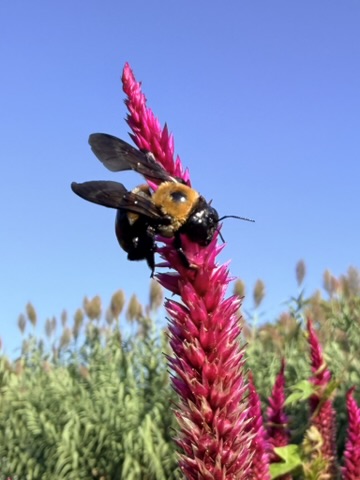
Bombus species
The Bumblebee
Everything bumblebees do, they do differently from other bees. Their flight buzzes at a lower frequency. Their bodies are larger and fuzzier — the pile on a bumblebee is called scopa, and pollen clings to it with every contact. And their approach to flowers involves a technique that no other pollinator in this garden can perform: they grab a flower and vibrate.
This is called buzz pollination, or sonication. The bumblebee grips the anther of a flower and vibrates her flight muscles at roughly 400 hertz — a frequency close to the musical note G — until the pollen shakes loose. This is the only mechanism that releases pollen from tomatoes, blueberries, peppers, eggplant, and potatoes. Honeybees cannot do it. They land on these flowers and leave without the pollen. The bumblebee is the reason these crops exist at the scale they do.
She is also cold-tolerant in a way other bees are not — she can warm herself by shivering her flight muscles before takeoff, allowing her to forage on days that ground every other pollinator. She starts before spring is fully here and finishes after it's gone.
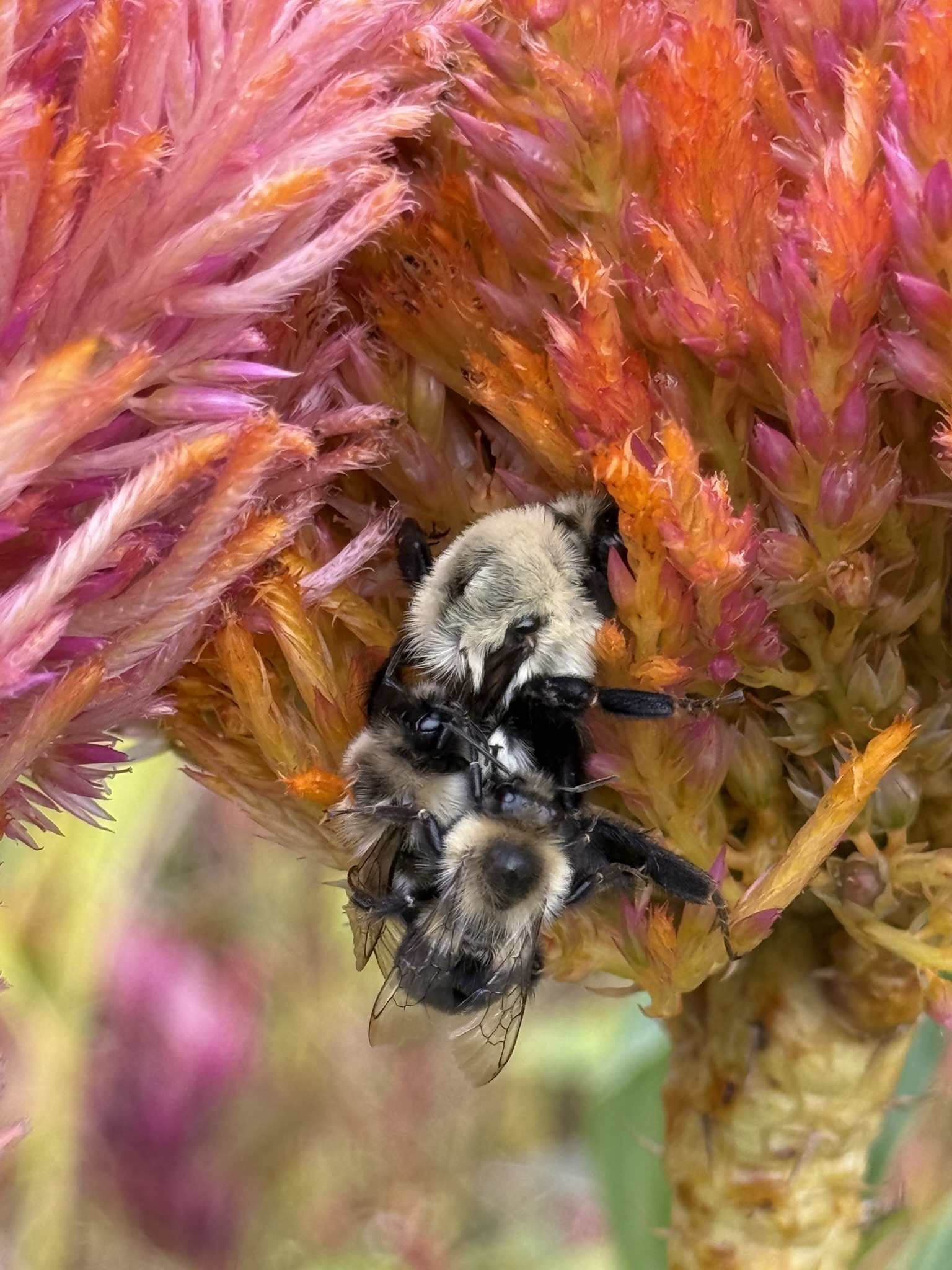
Bombus species
The Bumblebees
Look more carefully at this photograph. That is not two bees working side by side. That is one large bee with two smaller bees riding on top of her. This changes the story entirely.
What you are likely seeing is a mating event — or a competition for one. Male bumblebees emerge late in the season and spend their days patrolling for newly-emerged queens. When multiple males locate the same female, they mob her. They pile on. She carries them while foraging, while flying, while trying to do everything else she was doing before they arrived. It is chaotic and loud and nothing like the orderly colony life happening back at the nest. This is the other side of the operation — the part that looks less like engineering and more like everything coming loose at once.
The alternative reading: cuckoo bumblebees — a whole genus of parasitic bees that look almost exactly like bumblebees — invade nests, kill or displace the queen, and lay their own eggs for the host colony's workers to raise. They are brazen. They have no pollen baskets because they do no foraging. They are here only to take over something someone else built.
In either case, what is happening in this photograph is not peace. The cockscomb does not appear to care.
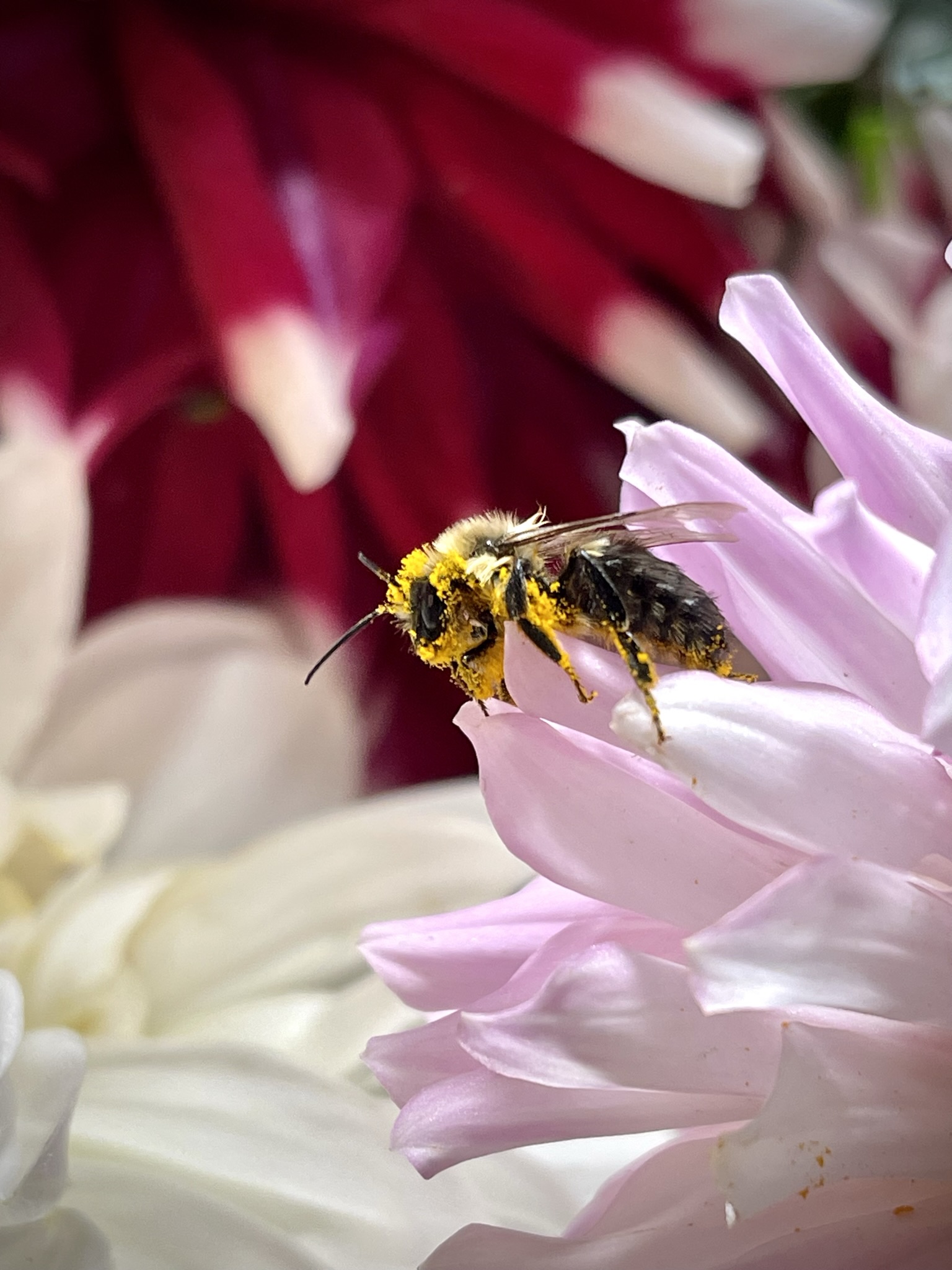
Bombus species · post-immersion
The Pollen Drunk
She has been inside every flower. The flowers have been inside her.
What you are looking at is pollen — individual grains of it, each one visible — coating every surface of her body. The scopa on her hind legs, engineered for exactly this, packed to capacity. The hairs of her thorax, the pile around her eyes, the joints of her antennae. She is dusted from end to end in the vivid electric yellow of whatever she spent the morning in. This is the work made completely visible.
Bumblebees don't groom between flowers. They accumulate. A bee that looks like this has visited dozens of blooms in a single foraging run — vibrating each one loose, pressing herself into the anthers, moving before most of the pollen has time to settle. What clings to her scopa goes back to the nest as food. What clings everywhere else goes to the next flower she visits. The mess is the mechanism. The excess is the point.
She is not aware of how she looks. She is aware of where the next flower is.
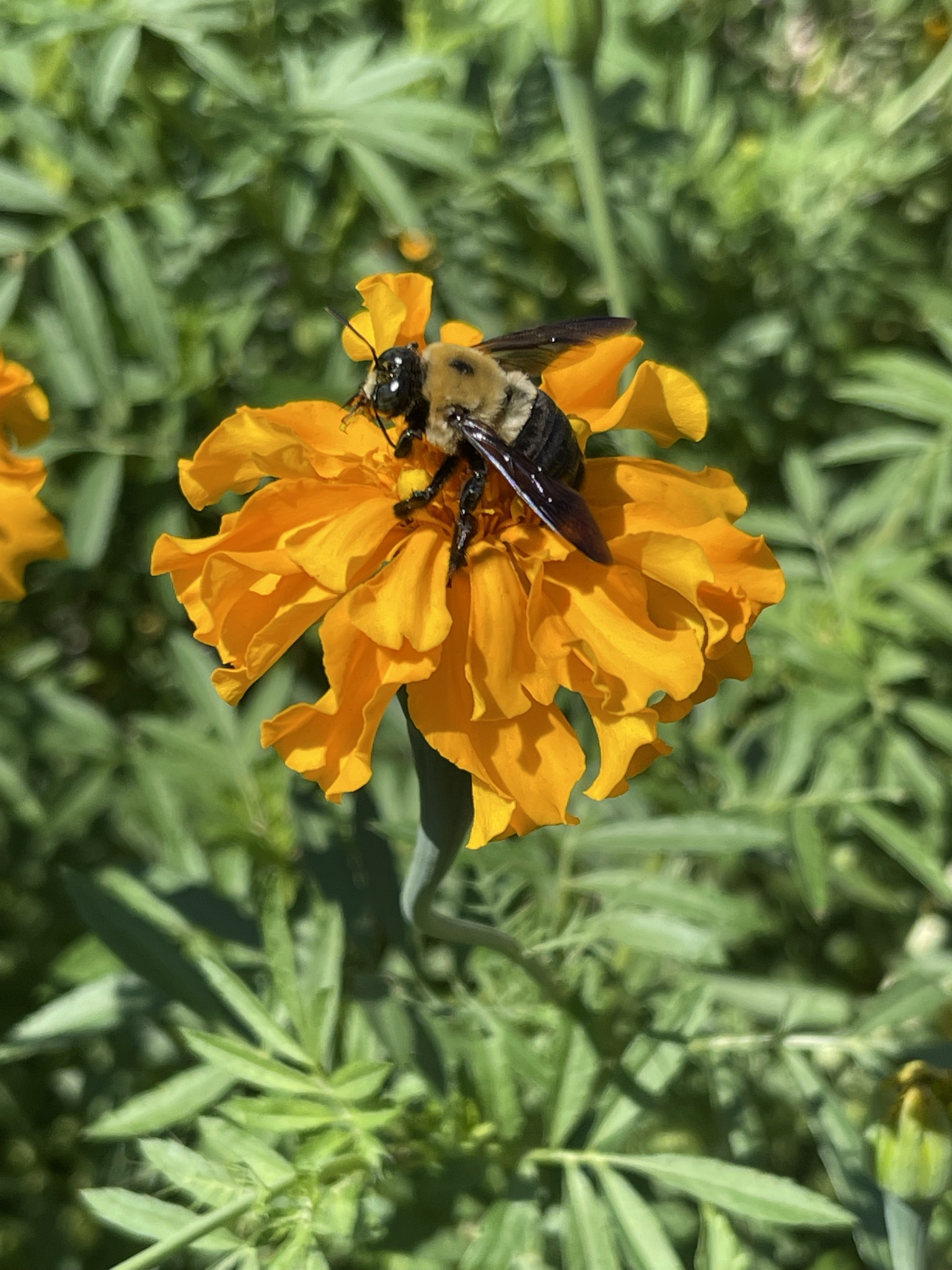
Xylocopa virginica
The Carpenter Bee
The male carpenter bee cannot sting you. Not won't — physically cannot. He has no stinger. The large, hovering bee that gets in your face, follows you through the garden, investigates your hat: that is the male. His face is yellow. He is bluffing. He is running territory surveillance and doing everything in his power to look threatening while possessing absolutely no capacity to harm you. You can walk through him. He will bounce off and come back.
The female can sting but almost never does. She is busy. She drills — a perfect half-inch circle into dry, weathered wood — and then the bore turns to run with the grain, creating a series of chambers. Each chamber is provisioned with a ball of pollen and nectar, sealed with one egg inside it, closed with chewed wood pulp. She can hear the quality of wood and selects accordingly. She is a critical pollinator for flowers with deep throats: her tongue reaches farther than a bumblebee's, accessing nectar that other bees can't reach.
She also sometimes bites the base of long flowers to steal nectar directly, bypassing the pollen exchange entirely. The flowers adapted to this too. The relationship is a negotiation that has been ongoing for millions of years.
"The bugs have the right idea. They show up. They do the work. They don't require explanation. I can't help thinking that sometimes the answers to difficult questions are right there, just in unlikely places."
The Others
Not pollinators, most of them. Something else. Hunters, night workers, indicators, anomalies. Each one with a story that changes the way you see the garden when you know it.
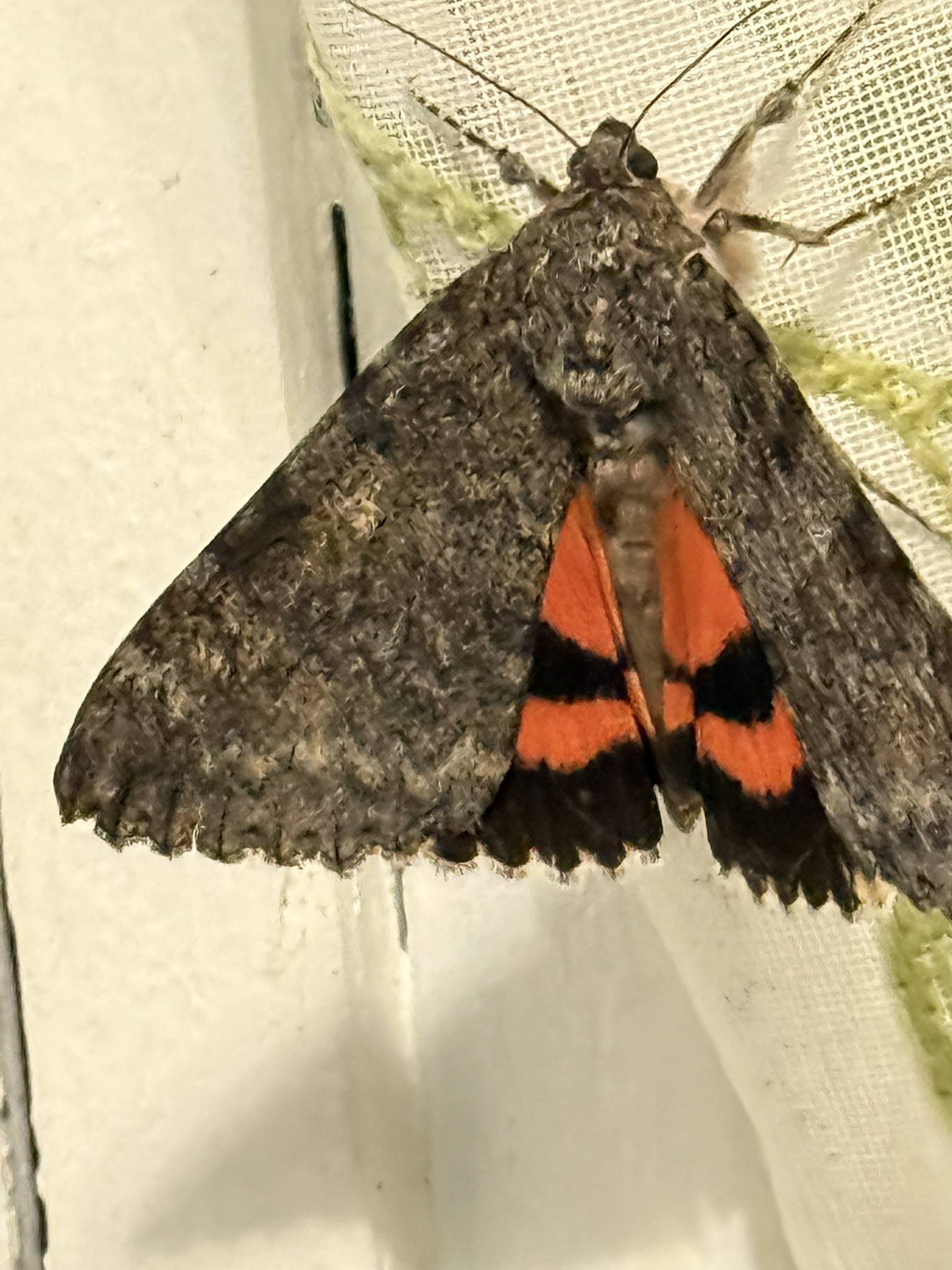
Order Lepidoptera
The Moth
Moths outnumber butterflies ten to one. There are 11,000 moth species in North America and 700 butterfly species. When you see a butterfly, you are seeing a small and celebrated fraction of what is actually flying. The rest of it is flying at night, when you're not watching.
This one has a secret. The gray outer wings are camouflage — resting against bark or a weathered wall, it disappears. But the hindwings are vivid orange-red. When a bird swoops at the moth in flight, it sees gray — then a sudden flash of color — then gray again when the moth lands. The predator's visual tracking breaks. It was following orange and now there is only gray. The moth uses that moment of confusion to buy itself a second. Often that's all it needs.
Moths pollinate plants that butterflies can't reach — night-blooming flowers that open only after dark, species that evolved specifically around moth visitors. Darwin predicted the existence of a moth with a foot-long tongue, based solely on the depth of a particular orchid's nectar tube. Forty years later, the moth was found.
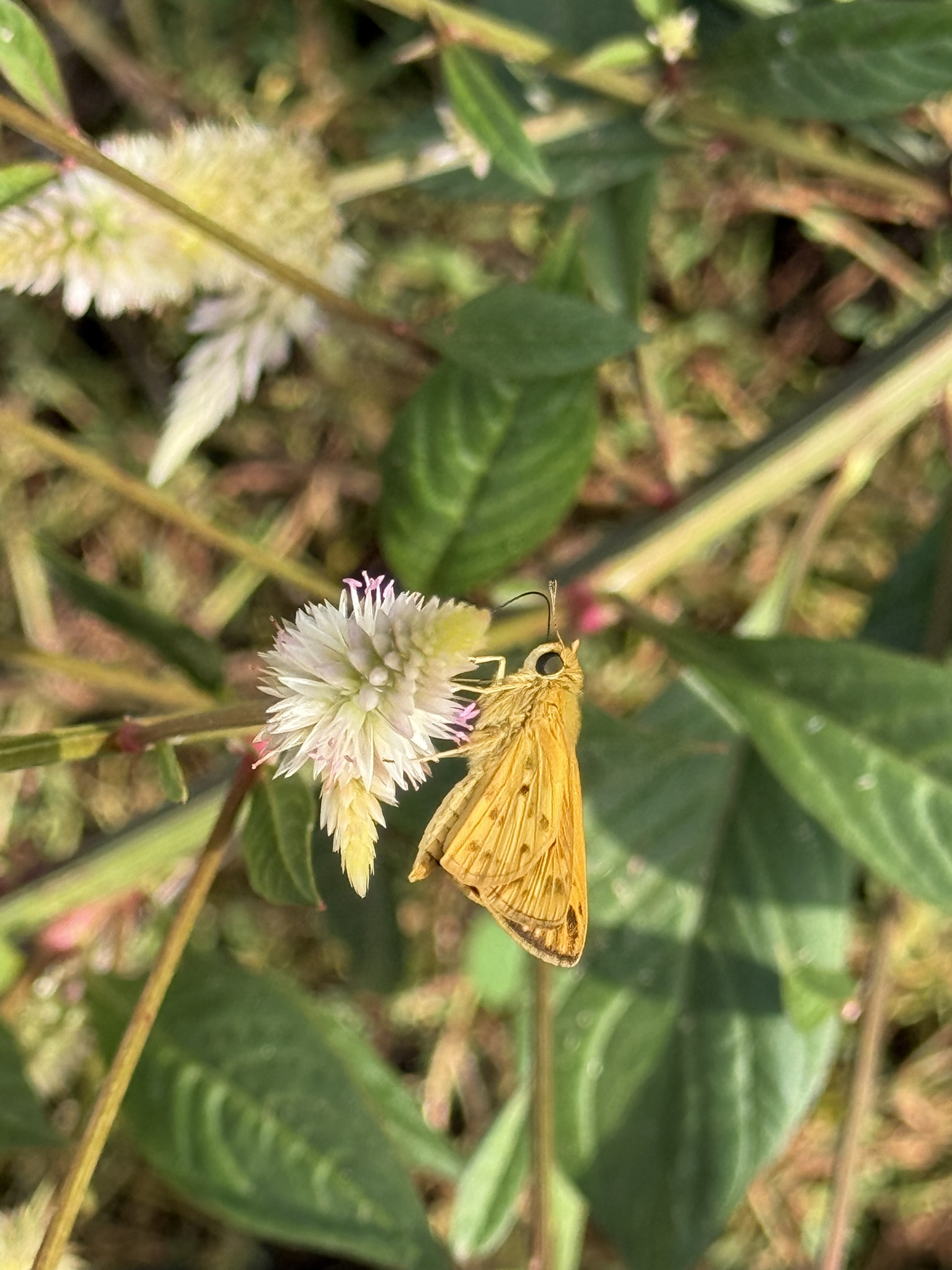
Family Hesperiidae
The Skipper
The Skipper is not a butterfly and not a moth. They separated from the butterfly lineage approximately 65 million years ago — before the mass extinction, before the continents reached their current positions — and have been doing things their own way ever since. They fold their wings differently from butterflies: hindwings flat, forewings raised at an angle, like a fighter jet at rest on a carrier deck. They are everywhere in this garden and almost nobody notices them.
The flight that gives them their name — fast, skipping direction changes — makes them nearly impossible for dragonflies to catch in open air. They're among the primary pollinators of red clover, a crop that honeybees and bumblebees can't fully serve because their tongues don't reach the nectar. The caterpillars roll individual leaves into tubes and live inside them. The adults live two to three weeks.
This one is on gomphrena, working it methodically, bloom to bloom. It has been doing this, in more or less this form, for sixty-five million years. It was here before most of what we recognize as the modern world.
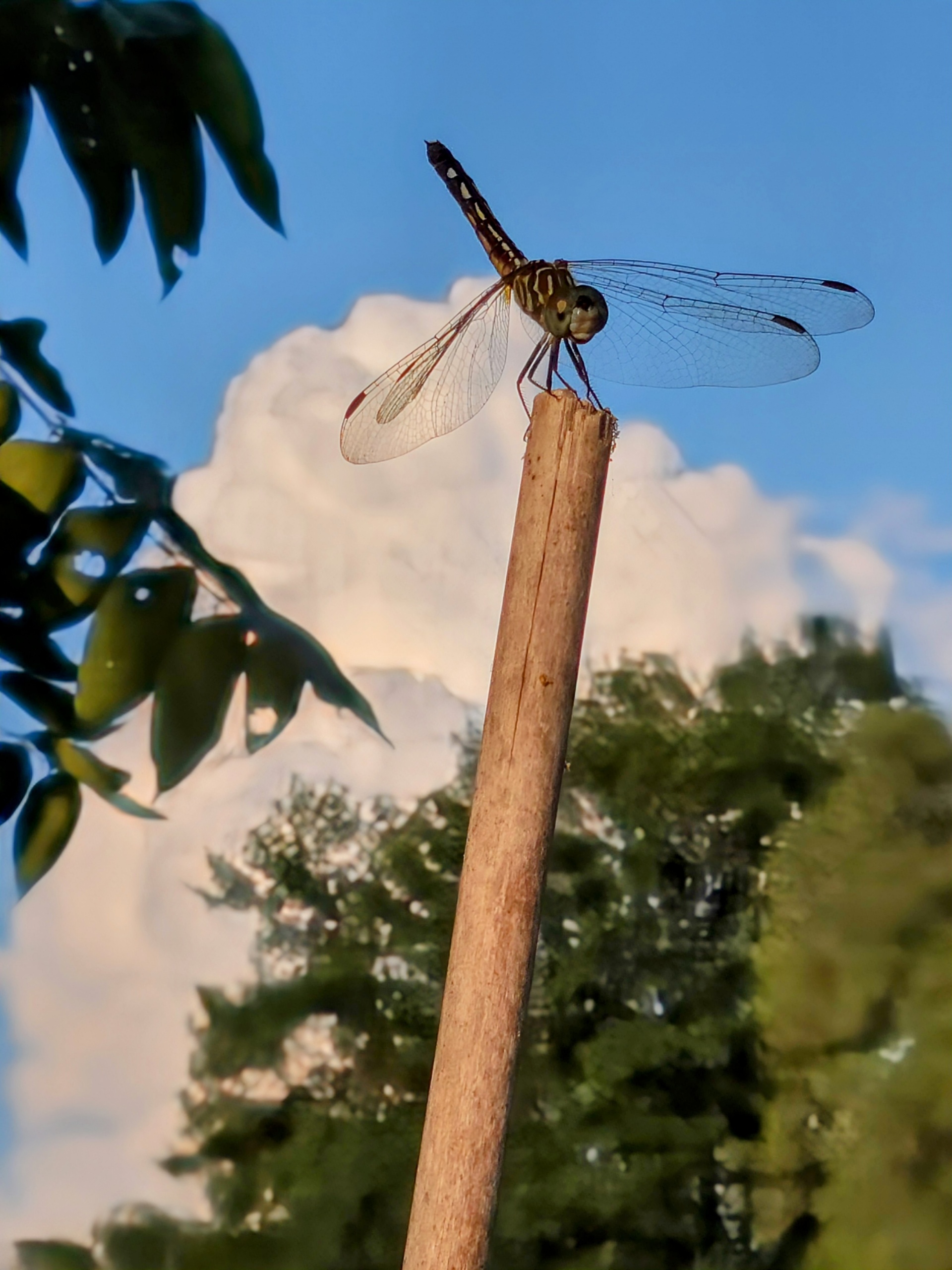
Order Odonata
The Dragonfly
The dragonfly is the most effective predator on Earth. Not the most feared — the most effective. Measured by hunting success rate, no other animal comes close: dragonflies catch their prey approximately 95% of the time. Lions succeed roughly 25% of the time. Great white sharks, perhaps 50%. The dragonfly misses almost never.
The reason is the calculation. A dragonfly doesn't chase its prey — it calculates where the prey will be and flies to that point. Predictive interception: the same mathematics used in missile guidance systems, worked out by evolution 300 million years ago. Four wings operate completely independently, each capable of changing speed, angle, and direction during flight. The dragonfly can hover, fly backward, stop mid-air, and make hairpin turns at full speed. It hunts mosquitoes — hundreds per day, per dragonfly.
When the dragonfly that patrols this garden follows the same route every morning, it is not wandering. It knows exactly where its territory ends. It is defending you from mosquitoes without asking anything in return. It has been doing this since before the dinosaurs. It watched them come and go.
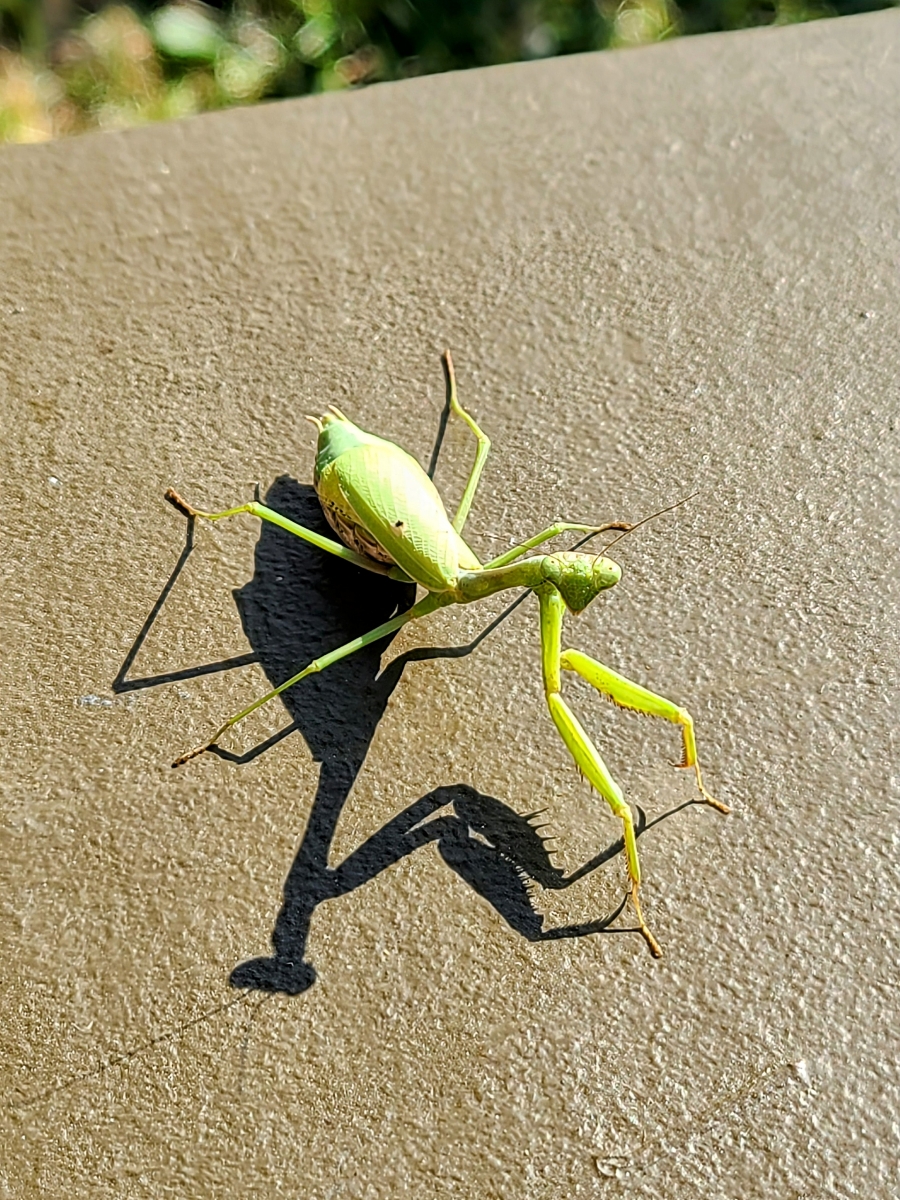
Mantis religiosa / Tenodera sinensis
The Praying Mantis
The praying mantis is the only insect that can look over its shoulder. Its neck rotates 180 degrees. It can see behind itself without moving its body. This matters for hunting: the mantis can track prey through a full arc — following its approach, timing the strike — while remaining perfectly still, giving nothing away.
The "praying" posture is an ambush posture, not a passive one. The mantis stands completely still for minutes, for hours, waiting for something to move into range. When it strikes, the motion takes 50 to 70 milliseconds. A human blink takes 100 to 400 milliseconds. You would not see it happen. You would see prey, and then no prey. The mantis eats aphids, beetles, crickets, grasshoppers, caterpillars — the roster of what would otherwise be damaging the garden. It builds no nest, joins no colony, requires no territory beyond the branch or wall it has claimed for the day.
The mantis in this collection found a wall and a shaft of morning light and stood there long enough to cast that shadow. It has been standing still long enough to cast shadows since the Cretaceous.
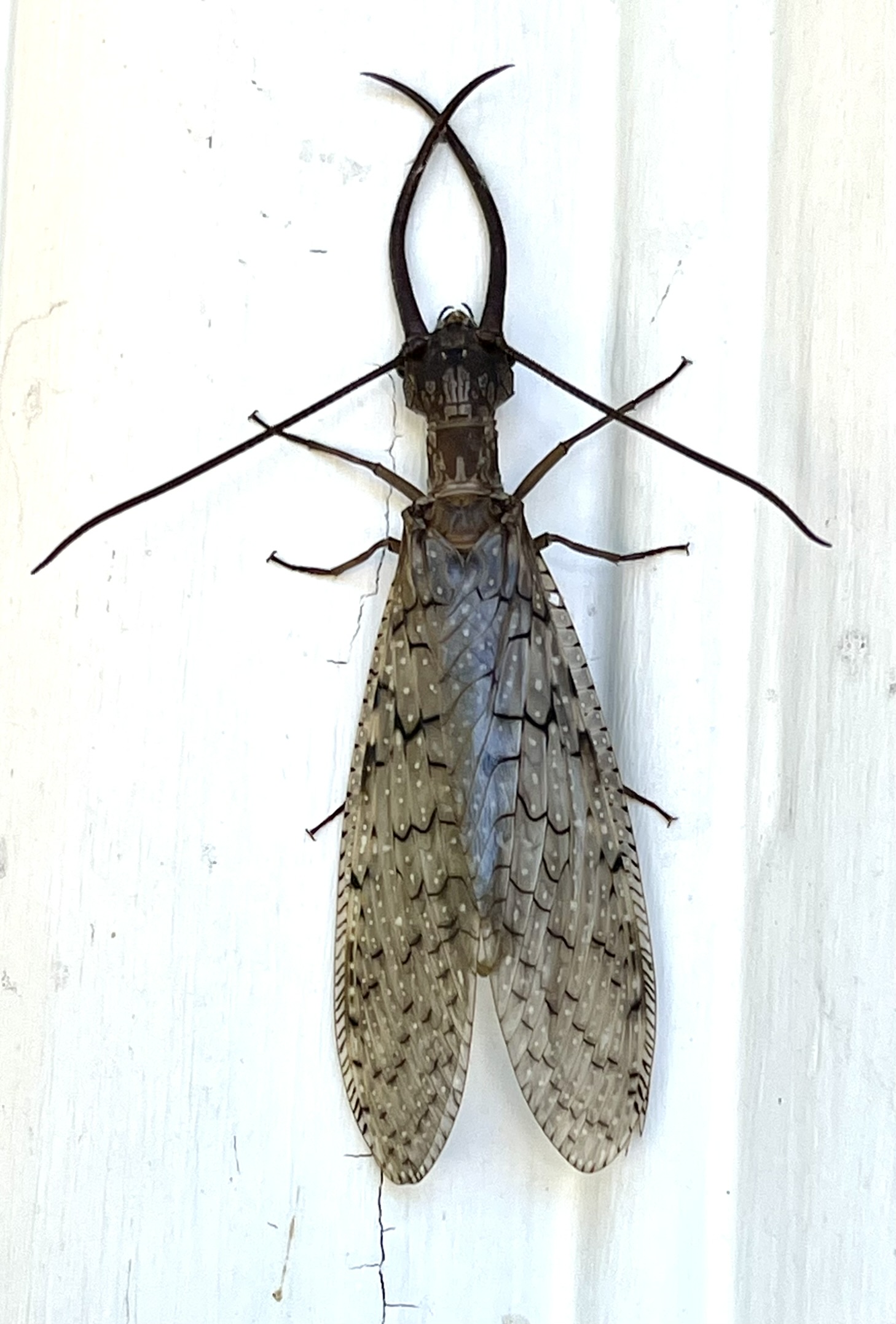
Corydalus cornutus
The Dobsonfly
Before it was this, it lived in water. The dobsonfly spends one to three years as a larval hellgrammite in the gravel bed of a clean, cold stream — hunting aquatic insects, growing slowly, breathing through gill tufts along its sides. Hellgrammites are one of the most reliable indicators of water quality that exists: they cannot survive in polluted streams. Where hellgrammites live, the water is clean. Finding a dobsonfly is evidence of a healthy watershed somewhere upstream.
Then it emerges and lives for approximately one week. One week, after three years of growing. The adult does not eat — it has no functional mouthparts for eating. It has spent years building itself, and now it has seven days. It finds a mate. It lays eggs over the water. It finishes.
The male's enormous curving mandibles look alarming and are physically incapable of breaking human skin — they are too soft, more like flexible hooks, designed for grasping the female during mating. The female's smaller mandibles can bite, though she rarely does. There is too much else to do in one week.
The Tree Frogs
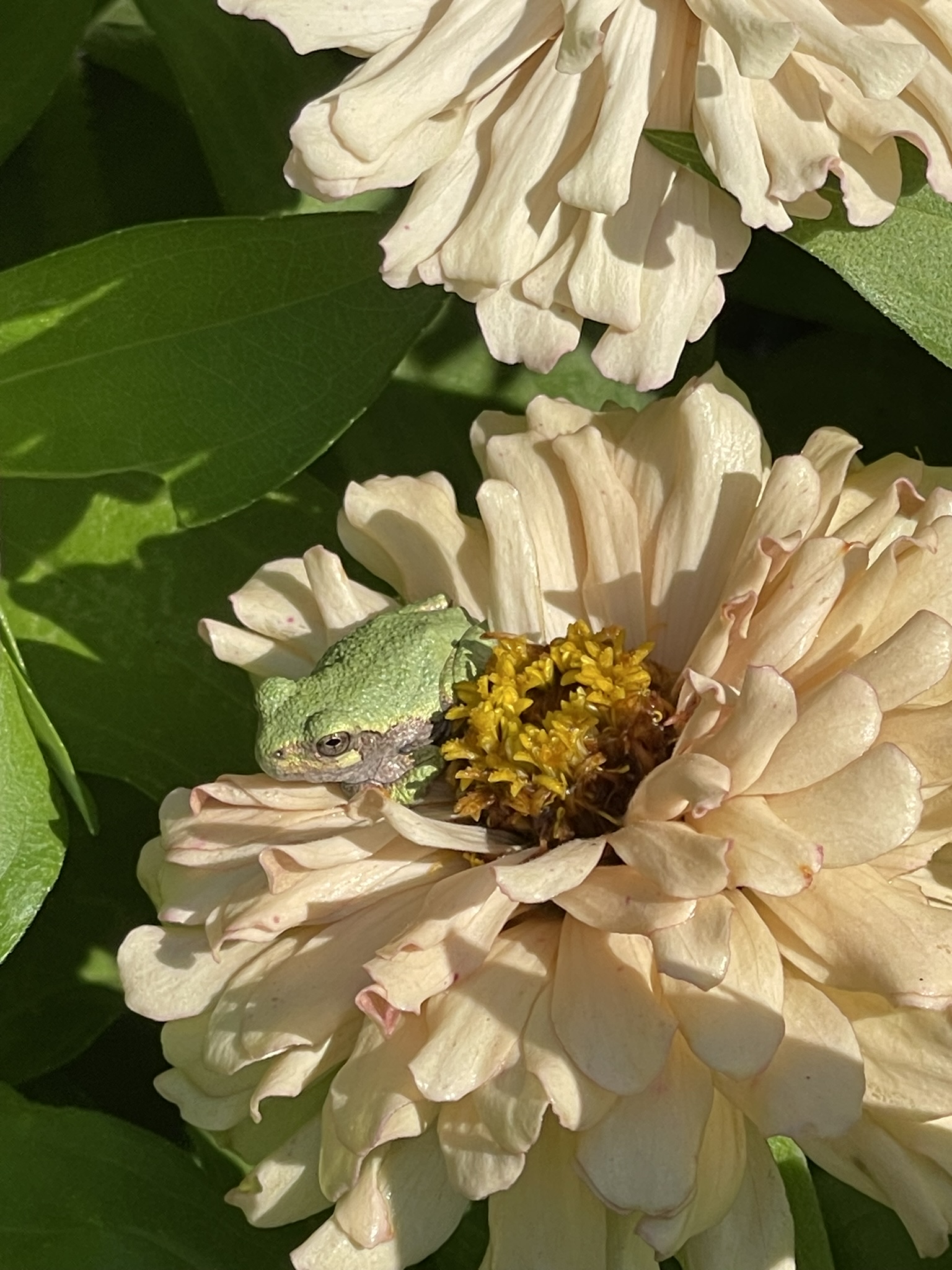
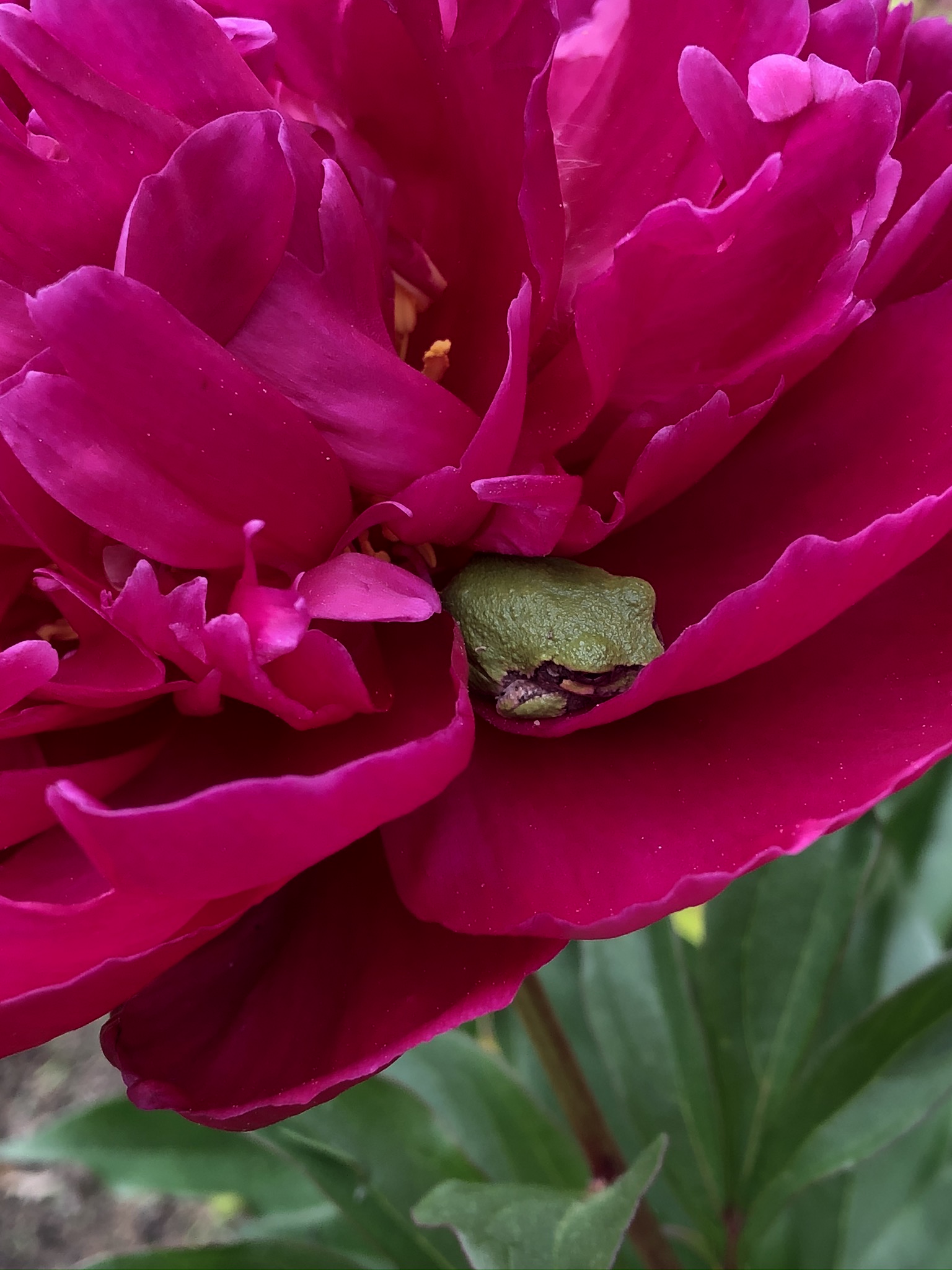
Hyla versicolor
The Tree Frogs
Tree frogs don't drink water. They absorb it. A patch of skin on the belly — called the seat patch — draws moisture directly from any damp surface they rest on. A wet flower petal is a drink. A zinnia after morning rain is a full refill. This is part of why they are in the flowers: not just for shelter, not just for the insects that shelter there too, but for the accumulated moisture. They chose real estate with utility.
The gray tree frog can change color — the same frog can be bright green one morning and gray-brown by afternoon, responding to temperature, light, and humidity. Their toe pads work through a combination of capillary adhesion and tiny interlocking hexagonal channels that create micro-suction against virtually any surface. They can hold their position on a wet petal in wind. They do not slip.
One tree frog eats approximately 600 to 800 insects in a single summer season. They work at night — the same hours the moths work, which is also the same hours the mosquitoes work. They are the night crew. Their call — the long rolling trill that fills summer evenings from every direction — is the males calling for mates, each one adjusting pitch and timing relative to every other male calling within earshot. What sounds like ambient summer sound is a complex, real-time acoustic competition. The night is much louder than it looks.
Lithobates pipiens
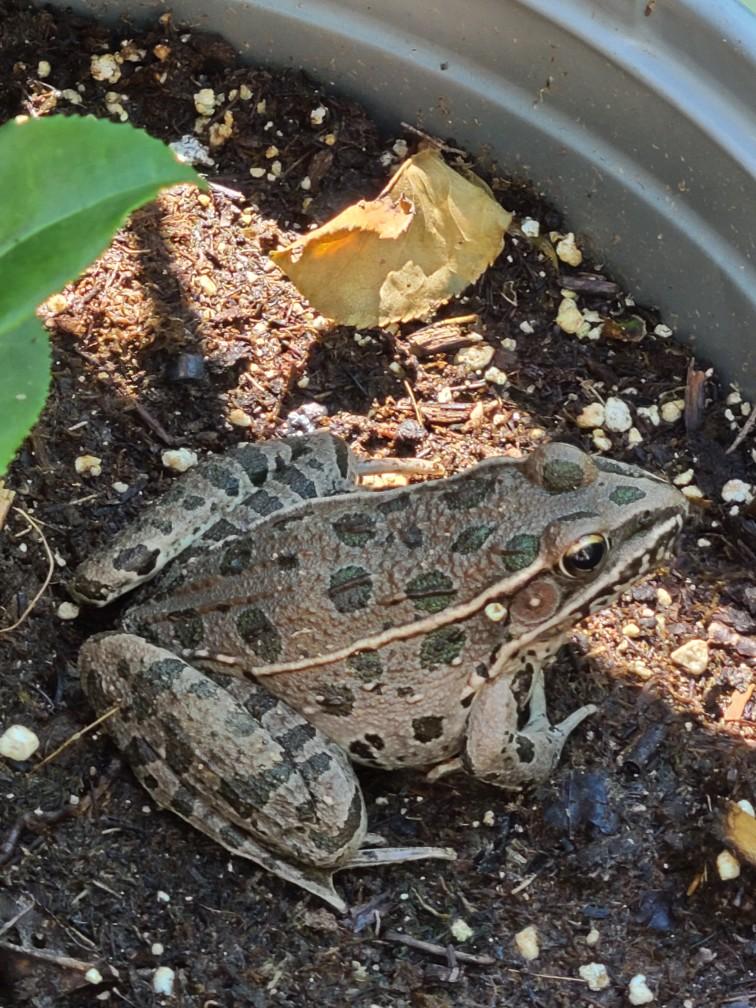
The Leopard Frog
The leopard frog's tongue is attached at the front of its mouth, not the back. It deploys forward like a slingshot, covered in a soft, sticky saliva that researchers have described as the softest biological adhesive ever measured — far stickier than any synthetic material of comparable softness. The tongue strikes, the prey adheres, the tongue folds back. The frog's eyes push down into the mouth cavity during swallowing, helping force the prey down the throat. It is not elegant. It works every time.
Leopard frogs breathe through their skin as well as their lungs — oxygen diffuses directly through the skin membrane, which requires the skin to stay moist and explains why proximity to water is not optional for them. They are one of the most studied vertebrates in the history of biology — more is known about their anatomy, development, and physiology than about almost any other wild animal — and they are among the first to show visible deformities when water quality or environmental hormone levels decline. Where leopard frogs are normal, the ecosystem is working. They are a living report card on the land they inhabit.
The Garden Supervisors
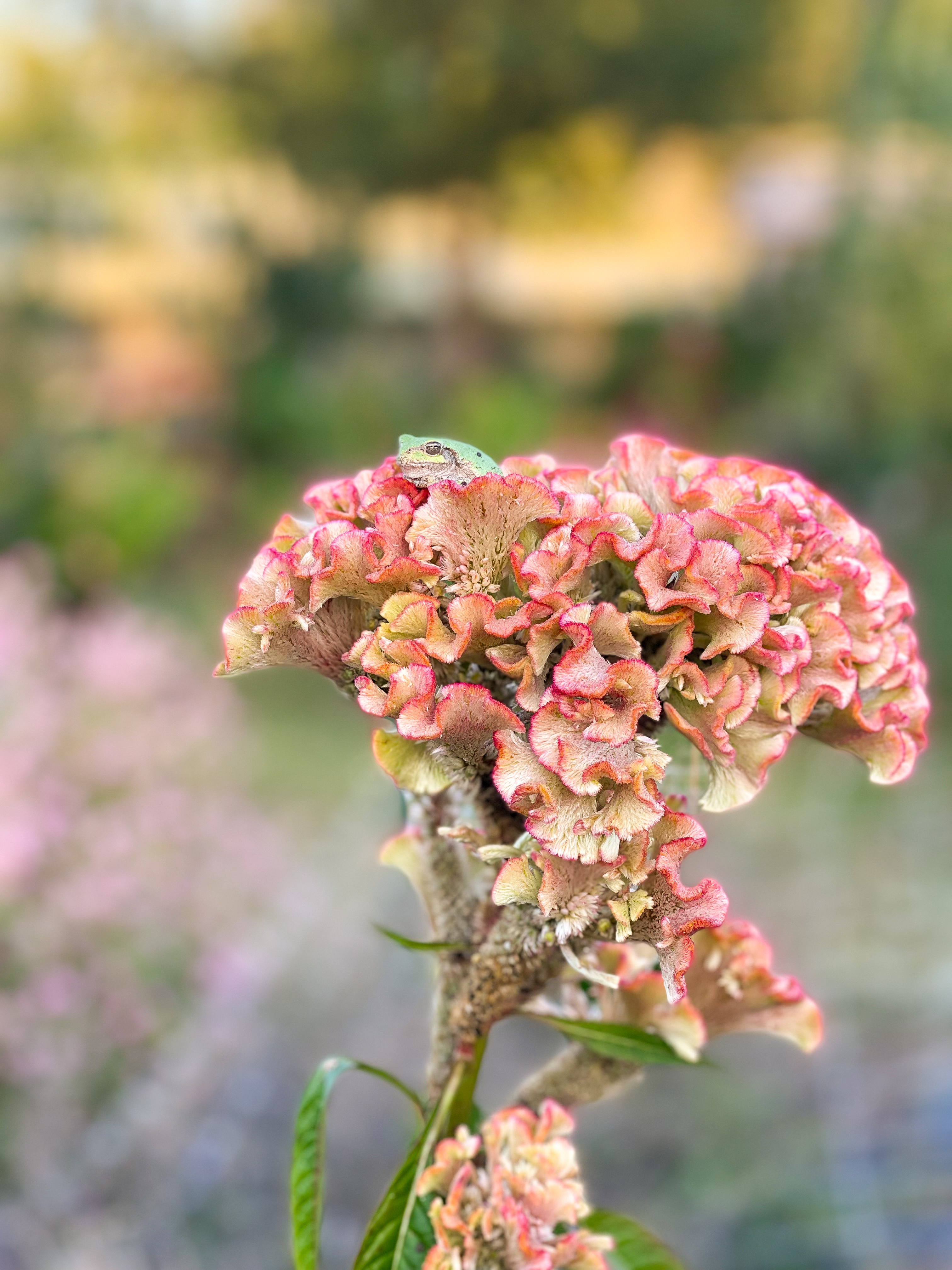
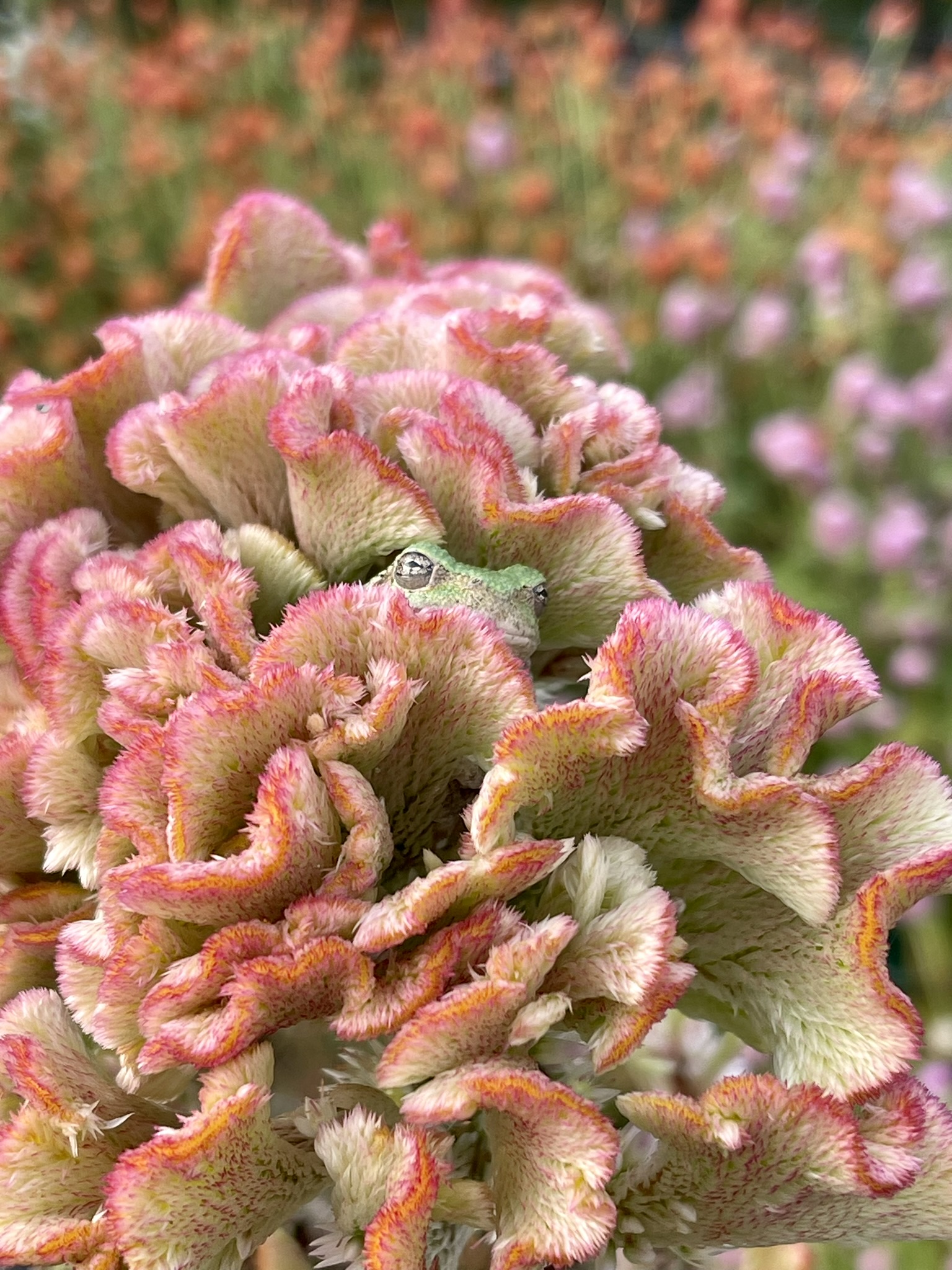
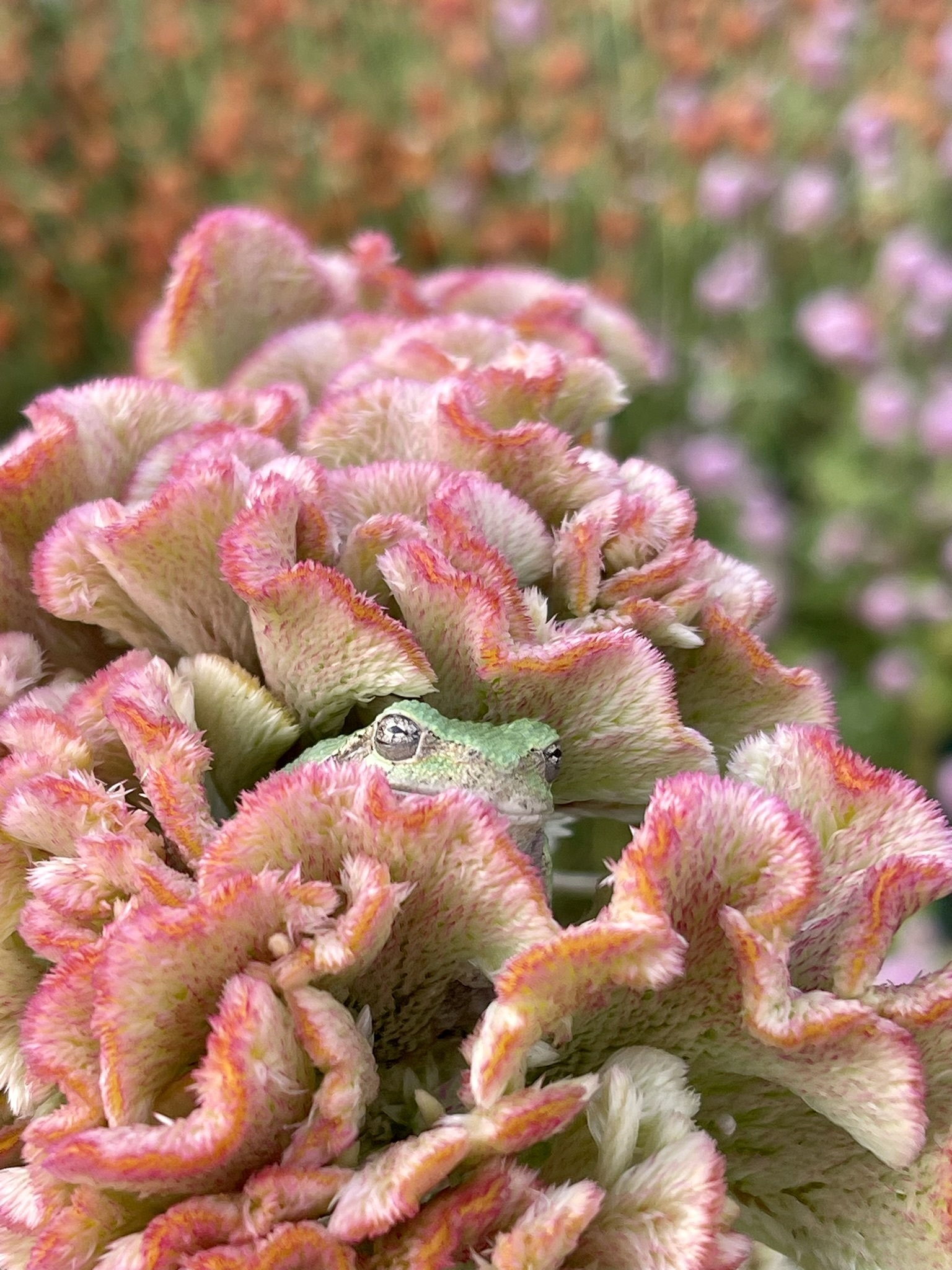
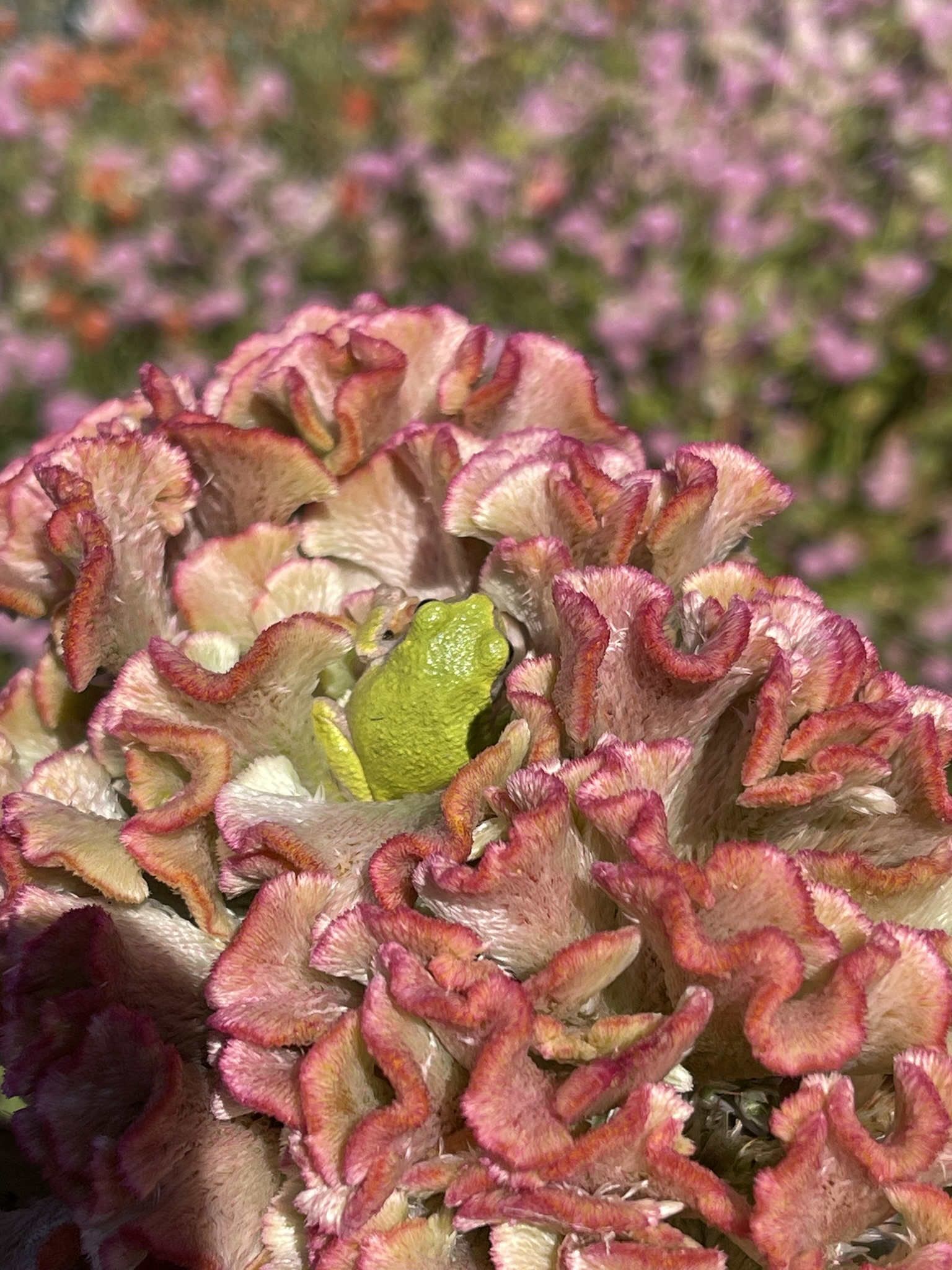
When a grey tree frog climbs to the very top of a celosia crown and holds perfectly still — it is not resting. It is watching. The celosia is the tallest structure in the garden. From up there, everything is visible.
Hyla versicolor · elevated post
The Watchtower
The celosia cockscomb grows tall — taller than most of what surrounds it at midsummer. Its crown is wide and flat and densely textured, a surface a toe pad can grip from any angle, in any weather. It holds warmth into the evening. It draws small insects. And it is the highest point available for a hundred feet in any direction.
The grey tree frog discovered this. Every season, they climb the celosia stalks and take up position at the summit. They sit there for hours — sometimes from mid-morning until dusk — watching. Head slightly lifted. Eyes tracking movement in every direction below. Every bee, every monarch, every shadow that passes through: noted.
The taxonomists would call this thermoregulatory basking — the frogs are warming their core temperature in the sun to sharpen muscle response time, making themselves faster, better positioned to take the insects that come to the celosia for the same reason everything comes to the celosia: it is abundant, and tall. But the best view in the garden is a side effect the frogs have clearly embraced. They found the watchtower and they use it, reliably, every season it stands.
They were here before the celosia was planted. They showed up the first summer it grew tall enough to climb. They will be back next year, when it does again.
The Toads
Anaxyrus americanus
The Garden Toad
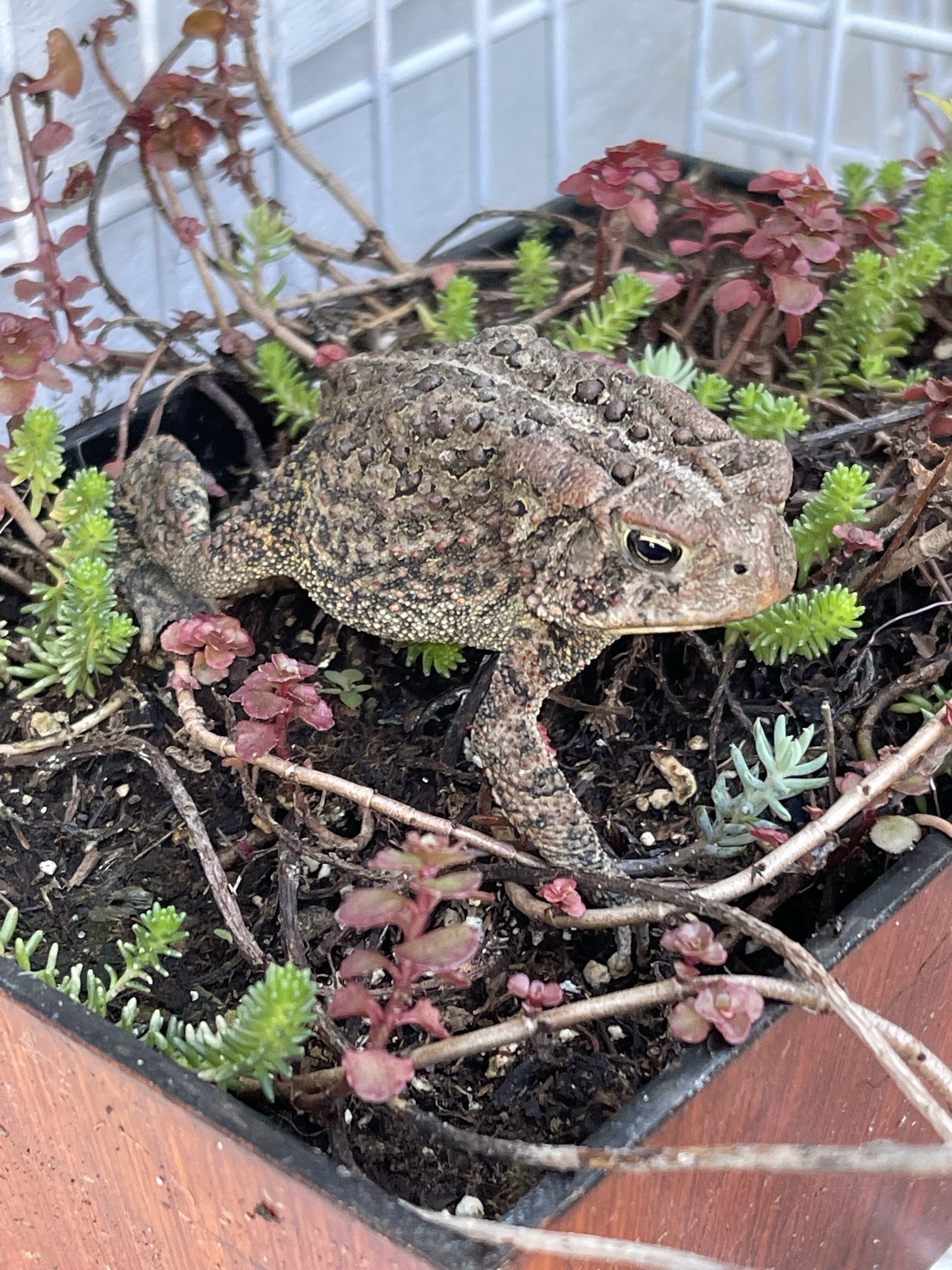
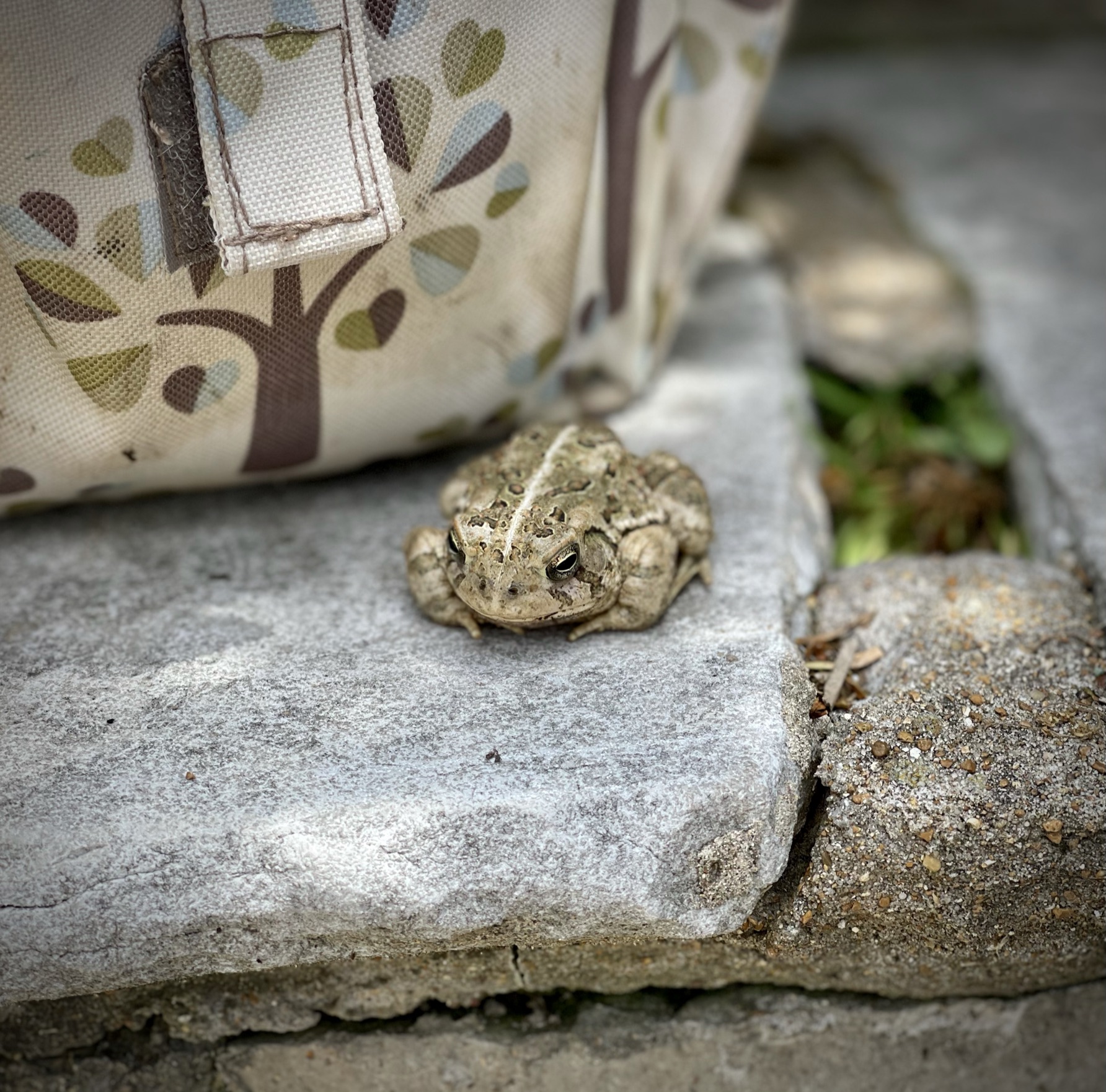
The bumps on a toad's skin are not warts. They are parotoid glands — structures that produce a mild toxin that makes toads taste terrible to most predators. The toxin does not transfer to human skin in any meaningful way. The belief that toads cause warts is not true in any biological sense, has never been true, and no mechanism by which it could be true has ever been identified. Handling a toad and washing your hands is sufficient and complete. The toad did not harm you. It never intended to.
One toad consumes up to 10,000 insects, slugs, and caterpillars in a single summer season. This is not an estimate — it has been measured. Slugs in particular, the ones that destroy seedlings overnight, are among a toad's preferred prey. Toads are almost entirely nocturnal: the toad sitting in the planter during the day is resting, waiting for dusk. At dusk it will work through the night. It absorbs moisture from damp surfaces the same way tree frogs do — the stone step and the wet planter soil are both a drink and a hunting ground.
Toads return to the same shelter locations year after year, across multiple seasons, navigating back to a specific pot or corner of a garden with reliable accuracy. If a toad has claimed a spot, it assessed the spot and found it good. It will be back next year, and the year after, if you let it.
Also present, all season — not photographed, never absent
- Yellow jackets on the pale butter sunflowers
- Hover flies — the bees that are not bees
- Native sweat bees in seven colors
- Squash bees, up before dawn
- Gangly thread-waisted wasps on the cockscomb
- Assassin bugs in the foliage
- Lacewings — the aphids' natural end
- Ground beetles working the soil overnight
- Grasshoppers and crickets in the rows
- Cicadas, the whole summer long
- Fireflies at the field's edge after dark
- Sphinx moths at the evening primrose
None of them signed anything. None of them asked for anything. They found a garden that was worth showing up to and they showed up — season after season, before the gate was open, after it was closed, in the early morning before anyone was watching. Every piece in this studio carries what they did. The flowers grew because of them. They are the team. They have always been the team.
If you leave this page and find yourself stopping to look at something you would have walked past before — a spider in a web, a bee working a flower from the top down, a moth sitting absolutely still against a wall — that's enough. That's the whole point of it.