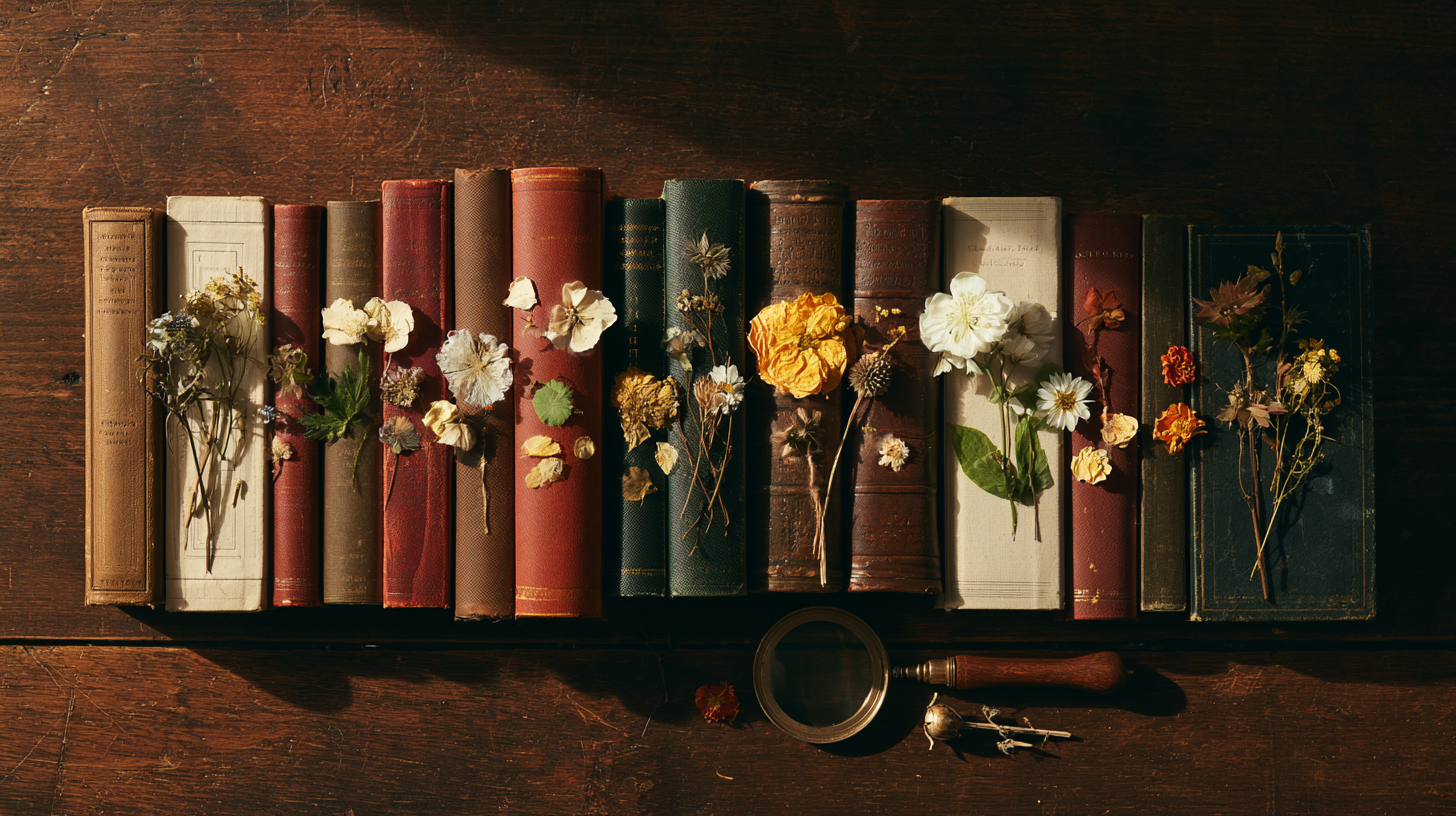
What feeds the wonder.
The books, the corners, the quiet sources.
Wonder is not self-sustaining. It needs feeding. The maker who works with flowers every day is not immune to the gradual dimming that comes from familiarity — the moment when a celosia is just a celosia, when pressing becomes a procedure rather than a practice. The antidote is not effort. It is input.
This drawer is a collection of what keeps the sense of wonder alive: the books that reframe the familiar, the physical spaces that invite a different quality of attention, the habits of looking that make the ordinary strange again. These are not universal prescriptions. They are Luli's prescriptions — what works for this maker, in this practice, at this particular intersection of growing and pressing and setting and giving.
Take what is useful. Leave the rest. Come back when the well feels low.
The Reading Life
These are not all botanical books. Some are about time. Some are about attention. Some are novels that happen to understand something about plants better than most field guides do. The criterion is simple: each of these books has, at some point, made Luli see a flower differently.
01
Braiding Sweetgrass
A botanist and member of the Citizen Potawatomi Nation on reciprocity with the plant world. The most important book about plants written in our lifetime. Return to it annually.
Find on Amazon →02
The Signature of All Things
A novel about botanical obsession, set in the nineteenth century, researched with extraordinary care. Alma Whittaker understands moss the way Luli understands celosia. Essential.
Find on Amazon →03
The Botany of Desire
Four plants — apple, tulip, cannabis, potato — and what they have done to us. The tulip chapter alone, on the Semper Augustus and Tulipmania, will permanently change how you look at a single stem.
Find on Amazon →04
The Hidden Life of Trees
A German forester on the social lives of trees — how they communicate, support each other, and remember. What he says about trees applies to every plant. Paradigm-shifting and, once read, impossible to unread.
Find on Amazon →05
Lab Girl
A memoir about science, friendship, and a lifetime spent with plants. Jahren writes about seeds the way poets write about love. The chapter on germination is one of the great passages in recent American nonfiction.
Find on Amazon →06
Pilgrim at Tinker Creek
Not about flowers specifically — about attention. About what happens when you look at the natural world with absolute, unsparing focus. The model for a certain quality of seeing that every flower-maker should practice.
Find on Amazon →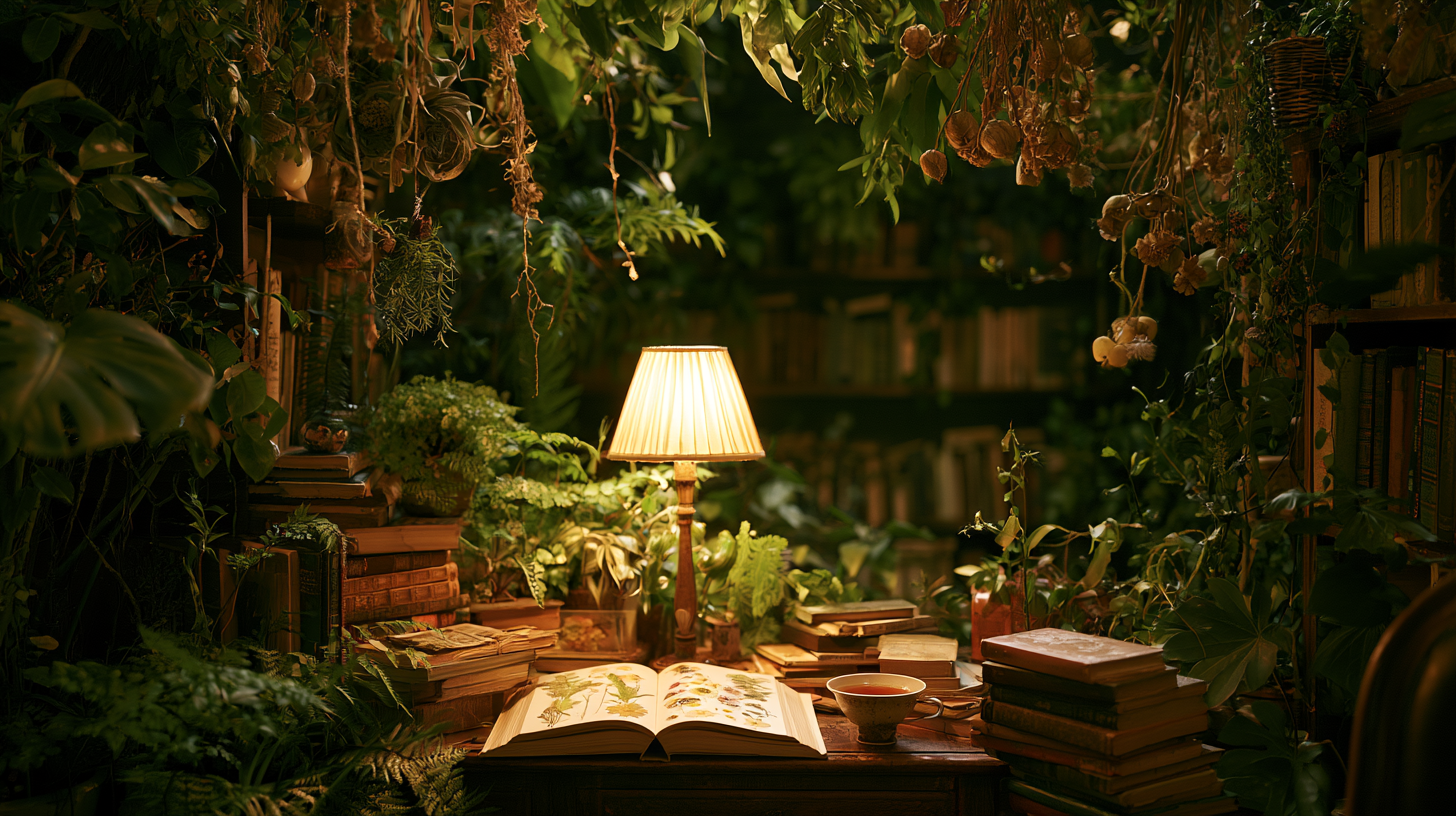
The Physical Space
Inspiration has a geography. The made things that surround you — the objects on a shelf, the quality of light in a corner, the textures within reach — contribute to the quality of thought that happens there. This is not mysticism. It is the basic fact that attention is embodied, and the body responds to its environment.
Luli's making spaces are not minimalist. They are full — of growing things, of specimens in various stages, of books left open to relevant pages, of tools whose patina is itself instructive. The clutter is not disorder. It is a record of active curiosity, a library of ongoing questions. Wonder, it turns out, likes company.
A note from Luli
"The seasons are the real curriculum. Everything I know about color I learned from watching what changes in October. Everything I know about patience I learned from the bulbs. The books confirm it, but the garden taught it first. Go outside before you read about it. Read about it after, so you know what you saw."
The Practice
Go outside every day, even briefly, and look at something growing. Not in passing — stop, and look at it until you notice something you didn't notice before. The number of petals. The direction the stem tilts. Which side the bees prefer. The way the light falls on it at this hour and not another.
Keep a notebook. Not a journal — a notebook. A place to record specific observations, specific colors, specific behaviors. Vague wonder fades. Specific wonder accumulates. The notebook is the mechanism by which attention becomes knowledge, and knowledge becomes craft.
And when it all feels familiar and nothing seems remarkable: find a child who has never seen a dandelion in seed. Watch them blow it. Watch their face. The wonder was never gone. It was just waiting for a fresh pair of eyes.