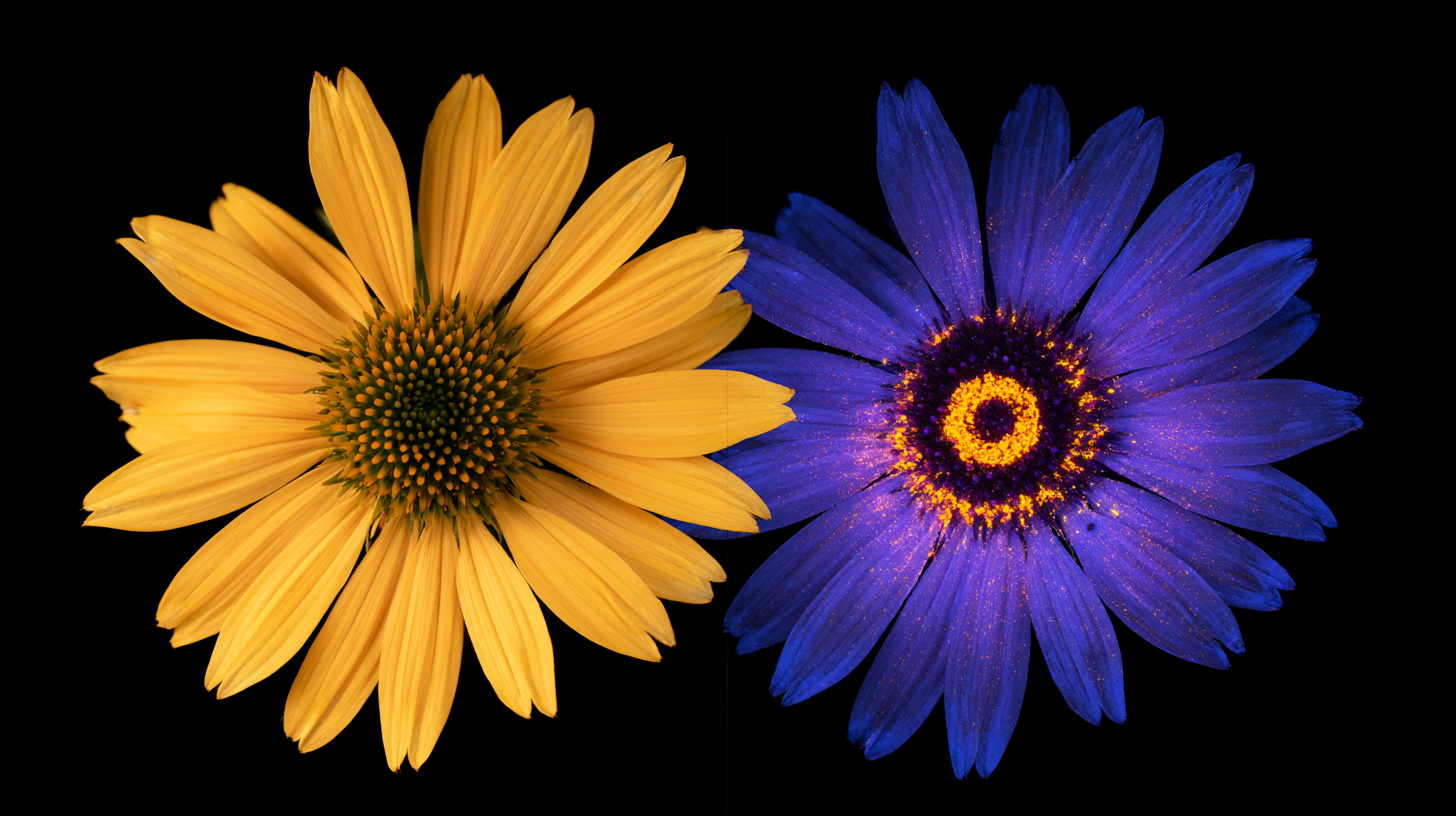
The flower you see is not the flower the bee sees.
Neither of you is wrong. Both of you are partial.
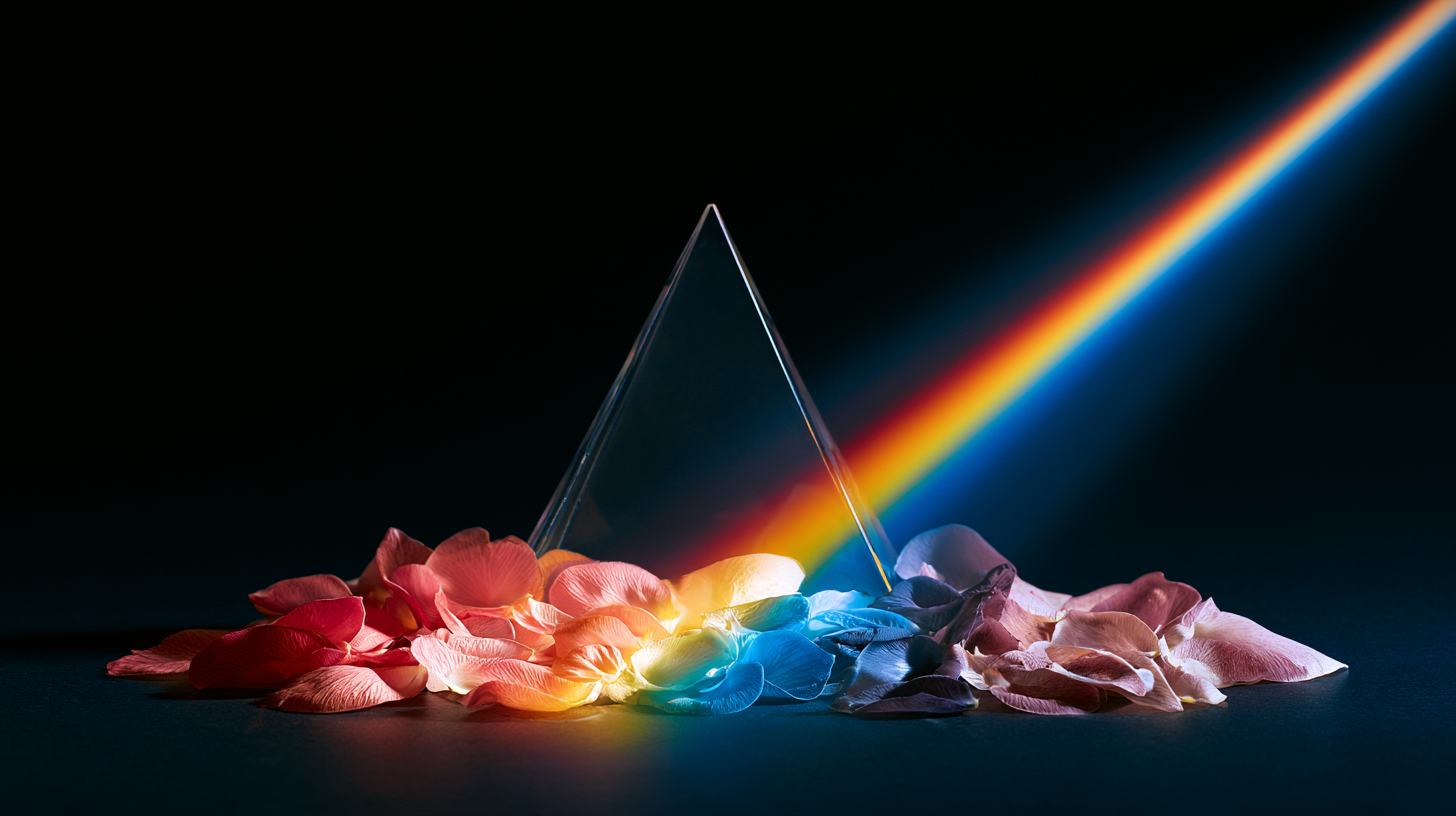
We think we see flowers. We do not, quite. What we see is the narrow slice of the electromagnetic spectrum that our eyes are built to receive — roughly 380 to 700 nanometers, a range we call "visible light." This range was not designed. It evolved, over millions of years, to be useful for a primate living in dappled forest light, hunting fruit.
Flowers did not evolve to be beautiful to us. They evolved to be found by their pollinators — bees, butterflies, moths, hummingbirds, bats. Each pollinator sees a different version of the flower. The flower we find beautiful is a translation, not an original. The original is something we cannot see with unaided eyes, and it is, if anything, more extraordinary than what we can.
What Each Eye Receives
Human eye
380 – 700 nm
Violet through red. No ultraviolet. No infrared.
Bee eye
300 – 650 nm
Into the ultraviolet, but shifted — bees cannot see red.
Butterfly eye
300 – 700 nm
UV-sensitive, some species with up to 15 photoreceptors vs. our 3.
In ultraviolet, flowers that appear uniformly yellow to us reveal elaborate runway markings — dark lines and patterns that guide bees directly to the nectary. Sunflowers, which look like solid yellow discs in visible light, have UV bullseyes at their centers. Black-eyed Susans have UV halos. Primroses have UV guides that look, under the right filter, like airports at night.
Karl von Frisch won the Nobel Prize in 1973 for discovering bee communication. But the study of what bees actually see — the UV photography of flowers — only became feasible with sensitive film in the mid-twentieth century. We have been living alongside flowers for all of human history and only recently learned what they actually look like.
The Bee's-Eye View
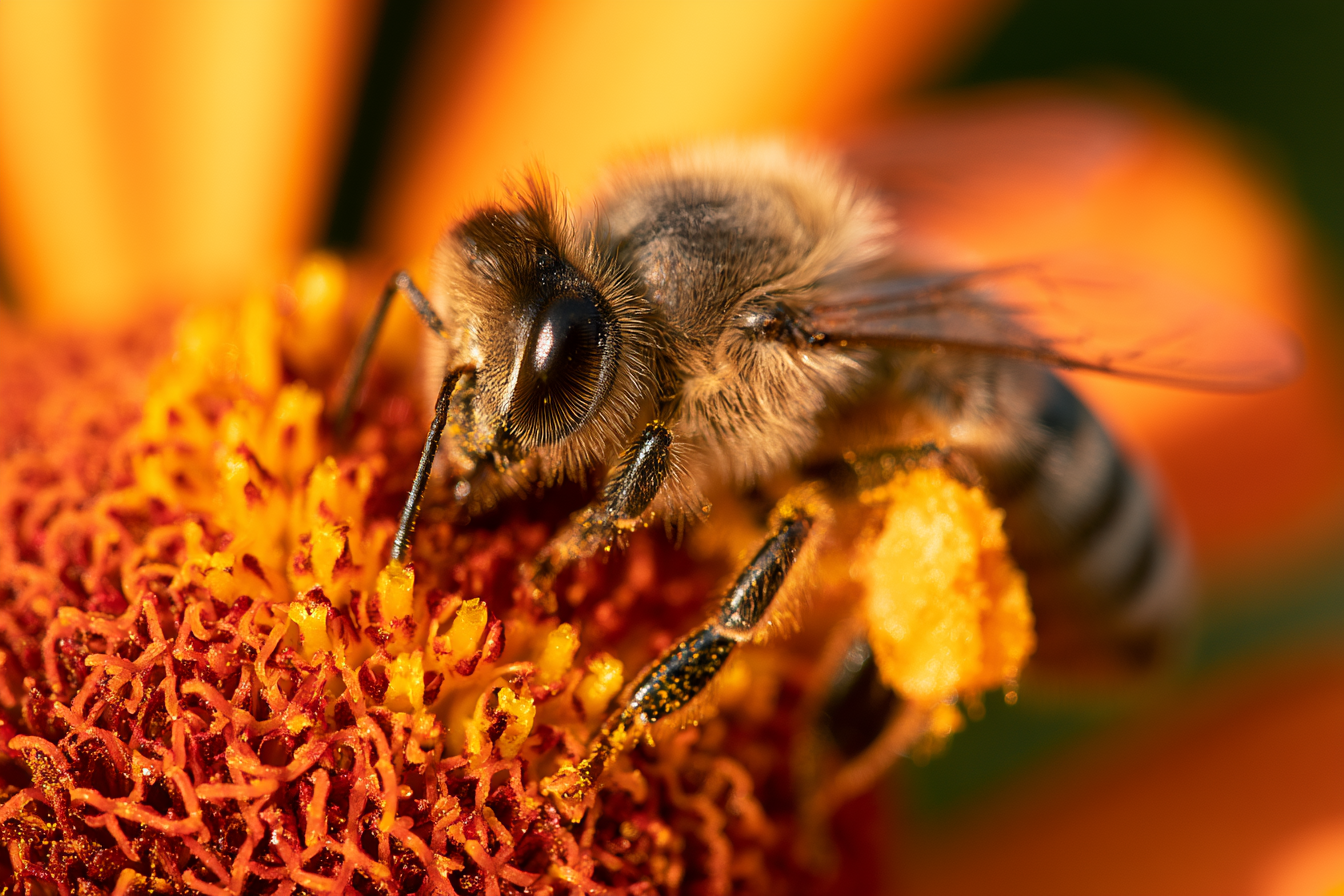
Like us, bees have trichromatic color vision — they see with three types of photoreceptors. But their three receptors are tuned to ultraviolet, blue, and green rather than to blue, green, and red. This means bees are completely blind to red flowers, which is why red flowers are almost always pollinated by birds, not bees.
The bee's world is a world in which flowers have faces — specific markings that say "here is where the nectar is, and here is where to land." The bee lands on the flower, collects its pollen, and departs having done the flower's essential work. The flower and the bee are in a contract that is millions of years old. We wander into this contract as admirers. We were never part of the negotiation.
The Hidden Pattern
UV photography requires special lenses and sensors — glass absorbs ultraviolet, so quartz lenses must be used instead. When photographers began documenting flowers in UV in earnest in the 1970s and 80s, the results astonished botanists who had spent careers studying the same species in visible light.
Flowers that seem unmarked in ordinary light have elaborate concentric rings, stripes, and spots in UV. The patterns are consistent within a species, and they are invisible to us without instruments. What we see as a plain face is, to the bee, a road map.
This drawer exists because looking at flowers is a practice, not a fact. The more carefully you look, the more there is to find. UV photography is simply the most dramatic proof of that — but the same principle applies to everything from petal texture to fragrance to timing to the angle at which a flower turns its face toward the sun.
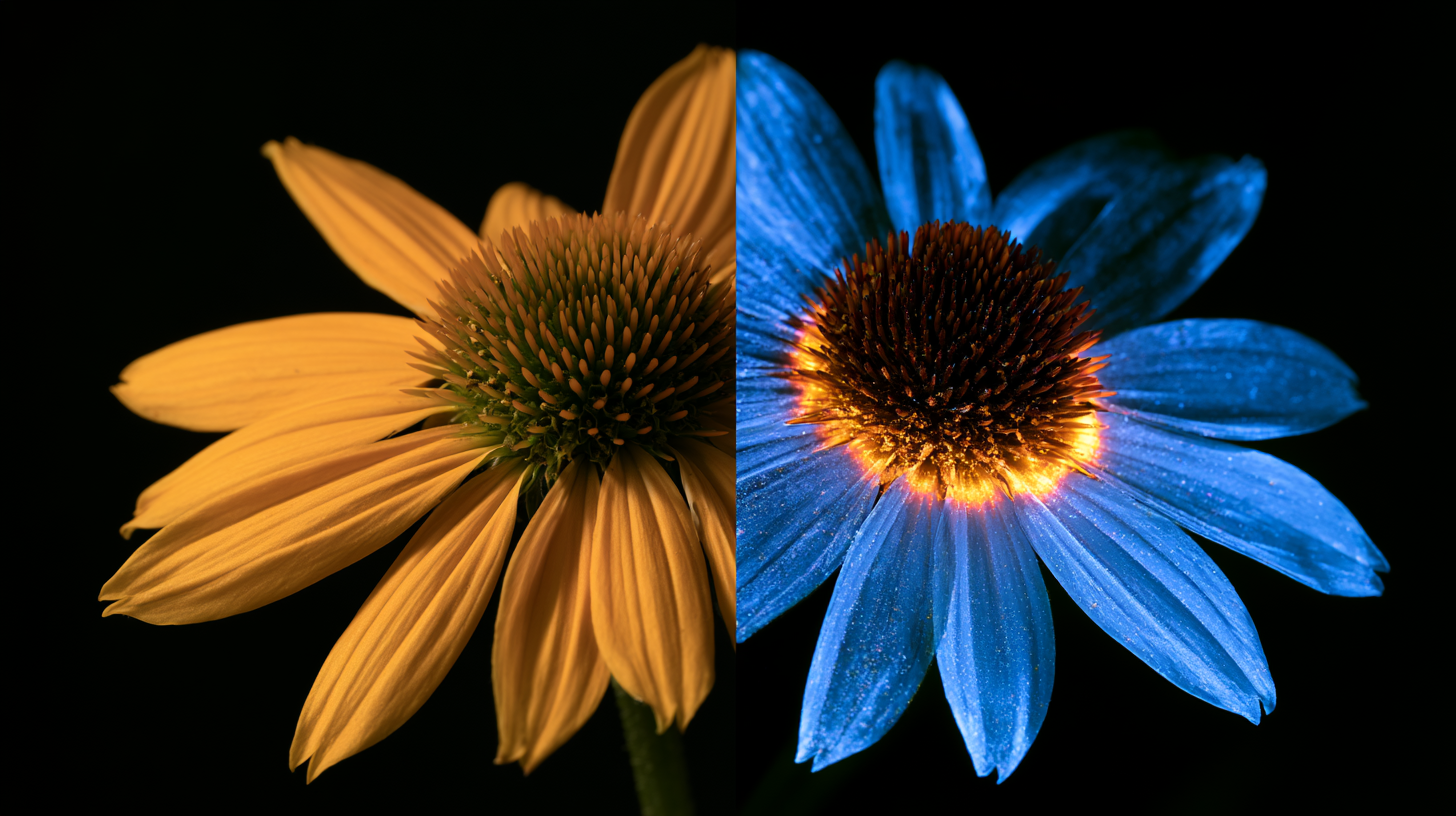
Visible light
Ultraviolet
Recommended Reading — Add to your library
An Immense World
The best popular book on animal sensory worlds — what bats hear, what fish feel, what bees see. The chapter on UV vision in insects is essential context for understanding what flowers actually look like to their pollinators. Yong won the Pulitzer for his COVID coverage; this book is equally brilliant.
Find on Amazon →The Soul of an Octopus
Not about flowers — but one of the most profound meditations on the question of what another creature's perceptual world actually is. Montgomery's encounters with octopus consciousness at the New England Aquarium will permanently alter how you think about any non-human perception.
Find on Amazon →The Lives of Bees
A Cornell professor who has spent his career watching wild bee colonies reveals how differently bees organize their lives from the managed hives we are accustomed to. The chapters on how bees evaluate and communicate about flowers are unlike anything else in the literature.
Find on Amazon →